
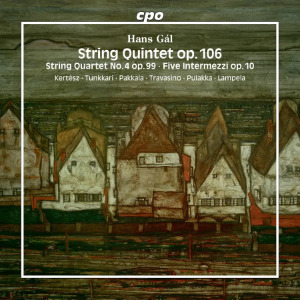
Hans Gál (1890–1987)
String Quintet Op.106 (1976)
String Quartet No.4 Op.99 (1970)
Intermezzi for String Quartet Op.10 (1914)
rec. 2021, Snelman’s Hall, Kokkola, Finland
Katalin Kertész (violin), Reijo Tunkkari (violin), Hanna Pakkala (viola)
Emiliano Travasino (viola: Quintet), Lauri Pulakka (cello: Quintet), Ulla Lampela (cello: quartets)
cpo 5557212 [81]
Recently, I reviewed a disc of Hans Gál’s choral music with works from 1914-1954. This disc covers 1914-1976. It is quite a jump from pre-WWI Vienna to Edinburgh in the mid-1970s. Yet Gál’s music shows a steady line of spiritual and technical development, and that makes a comparison of his early and late works all the more interesting.
Gál’s Five Intermezzi still betray the influence of Brahms and especially Dvořák, but they already show his great technical ability: they are wonderfully written for the medium of the string quartet. Each piece is individual, but there is a little sameness among the first four. The third is the most substantial. The last Intermezzo, as Gál’s daughter Eva Fox-Gál points out in her notes, is an interesting combination of sonata form and fugue, but what really stands out is the ‘con grazia’ element throughout. This is an early example of an attractive quality one frequently finds in Gál’s work, especially the chamber music.
All but the last movement of Gál’s Fourth String Quartet, his last, bear subtitles, unusually in his output. The first movement, Legend, begins with an almost atonal adagio opening before progressing to the main allegro. This is confident music, almost joyous. One could be forgiven for not believing an 80-year-old wrote it. As his daughter observes, one of the most interesting features is the use of the adagio music as a unifying force in the whole movement. The scherzo movement, Burleske,continues the sunny mood of the first movement; it may remind some listeners of Richard Strauss’s late music. The slow movement, Elegy, is the most impressive of the four, very serious but not tragic. Like the last of the Intermezzi,the final movement has fugal elements. It may remind listeners of Korngold’s quartets with their mixture of seriousness and merriment.
After this Quartet, Gál only slowed down a little. In 1976-1977, he wrote two of his most important chamber works, the Clarinet Quintet and the String Quintet recorded here. There are emotional similarities between the Quintet and the String Quartet No.4, but the former is a more serious work. It also shows how technically adroit Gál had become in the last years of his career. The opening movement Andante quasi andantino again bears similarities to Strauss and Korngold. Most notable is the composer’s skillful use of the two violas, and the whole work demonstrates a consummate understanding of the possibilities of the quintet form. The scherzo Allegro con spiritois another example of Gal’s skill with form, even more impressive than the same movement in Quartet No.4. As Eva Fox-Gál says, the third movement Poco andante is the heart of the Quintet. The opening theme is truly noble, and the material is brilliantly developed, with ingenious combinations of the five instruments. The Vvivace finale is heartwarming and lyrical.
The instrumentalists on this recording, uniformly excellent, blend very well, especially in the Quintet. Katalin Kertész is remarkable in the violin parts, and Ulla Lampella shines in her cello parts. Sadly, this Lauri Pulakka’s last recording before his death in 2024, but one could not imagine a better tribute to his virtuosity. Gál’s grandson Simon Fox-Gál produced and engineered the release. The result is a lovely, rich sound.
William Kreindler
Buying this recording via the link below generates revenue for MWI, which helps the site remain free













