
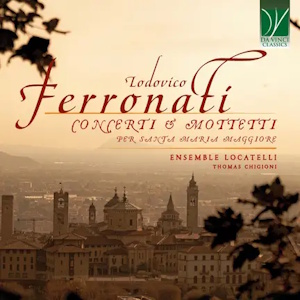
Lodovico Ferronati (fl 1710-1767)
Concerti & Mottetti
Francesca Longa (soprano), Margherita Maria Sala (contralto), Jérémie Chigioni (violin)
Ensemble Locatelli/Thomas Chigioni
rec. 2023, Chiesa del Santo Sepolcro del Monastero di Astino, Bergamo
No texts included
Reviewed as a download
Da Vinci Classics C01095 [52]
Those who regularly read my reviews on this site, may know that I often turn to the music encyclopedia New Grove for information about composers that are not part of the mainstream. Despite all its virtues, it is a mystery why often in an article about a composer someone is mentioned as his teacher, but is not given an entry of his own. Lodovico Ferronati is a case in point. He is mentioned as one of Pietro Antonio Locatelli’s teachers in the article on the latter, written by Albert Dunning. The reason may be that at the time of publication little or nothing was known about him. The disc under review is the result of research into music life in the region around Bergamo, where Ferronati, born in Padua, worked more than sixty years, at the Cappella Musicale of the Basilica of S. Maria Maggiore, initially as leader of the violins, and then as maestro di cappella.
It is not entirely clear how much Ferronati may have written, but Thomas Chigioni, in his liner-notes, mentions that it has been possible “to restore to public attention a number of compositions hitherto thought lost: five concertos for violin and orchestra, and two hymns, all from the composer’s Bergamasque period and unearthed in the archives of Bergamo, Vienna and Dresden.” This suggests that this disc consists of his entire extant oeuvre, taking into account that the term ‘violin and orchestra’ is not entirely correct.
The five instrumental works fall into two categories. The first comprises two concerti à 4; the Concerto in B flat is of the same type. They show some similarity with the ‘ripieno concertos’ by Antonio Vivaldi, although Ferronati’s concertos include some solo episodes for the first violin. It makes sense to mention Vivaldi, as the solo concertos are written after the Vivaldian model: ritornellos for the strings frame solo passages for violin(s) and basso continuo. The solo parts show that Ferronati must have been a virtuoso (which also explains why he could have been one of Locatelli’s teachers). They include double stopping, bariolages, arpeggios and scales. The Concerto in C has two obbligato violin parts. Moreover, there are some solo interventions of the ripieno violins, which gives this concerto some traces of the concerto grosso. This work is also notable for the basso continuo part, as the manuscripts make a difference between the harpsichord and the organ. Jérémie Chigioni has added a cadenza that is based on the Capriccio No. 1 by Locatelli – a nice gesture, connecting the possible teacher to his pupil.
The dissemination of Ferronati’s works performed here indicates that he was known and respected in his time. Four of the concertos – the solo concerto in D (CFC 1:D2) is the exception – have been found in the Österreichische Nationalbibliothek in Vienna. It is remarkable that they have separate parts for the violone, with a simplified bass line. It is assumed that these have been added by the copyist Nicolò Sanguinazzo, who called himself an amateur of the violoncello.
The two hymns have been preserved in the Biblioteca Angelo Maj in Bergamo. Crudelis Herodes is a hymn for the Vespers at Epiphany, referring to the Massacre of the Innocents. The text dates from the 5th century. Ferronati’s setting is scored for soprano, strings and basso continuo. The manuscript indicates that it has to be repeated twice, which means that further stanzas are to be sung on the same music. That is how it is performed here: two odd stanzas are sung, whereas in between two even stanzas are performed in plainchant. (The booklet does not mention the singer.)
Engratulemur hodie is a hymn for Vespers on the feast of St Anthony (Anthony of Padua); the text dates from the 13th century. Notable in this work is the scoring: alto, strings and basso continuo are joined by a pair of horns. In both motets the singer adds a cadenza, suggested by fermatas at cadential points. The vocal parts are technically demanding.
These two vocal pieces were certainly intended for performance at the Basilica of S. Maria Maggiore. The instrumental works may well have been played during the liturgy as well. In Italy the performance of instrumental works during the liturgy was common practice.
This disc provides an interesting insight in the performance practice in a basilica in Italy in general, and in music life in Bergamo in particular. Ferronati is one of many composers of the time who have been forgotten and hardly ever appear on disc or in concert programmes. It cannot be appreciated enough when scholars and performers investigate the oeuvre of such forgotten masters. The programme recorded by the Ensemble Locatelli shows that in the case of Ferronati it was well worth the effort. This is good music by a composer who undoubtedly was a master on his instrument. The two vocal pieces are also well-written. It is a shame that the lyrics are omitted in the booklet, but as they are liturgical, one may find them on the internet. The performances are overall very good. Jérémie Chigioni is a fine player who gives an excellent account of the solo parts. Francesca Longa and Margherita Maria Sala have nice voices and sing the hymns very well, although the latter should have reduced her vibrato. The ensemble leaves nothing to be desired.
In short, this disc may be a little modest as far as the playing time is concerned, it is well worth being investigated by those, who have a liking of Italian 18th-century music. It is to be hoped that the research of archives and libraries will bring more forgotten repertoire from the Bergamo region to light.
Johan van Veen
http://www.musica-dei-donum.org
https://twitter.com/johanvanveen
https://bsky.app/profile/musicadeidonum.bsky.social
Buying this recording via the link below generates revenue for MWI, which helps the site remain free
Contents:
Concerto col violino 2ndo obbligato in C (CFC 1:C1)
Concerto à 4 in F (CFC 1:F1)
Crudelis Herodes, Inno per l’Epifania e sua otava C.to solo con str.ti (CFC 3:1)
Concerto in B flat (CFC 1:B1)
Concerto à 4 in D (CFC 1:D1)
Engratulemur hodie, Inno per Sant’Antonio à alto solo, due corni, archi e continuo (CFC 3:2)
Concerto con v.no conc: vv.ni, v.la e basso in D (CFC 1:D2)













