
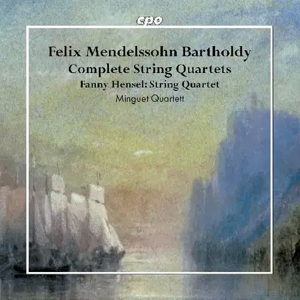
Felix Mendelssohn Bartholdy (1809-1847)
Fanny Mendelssohn Hensel (1805-1847)
Complete String Quartets
Minguet Quartett
rec. 2009-2018, Johanneskirche Köln-Klettenberg, Cologne, Germany
cpo 555 795-2 [4 CDs: 239]
Felix Mendelssohn’s quartets are normally considered to be six, but this generously planned set also includes the early unnumbered quartet and the Four Pieces Op.81, as well as the single quartet by Felix’s sister Fanny Mendelssohn Hensel. Only the twelve fugues Felix wrote at the age of twelve are not included, and I do not think they will be missed. The four discs of this set were originally issued separately, each designed to make a satisfying programme, but that meant mixing up the quartets numerically and chronologically. I shall discuss Felix’s quartets in chronological order – not always the same as opus number order – and insert Fanny’s quartet at the appropriate point.
We start, then, with the unnumbered quartet in E flat, which Mendelssohn wrote at the age of fourteen. We must remember that he was a child prodigy, at least as remarkable as Mozart or Korngold, and possibly even more precocious than either. Here we have a perfectly shaped, fluent composition in four movements, attractive to listen to, and with a fugal finale.
Mendelssohn composed his first acknowledged quartet, in A minor Op.13, in 1827, the year of Beethoven’s death. (He rather confusingly called this his second quartet, but it precedes the numbered first quartet by three years.) This quartet and its successor show Mendelssohn’s study of, and admiration for, Beethoven’s quartets. It is remarkable that he does so without falling into pastiche or absurdity. There are obvious reminiscences, particularly of Beethoven’s A minor quartet Op.132 and of his other passages. Yet Mendelssohn carries them off, and he is not to blame if the result is an exquisite pathos rather than Beethoven’s searching grief and resolution.
The E flat quartet Op.12 is more lyrical and less Beethovenian than the A minor quartet. It also has the unusual feature: a theme from the development section of the first movement reappears in the finale. The second movement is a charming Canzonetta instead of a scherzo. The slow movement is quite short, but has a recitative passage. The finale, marked Molto allegro, goes like the wind.
Next we should consider Fanny’s quartet, written in 1834. She was as gifted as her brother, but their father denied her the composition lessons which were given to him. She did compose, though mainly in smaller forms. She was encouraged by her brother and particularly by her husband Wilhelm Hensel. Felix, however, did not care for this quartet because of the harmonic boldness of the opening Adagio, though he liked the middle two movements, particularly the ghostly scherzo. The quartet was not published until 1988. Since then, it has been frequently performed and recorded, and can take its place among quartets of the time.
Of the three quartets of Felix’s Op.44, No.2 was the first he wrote. It is in E minor, the same key as the violin concerto, which was begun at around the same time but only completed later. While the opening themes of the two works are rather similar, the concerto is more attractive. The quartet’s scherzo is excellent, and not in Felix’s fairy idiom. The Andante is lyrical and the finale exuberant.
Next came the E flat quartet, Op.44 No.3. This is a really impressive work, with vigorous and memorable themes and clearer working-out than in its predecessor. Again there is a fine scherzo, and the slow movement is an Adagio, not an Andante, correspondingly more serious. The finale is much lighter.
The D major quartet, Op.44 No.1, was actually the last of this set to be written; it was also, apparently, the composer’s favourite. It is easy to understand why. The first movment has a lot of energy and excellent themes. Instead of a scherzo, there is a gentle Menuet. The Andante has been compared with that of the Italian symphony, and the finale seems to me the best finale of this set.
Mendelssohn completed his last quartet in the year of his death. The quartet is sombre, indeed tragic. It has been argued that the work was prompted by the death of Fanny earlier that year. Its emotional range and depth put it in a class apart from his other quartets, good though they are. And he returns here to his early love of Beethoven, whose F minor quartet, Op.95, obviously influenced the opening of Felix’s work. The writing of the first movement is somewhat orchestral, though not unduly so. The scherzo is a strong piece, even fierce, quite uncharacteristic of the composer but again suggesting Beethoven, and the Adagio is dark. The finale is passionate. One wonder what Felix might have gone on to write had he lived longer.
As a pendant to the completed quartets, we have four pieces grouped togther as Op.81. They come from different periods. The earliest is the fourth, a gentle fugue in E flat. Next to be written was the Capriccio in E minor of 1843, another fugue, livelier than the earlier one and preceded by an introduction. The other two pieces would have been the central movements of another quartet; we have only the Andante, a theme and variations, and the Scherzo. Although they date from 1847, they are in a completely different mood than the F minor quartet.
The Minguet Quartett, formed in 1988, has had a successful career, mainly in continental Europe. As well as the standard repertoire, they play contemporary and out-of-the-way works. These performances of Mendelssohn were not a rush job; they were planned and performed over a period of nine years. The players perform with the flawless intonation and crisp technique we expect of quartets nowadays. They also bring to these works elegant phrasing, virtuoso playing where required, and a great sense of wit. The recorded sound is excellent, the sleeve notes helpful.
Two of the separate recordings which make up this set have been warmly received on MWI (review ~ review). There are, of course, many other recordings of Felix’s quartets, and some of them include Fanny’s piece. However, if you choose this version, you will not be disappointed.
Stephen Barber
Buying this recording via the link below generates revenue for MWI, which helps the site remain free

Contents
CD1
Felix Mendelssohn Bartholdy
String Quartet No.2 in A minor Op.13 (1827)
String Quartet No.6 in F minor Op.80 (1847)
CD2
String Quartet No.1 in E flat major Op.12 (1829)
Four Pieces for string quartet Op.81 (1843-1847)
String Quartet in E flat (1823)
CD3
String Quartet No.3 in D major Op.44 No.1 (1838)
String Quartet No.4 in E minor Op.44 No.2 (1837)
CD4
Fanny Mendelssohn Hensel
String Quartet in E flat major (1834)
Felix Mendelssohn Bartholdy
String Quartet No.5 in E flat major Op.44 No.3 (1838)













