
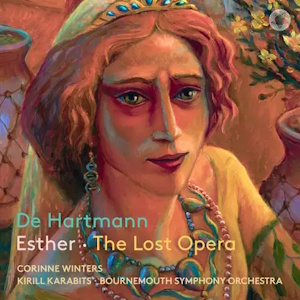
Thomas de Hartmann (1885-1956)
Esther Op.76 (1946)
Corinne Winters (soprano), Bournemouth Symphony Orchestra / Kirill Karabits
rec. 2025, Poole, UK
Pentatone PTC5187424 [116]
Seventy years after the death of its composer and eighty since he completed this epic work, Esther, Thomas de Hartmann’s magnum opus, finally receives not just the recording but the performance it richly deserves. First recordings of major works are always to be celebrated, but there may be a sense of a good first take – for future performances to reveal greater depths and nuances. Not so here. This is a sensationally fine presentation in every respect. Pentatone have rolled out a top-drawer production. The clearly inspired conductor Kirill Karabits marshals with complete authority the large forces of the Bournemouth Symphony Orchestra, Grange Festival Chorus and seven soloists.
Here is that rarest of modern things: a dedicated studio recording of an opera, with sessions spread across four days in the excellent acoustic of the Lighthouse, Poole. Before a note could be played, a performable edition of the parts and score(s) had to be produced. This is a massive undertaking for a work of this scale, so huge credit goes to Tom Daly of the Thomas de Hartmann Project. Projects like this turn on the quality and legibility of the parts in front of the performers, when valuable session time may be eaten up querying and correcting less-well produced parts. This performance lets Esther to be heard in all the glory. Listeners can discover and judge the work, pretty much certain that this is likely not to be bettered.
Thomas de Hartmann’s music has been a revelation for me ever since I first encountered it (review); I recommend that disc again if you are yet to encounter this strikingly individual composer. There has been a significant uptick in recordings and performances of his music, but he remains relatively unknown, so a little biographical context is merited. He was Russian of German desxent, born in what now is Ukraine. He studied with stalwarts of the Russian conservatory system, Arensky and Taneyev, and was enough of a young prodigy to be published in his mid-teens while also going to study with Felix Mottl in Munich. The 1917 Revolution forced de Hartmann to flee Russia. He settled in and around Paris for the next three decades. After World War II he moved to the USA, where he remained for the last decade or so of his life.
Until the founding of the Thomas de Hartmann Project in 2006, he was all but forgotten despite the indefatigable efforts of his wife Olga de Hartmann. She was responsible for getting a 1976 concert performance of Esther off the ground; it was also recorded for a limited private LP release. De Hartmann’s musical style is eclectic yet individual. His music really sounds like by nobody else that I can think of. At the same time, the multiple flecks of influences are clearly audible.
The score for Esther is a case in point. He worked on it when he lived south of Paris in occupied France. (The score was not fully orchestrated until 1951, in the USA.) The Germans commandeered his hilltop home for an anti-aircraft battery, so he moved with his wife, a piano and some furniture to a nearby deserted house. Serendipitously, he found there, in the henhouse, an 18th century gilded copy of Jean Racine’s plays. Esther was the first play in the volume. De Hartmann created his own libretto as a direct distillation of the play. To produce such a work, often by candlelight due to the numerous power cuts – a show of solidarity with the persecuted Jewish population – was personally brave and artistically courageous.
While not Jewish, de Hartmann had a deep lifelong connection with Jewish culture, spirituality and music. He wrote the 1935 Cello Concerto as a direct response to the rise of Fascism and the persecution of the Jews. The second movement embodies the sound of a Jewish Cantor, and the third has been termed a Klezmer Concerto. The 1943 Violin Concertoalso contains elements of Klezmer music; it was dedicated secretly to his friend, the Jewish violinist Albert Bloch. So, while the essence of de Hartmann’s musical voice is post-Romantic modernist, throughout Esther there are melodic shapes and gestures or pentatonic harmonies that suggest other regional ethnicities. The final third act opens with a group of four dances; extracted as a standalone work, they were performed by the likes of Stokowski and Nikolai Malko. Yet the totality of the work remains strikingly de Hartmann’s own.
Kirill Karabits provides an interesting introduction to the work. A valuable Gramophone podcast online, where Karabits is talking to James Jolly, elaborates upon the work as a whole. Karabits repeats the view that the work is more of an oratorio than an opera. That may be a moot point when one listens to audio alone, but it affects the structure of the work and the nature of the solo and choral writing. Interestingly, and with some validity, I feel, Jolly points to Enescu’s Œdipe as a similarly ‘static’ opera.
In the liner notes, Karabits references Honegger, Poulenc and Stravinsky amongst others as sharing a similar space within the genre. I would possibly add Martinů’s Epic of Gilgamesh, another work where modernism and ancient narratives are fused. In each case, however, it is not that de Hartmann is directly musically influenced by any of those contemporaries. Rather, each of them is exploring a similar space where the past can teach the present lessons. In the podcast, Karabits suggests Korngold as a musical point of entry for unfamiliar listeners. I do not hear much of a similarity, except that both composers are very comfortable handling large and colourful orchestras with opulent writing that strains the extreme limits of tonality. Do not expect ‘big tunes’ in the way that Korngold could unfurl.
The opera is in three acts, each in two scenes, and runs for just short of two hours. The Pentatone recording sensibly places the first two acts on a generous first disc, and the 42-minute act 3 on the second. As noted, de Hartmann drew on Racine’s play rather than the biblical text. Racine described his play as “tragedy pulled from Holy Scripture” that sought to highlight the “subject of piety and morality”. The opera sets only about a third of Racine’s text. Entire scenes are cut, monologues and dialogues compressed, and some characters eliminated.
The sense that the work is an oratorio rather than opera is heightened in the way that characters speak at each other. There is no true cut and thrust of dialogue, and no evolving storyline. Here is the narrative, briefly. The Persian queen Esther is encouraged by her uncle Mordecai to reveal to her husband King Ahaseurus her hidden Jewish heritage. That is meant to encourage him to rescind an edict promoted by the Vizier Haman to exterminate all Jews in the kingdom. She risks her own death but the King spares all the Jews, the Vizier is sent for execution, and there ensues general rejoicing and celebrating the goodness of God. De Hartmann set Racine’s original French text; that adds to the slightly archaic, formal, even stilted linguistic style. In turn, this underlines the sense of ritual and stylisation of the work.
There are significant demands on the lead singers, none more than Esther, a true dramatic soprano role. Corinne Winters sings with great effect if with occasional effort. The other six named roles go to singers with strongly individual and commanding voices. The Grange Festival Chorus projects the choral writing very well, especially in the closing celebratory scene where it is extended and demanding. A session photograph suggests a quite small choral group, but they make a powerful and highly effective sound. Credit also goes to producer Adrian Peacock and engineer Chris Caton. They achieve an ideal balance between the voices, choral and solo, and the often extravagant orchestral writing. The cumulative sound is excitingly full and dynamic, while detail registers throughout. The release is a standard red book CD but I would say the sonics are very fine.
In the Gramophone podcast, Karabits remarks that he has already recorded a further disc of orchestral works including the Harp Concerto and the early La Fleurett Rouge – an exciting prospect. This remarkably impressive new issue underlines the individuality of Thomas de Hartmann’s compositional voice. In many ways, he is an amalgam of all the contemporary music of the first half of the 20th century that chose not to follow Schoenberg down the path of serialism. Yet, quite aside from the musical skill, there is also a deeply humane and empathetic centre to his work. Olga de Hartmann wrote in 1976: “Esther is a symbol and an inspiration for everyone who is trying to save the world from the terror which threatens to engulf […] all Europe.” It is salient that such a sentiment is as relevant in 2026 as it was in 1976 and 1946.
Nick Barnard
Other review: Jim Westhead
Buying this recording via the link below generates revenue for MWI, which helps the site remain free
Other cast
Yuriy Yurchuk (baritone)
Andrew Foster-Williams (baritone)
Bernard Richter (tenor)
Olga Bezsmertna (soprano)
Edwin Crossley-Mercer (bass-baritone)
Paul Appley (tenor)
The Grange Festival Chorus / William Vann (chorus master)













