
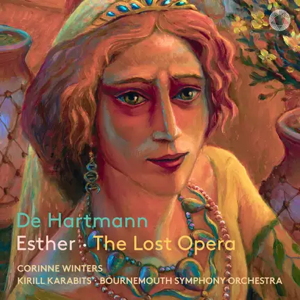
Thomas de Hartmann (1885-1956)
Esther (1946)
Corinne Winters (soprano), Bournemouth Symphony Orchestra / Kirill Karabits
rec. 2025, Poole, UK
Reviewed as a Hi-Res Digital Download 96kHz / 24 bits
Pentatone PTC5187424 [116]
I have remarked in an earlier review of a Toccata disc that Thomas de Hartmann’s music is a perfect example of recordings which small companies do well but large multinationals have abandoned. Here we have an even better example: Pentatone’s first-ever recording of de Hartmann’s magnum opus, his opera Esther. My earlier review already has de Hartmann’s biographical details; the immense effort that has gone into making this recording manifestly deserves comment.
The Thomas de Hartmann Project (website) has been responsible for funding and recording several of the composer’s orchestral works. Begun in 2006, it has been driven in large part by its orchestral project director Efram Marder, executive producer of this recording and author of much of the booklet. He outlines the long gestation of bringing Esther to disc and the earlier recordings that paved the way. Crucial, too, were the commitment of Tom Daly, inheritor of de Hartmann’s estate – whose voluntary efforts were instrumental in preparing the score for performance – and the support of conductor Kirill Karabits.
In short, this recording would not have happened without the good will and dedication of several individuals. I am sure that this is the case with the recordings of many obscure works that have made it to the recording studios since the advent of digital recording techniques. Those of us who like exploring the music of unsung composers can only be grateful for such efforts.
The music is a mix of styles. It is known that towards the end of his life, de Hartmann wanted to explore a greater use of dissonance, and that shows here to no small degree. The work opens with a short brass fanfare which on first hearing sounds quite dissonant, and remains so when it is repeated later. It is used to introduce a cantor who sings of the unhappy condition of Israel, its people in bondage to Ahasuerus, King of the vast Persian Empire, historically identified as Xerxes I. In comparison to the brass outburst, the cantor’s short aria is not particularly dissonant as he goes on to marvel that Esther, a Jewess, should have become Queen. There follows the first appearance of Esther and her confidante Élise, who have been separated. They sing of Esther’s good fortune in being an exceptional beauty, so she was chosen to be Queen, and her distress at the fate of the Jewish people under the Persians.
De Hartmann assigns both leading female roles to sopranos, and this creates a problem: the two voices are not markedly different. Olga Bezsmertna, singing Élise, has a slightly lighter timbre than Corinne Winters in the title role, but the distinction is often subtle, and it is easy to confuse the two unless one follows the libretto closely or has fluent French. Both singers have attractive voices, though Winters’s becomes noticeably less distinctive when reaching for the loud high notes de Hartmann gives her. It is hardly an exaggeration to say that her tone turns shrill.
In the major aria, O mon souverain roi, where de Hartmann finally grants the music a certain melodic breadth, Winters must begin with a soft, pleading tone to persuade the King not to execute the Jewish population, then shift to a forceful exhortation urging him to confront his true enemies. In the climactic phrase Tourne enfin sa fureur contre nos ennemis, she is pushed to the very edge of her vocal capacity – and with de Hartmann writing fortissimo for the brass at the same moment, she is compelled to sing at full volume. The result is best described as a shriek.
The dominance of brass and percussion is immediately apparent with the entrance of Mardochée (Mordecai), who arrives to warn Esther of the plot to exterminate the Jews. The news is dreadful, and the orchestration makes sure we feel its weight: the brass and drums repeatedly and almost violently cut across his declamation. Andrew Foster-Williams handles the relatively fluid vocal writing with assurance despite this splintered, disruptive accompaniment, but his tone acquires a noticeable wobble when the line demands greater volume. As he presses on, describing the horrors to come and urging Esther to implore the King to revoke his decree, he is pushed close to his limits.
De Hartman’s use of the brass to effect interruptions in the lyrical flow of the music is heard when the King, singing in a smoothly flowing vocal line, is ordering that Mardochée be greatly honored. Virtually every sentence that he utters is interrupted by a bar or two of dissonant brass, emphasizing the absolute power behind his commands. There follows quietly foreboding music as Esther enters, risking her life because on pain of death no-one, not even the Queen, can enter into the King’s presence without being summoned. The King’s ire when he sees her, unrecognized, is represented by his words (obviously) but also by brief dissonant brass outbursts interrupting his speech. It is very effective. Next comes the most purely lyrical male solo vocal lines in the opera, a love aria as the King sings of Esther’s beauty: she lightens his every day. Here the brass and woodwind, again orchestrally dominant, do not interrupt the flow. They play noble-sounding music as the King’s song ends.
The chorus plays a vital role throughout the opera. After Esther and Élise are introduced, it evokes the beauty of their homeland and the sorrow of their condition. De Hartmann may well have drawn on a traditional melody here, for this passage is perhaps the most folk‑inflected in the entire score: a gentle, soothing line, exquisitely sung, with harp‑led orchestration that is an ideally tender backdrop. At the opposite end of the work, the chorus returns in a blaze of jubilation as they celebrate deliverance from persecution. Here they sound almost like a victorious army, propelled by thunderous percussion. The sheer rhythmic force and vocal weight of the chorus, combined with the orchestral tumult and the principals’ exultant lines, give the finale a barbaric edge – jaggedly Stravinskian, even. In truth, de Hartmann might have felt justified in letting the music erupt with such ferocity. In the biblical Book of Esther, the Jews newly spared execution and granted royal permission to avenge themselves on their accusers, rejoice in the ensuing slaughter of their enemies. This darker episode is omitted from de Hartmann’s adaptation, which draws on roughly a third of the episodes from Racine’s 1689 play Esther.
Finally, I must mention the orchestral interlude and dances that end Act II and begin Act III, with total playing time of 18:30. De Hartmann extracted them from the opera as an orchestral suite, quite attractive. The interlude sounds like a cross between Bartók’s Miraculous Mandarin and Stravinsky’s Rite of Spring. The Danse Scythe is a rhythmic but uninteresting affair that could have been composed by almost anyone active at the time. The Danse Hellenique takes us to the style ofRimsky-Korsakov’s The Young Prince and the Young Princess from Scheherazade, but the tune does not ‘flower’ in the same sumptuous way. Next is the Danse Assyrienne, a piece largely for flute and orchestra; the flute’s notable solo makes one think of Debussy or Ravel. The final is a Danse Parthe, and here I was reminded of Khachaturian or other Soviet-era composers writing for the proletariat.
Speaking generally, de Hartmann’s orchestration is clear, even when all hell breaks loose. He avoids the emphatic use of strings, favouring woodwind and brass instead.
I am not surprised to read that the work is described as an oratorio-opera. It does proceed as a series of static scenes with a significant degree of choral commentary. De Hartmann composed it in the candle light of the WW2 Nazi occupation. He took his own experiences to express the grief and hope of the Jews trapped in the Achaemenid Persian Empire.
The performance of the orchestra is excellent. In the hands of Pentatone’s engineers, the recording venue yields the to-be-expected very fine sonics that I have heard from this orchestra in previous recordings on different labels.
The booklet is first-rate, with a full libretto in French and in English translation side by side, de Hartmann’s detailed biographical facts, and descriptions of some of his major works.
This is a very fine release indeed, worthy of considerable praise. There is unlikely to be another, and I have no doubt that it does the composer proud. All involved can be very, very satisfied with their achievement.
Jim Westhead
Other review: Nick Barnard
Buying this recording via the link below generates revenue for MWI, which helps the site remain free
Other cast
Yuriy Yurchuk (baritone)
Andrew Foster-Williams (baritone)
Bernard Richter (tenor)
Olga Bezsmertna (soprano)
Edwin Crossley-Mercer (bass-baritone)
Paul Appley (tenor)
The Grange Festival Chorus / William Vann (chorus master)













