
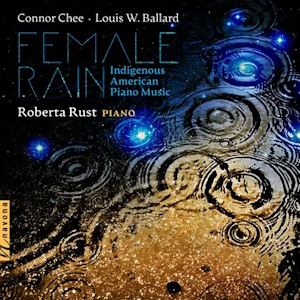
Female Rain: Indigenous American Piano Music
Connor Chee (b. 1987)
The Navajo Piano: Navajo Vocable for Piano (2014) [Excerpts]
Louis W. Ballard (1931-2007)
The Four Moons Ballet: Pass de Quatre (1967)
Connor Chee (b. 1987)
Scenes of Dinétah (2020) [Excerpts]
Louis W. Ballard (1931-2007)
Four American Indian Preludes (1963)
Connor Chee (b. 1987)
The Navajo Piano: Navajo Prelude for Piano (2014)
Roberta Rust (Piano) rec. 2025, Shalin Liu Performance Centre, Rockport, Massachusetts, USA
Reviewed as a digital download
Navona Records NV6875 [60]
In an 1895 essay published in Harper’s Monthly Magazine, Antonín Dvořák wrote a rave review of the Native American music he had discovered during his travels throughout the United States of America. “The music” he wrote, “is like a rare and lovely flower growing amidst encroaching weeds.” He encouraged American composers to develop a uniquely “American” idiom based on both Native American and African American music. By way of demonstration, as it were, he had already composed his E minor symphony, From the New World. There are no authentic Native American melodies to be heard in the symphony, but Dvořák took pains to write and explain how he had been inspired by the unique features of Native American melodies in composing his own themes.
The rest, one might have thought, would be history. Dvořák’s New World Symphony was a runaway success; it has topped polls and filled concert halls since the day of its premiere. And yet, I do not think we ever saw what Dvořák suggested. American Classical Music is not, generally speaking, built on Native American music. There were American composers who went out and incorporated Native American music, of course: Edward MacDowell and Arthur Farwell, to name two, but these are rather deep cuts. Some composers even strongly disagreed with Dvořák – Amy Beach went out and wrote her Gaelic Symphony to argue that the real American heritage lay in Western Europe. And yet the story does not quite end there; Beach disavowed this idea as she became fascinated by Inuit melodies and used them in some of her later works.
I mention all of this because I have long been fascinated by Native American music, and I cannot help but be mystified by the lack of general interest in it within Classical circles. It’s not as though From the New World is some obscure, unpopular work!
We should at this point want to turn to Native American composers, but they remain sadly an obscure bunch. I was only familiar with two before picking up this disc: Barbara Croall, who has a lovely choral work titled Giishkaapkag (Where the Rock is Cut Through),which was recorded by the Elora Singers in 2020, and then Raven Chacon, a Pulitzer-Prize-winning composer of fascinatingly dense, challenging music.
This present album doubled my knowledge of Native American composers by offering two more, and it also, I think, proves Dvořák’s right. This is music that sounds fundamentally American, quite original, beautiful and immediately likable. The bottom line is this: if you are interested in 20th-century character studies for piano, you will enjoy Ballard’s pieces, and if you like contemporary ‘minimalist’ piano music, you will love Chee’s contributions.
I want to start with Louis W. Ballard, the elder of the two composers. Hailing from a place with the incredible name of ‘Devil’s Promenade’ in Oklahoma, Ballard went on to study music under Milhaud and Castelnuovo-Tedesco (among others), and dedicated his career to combining Native American melodies with Western forms. He wrote symphonies and ballets and is known as the “father of Native American composition.” He has so far, I think, only one CD dedicated solely to his music–a Naxos release from 2024 (review). He was also featured on a piano recital album, Walk in Beauty, from 2017 (review).
He is represented by an excerpt of the piano arrangement of his ballet The Four Moons, first performed in 1967 for the 60th anniversary of Oklahoma’s statehood. The piece is inspired by four ballerinas of Indigenous American descent. Each movement, then, is a character study of a particular dancer. I stress this because a casual listener might not readily understand what the track titles mean (The Shawnee Moon, The Choctaw Moon, etc.). The Shawnee Moon, for example, was Moscelyne Larkin (1925-2012), who danced with the Original Ballet Russe and is said to have “excelled in comical roles as a soubrette”. This is surely an important bit of context – I think I can hear some of that comedy and sprightliness in the music. Each Moon has, at any rate, a slightly different personality – contrast the Shawnee Moon with the much more dramatic Osage Moon. Maybe this is just because it’s ballet music, or maybe it’s a legacy of Ballard’s studying with Milhaud, but I did hear something rather French in this set: something of Poulenc, maybe. I’d enjoy hearing any of these in recital, and Rust perfectly nails the sense of playfulness and rhythm.
Ballard also wrote the 4 American Indian Piano Preludes, which were previously recorded for Walk in Beauty. These portray a totally different side to Ballard’s artistry. All four are rather nervous and spiky, but Ballard endows them with unfailingly high energy – I thought of Shostakovich. No. 2 makes use of a partial 12-tone row. Several of the melodic ideas in these pieces were inspired by the unmetered playing of a North American Plains Flute. They make a very successful contrast with the rest of the music on this disc.
Perhaps two-thirds of the runtime on this disc is given over to Connor Chee, a graduate of the Eastman School of Music. He is, I hope, on the cusp of making a splash in the world of recorded music, having been featured occasionally on discs in the past (the aforementioned Walk in Beauty, and Folk Trails (review) on Toccata Next). There are really two works of his featured here: The Navajo Piano comprises twelve ‘vocables’ (of which, six are presented here) and three preludes. The music is based on traditional Navajo chants and songs, in particular, corn grinding songs, and something called the Enemy Way Ceremony, a traditional summer ritual in which slain enemy ghosts are exorcised. If the word ‘vocable’ is new to you (it was to me, I must confess), it is a syllable used in lyrics without a specific meaning. The six ‘vocables’ sound rather like variations on a theme, and you will hear the same scale, similar progressions, and similar moods throughout the six excerpts. The three Preludes sound to me like they might also be linked, but based on a different source.
Chee’s style bears a family resemblance to what I would describe as ‘Contemporary Piano Minimalism’ – c.f. Philip Glass, Arvo Pärt, Simeon ten Holt, Yann Tiersen, Michael Nyman – the sorts of work featured on Jeroen van Veen’s anthology (review). That is to say, Chee’s writing is slow, thoughtful, cinematic, and uncomplicated yet deeply engaging. I am not always (or, often) a fan of ‘Contemporary Piano Minimalism’, but the Navajo Piano won me over because it is expressive and unique. Chee’s approach really shines a light on the beauty of the melodies themselves, which, as they were all new to me, was exactly what I wanted. I know this sort of description is somewhat overused, but these are all singing, cantabile pieces for piano – and I cannot imagine a better advocate for this music than Rust. She makes every single chord, line, and ornament to shine. This is a good time to point out that the sound engineers have done a brilliant job with this album. You do feel rather close to the piano, but for this style of, as I say, slow and spacious, somewhat hypnotic writing, that’s just where you want to be.
Finally, we have five of Chee’s 12 Scenes of Dinétah (the endonym for the Navajo Nation). One of these has provided the album’s title, Female Rain, but there is, alas, no information in the programme notes about what this means. At any rate, if the Navajo Piano sounded quite cohesive, these all feel distinct. It was nice to hear Chee in a slightly faster tempo in No. 9 (Fry Bread), which has a charming dance rhythm.
Roberta Rust (herself a Lakota descendent) has recorded several albums in the past, including Devoted to Debussy on Centaur, (review), which I’m tempted to listen to just for the title. I am not a piano person per se, but to my ears, Rust presents all of this material ideally.
I’ve kept up with a lot of this year’s new releases and Female Rain offers a unique experience. I will be spinning it again in the weeks to come.
Aidan Gray
Buying this recording via the link below generates revenue for MWI, which helps the site remain free














Thanks so much for such an informative and engaging review Aidan. I would have missed this album if it weren’t for you and am very glad to have made its acquaintance.