
Charles Hubert Hastings Parry (1848-1918)
Piano Music Volume 2
Sonata in A major (1876-1877, publ.1878)
Sonnets and Songs Without Words: Book 2 (1867-1875, publ.1875)
Hands Across the Centuries: Suite (publ. 1918)
Christopher Howell (piano)
rec. 2023, Studio of Griffa e Figli, Milan, Italy
Da Vinci Classics C01138 [60]
This is the second instalment of Christopher Howell’s survey of Charles Hubert Hastings Parry’s piano music. The first was reviewed here and here.
Parry composed Sonnets and Songs Without Words: Book 2 over an eight-year period. The liner notes tell us that the collection had its roots in the days when Parry was courting Maude Herbert. They were to marry in 1872, but the union was to remain problematic for many years. At one time, Parry was “ordered off” by Maude’s mother, which perhaps led to the first number, the stoical Resignation.
Milton’s poetry sets contrasting moods for the next two numbers. L’Allegro delights in daylight, music and lively company, while Il Penseroso turns inward to night, study and quiet reflection. Together they sketch a life balanced between outward joy and inward thought. Parry provides a muted commentary on these poems. Overall, this introverted collection of pieces – despite a nod to Mendelssohn – is more inward and personal than salon‑bound.They show a young composer testing emotion rather than virtuoso display. This collection gets a first recording.
Parry was a past master at writing Suites that nod to Baroque exemplars. To recognise this expertise, one need only think of the early Suite de pièces, the Partita in D minor and the Lady Radnor’s Suite, with the English Suite between them. A near-contemporary review by Stanley Bayliss of the Hands Across the Centuries: Suite (publ. 1918) suggested that, compared to the Shulbrede Tunes, it failed. The critic felt that although they “attract the attention”, they show signs of hurriedness. Yet this contradicts Charles L Graves’s contention that here “he happily justified the title by a dexterous accommodation of eighteenth-century conventions to modern idiom”. He quotes Parry’s friend, disciple and assistant Emily Daymond (and the Suite’s inspiration and dedicatee): “Over and over again, he would rewrite something because ‘it must be the very best I can do.’”
The liner notes suggest that, despite the Suite’s historical background, Parry has expressed “unease and emotional isolation” from a difficult marriage to Maude. Christopher Howell also suggests a kindred spirit with “the sea and weathers experienced on Parry’s beloved yacht, The Wanderer”. Whether I fully agree with this contention, there is little doubt that the sea is present in the opening Prelude (which also nods to a Bach fantasia) and in the lapping wavelets of the capricious Courante. Parry scholar Jeremy Dibble has noted the Brahms-tinged Passionate Allemande and the expressive Quasi Sarabande which was played at the composer’s funeral. This seriousness is dismissed by the cheerful Gavotte and Musette and the Quasi Minuetto before all is blown away by the Lisztian Whirling Jig. Surely this final number would make a splendid encore for any recital of British music.
The main event on this disc is a distinctive performance of Hubert Parry’s Piano Sonata No.2 in A major. I first heard it played by Anthony Goldstone (Albany Records TROY 132, 1994) on the composer’s Hagspiel grand piano at Shulbrede Priory in Sussex. The historical significance of the recording aside, I was unmoved by the tone and balance of the instrument. In 2023, I appraised Richard Deering’s account of both sonatas on Heritage Records (review) in a reading that I could do business with. I am equally impressed with Howell’s account.
The liner notes remind us that, although the Second Sonata was finished before the First, Parry wished it to be known as the second; it seemed to be a “logical development from the less ambitious first”. Confusing! The work was dedicated to his close friend Tora Gordon on the engagement to Victor Marshall. Jeremy Dibble notes that Parry’s affection for Tora was “deep but necessarily restrained”. The sonata was a “perfect outlet for his sense of loneliness” from his “increasingly unresponsive” wife, Maude.
The opening movement adopts a modified sonata design, effectively a rhapsodic play on two contrasted themes, one of which may conjure up “a vision of Tora”. The Adagio con sentimento that follows may glance toward the early Romantics, yet its harmonic language is unmistakably Wagnerian. Tender and reflective, it unfolds in a sophisticated binary structure, each half containing two distinct ideas. The Scherzo dances along in a lively 6/8 with a few unexpected twists. The finale, an Allegretto, is a deftly crafted rondo. Its genial refrain frames two contrasting episodes and is propelled by a succession of striking modulations. Towards the close, it nods back to both the first movement and the Adagio.
Listeners who cherish Brahms, Schumann and Schubert will find much to enjoy in this warm‑hearted, affectionate sonata, which is in no way a pastiche or parody.
This recital of Parry’s piano repertoire is well‑judged, sympathetic and alert to every shift of mood and character. Howell beautifully captures these diverse historical threads – from Baroque frameworks to high-Romanticism – and synthesises them to highlight an important, if not fully recognised, voice. It is supported by an outstanding recording.
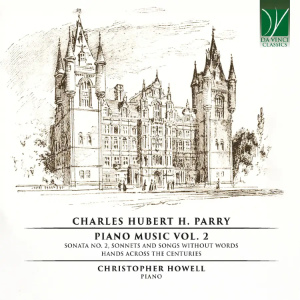
I am indebted to Christopher Howell’s outstanding liner notes in preparing this review; they are engaging, informative and refreshingly untechnical. A résumé of the soloist and his discography are also provided. The disc’s cover features a contemporary print of the Royal College of Music on Prince Consort Road.
There is ample scope for a third volume to round off this absorbing survey of Parry’s published piano music. One can only hope it appears before long, bringing to completion what has already proved a fascinating exploration of a too‑often overlooked corner of his catalogue.
John France
Buying this recording via the link below generates revenue for MWI, which helps the site remain free














The third and final volume of this series is recorded and fully edited so its issue should not be far away