
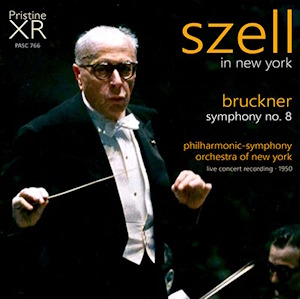
Anton Bruckner (1824-1896)
Symphony No. 8 in C minor, WAB 108 (1887/90)
Philharmonic-Symphony Orchestra of New York/George Szell
rec. Carnegie Hall, New York, December 1950
Pristine Audio PASC 766 [71′]
Even veteran discophiles mightn’t realize that George Szell, of the Cleveland Orchestra, had a long-lasting association with the New York Philharmonic as well, as guest conductor and, later, Music Advisor. Decades ago, Columbia Records in the U.S. reissued three LPs’ worth of monaural recordings the conductor made in New York. He’d redo most of that material for stereo in Cleveland, though not Smetana’s From Bohemia’s Woods and Fields, making that album worth hunting down.
The first movement of this Bruckner Eighth, recorded in concert, tells us most of what we need to know. The cello counterpoints are transparent and lustrous, leading to a taut, clear tutti; Szell sees to it that each section flows straightforwardly, including the transition into the lyrical second theme, making the movement more of a piece than most. The lower instruments have trouble fitting into Szell’s clean, well-organized plan: the bassi at the start are awkward, the tuba in the development sclerotic.
The brisk Scherzo’s main theme is more articulate than most – no gummy, Karajanish legato here. Unfortunately, the Adagio doesn’t hold together as well as the first movement did.
The initial unclear scansion is very much Bruckner’s fault, though the passage feels a bit woozy; however, by the first return of that passage, it feels as if we’d already been through half a long movement, with much more to come; it’s hard to sit through. The Finale‘s immediate galloping stride calls the listener to attention, and the second theme brings a contrasting warmth, but in the home stretch, Szell’s odd rhetorical adjustments break the established momentum.
Sonically, Andrew Rose may not have had the best source material to work with. The buildup in the first-movement development sounds thick and confusing; the raucous, clattery tuttis in the Scherzo and the Finale are just plain hard to listen to. The final note of the piece is chopped off prematurely.
The uncredited program note tells us that Szell did not make Bruckner’s Eighth part of his recorded studio legacy. I remembered differently, and the discography in Donald Rosenberg’s The Cleveland Orchestra Story: Second to None bears that out, listing a 1969 Columbia studio account (and not tagging it as a concert recording). I’ve not heard that in half a century, but certainly it would have sounded clearer and more impressive than this (broadcast?) tape. The Pentatone remains useful, but more to serve my much-bruited documentary imperative than as a preferred library choice.
Stephen Francis Vasta
stevedisque.wordpress.com/blog
Availability: Pristine Classical












