
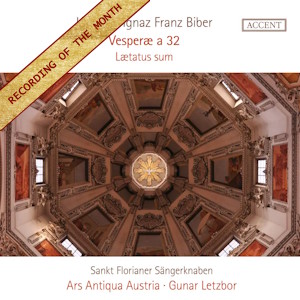
Heinrich Ignaz Franz Biber (1644-1704)
Vesperae a 32 – Laetatus sum
Pater Ignatius (17th C)
Aufzug for two clarini, two trumpets and timpani
Benedikt Anton Aufschnaiter (1665-1742)
Missa Laetamur in ea a 12
Heinrich Ignaz Franz Biber
Laetatus sum a 7 in A (C 9)
Vesperae a 32 in C (C 11/12)
Alexandre Baldo, Gerd Kenda (bass)
Sankt Florianer Sängerknaben; Schwanthaler Trompetenconsort; Salzburger Lautenconsort; Ars Antiqua Austria/Gunar Letzbor
rec. 2025, Summer refectory of St Florian Abbey, St Florian, Austria
Texts and translations included
Reviewed as a download
Accent ACC 24419 [67]
Gunar Letzbor and his ensemble Ars Antiqua Austria cover a wide repertoire of music from the pre-Romantic era, but focus especially on the musical heritage of Austria and neighbouring regions, such as southern Germany and Bohemia. As Letzbor enjoys venturing into unknown territory, he has brought to light many unknown treasures, and made them available on disc. On of his discoveries is the oeuvre of Benedikt Anton Aufschnaiter. The cover of the disc which includes a mass by him, only mentions the other work, Vespers by Heinrich Ignaz Franz Biber. The reason may be commercial; it seems likely that most music lovers are more inclined to investigate a recording with his music than with a piece by the largely unknown Aufschnaiter.
He was born in Kitzbühel; apparently nothing is known about his background and his first musical education. There is evidence that he studied in Vienna; among his teachers he mentioned Giacomo Carissimi and Johann Caspar Kerll. The mention of Carissimi is interesting; it shows his interest in vocal music from early on but one also wonders how he may have studied with him. Did he go to Rome where Carissimi worked all his life or did he learn from him by studying his music? It is clear that he was under the influence of Italian music, just like Georg Muffat, whom he succeeded as Hofkapellmeister in Passau in 1705. It seems that he was not entirely happy with the quality of the instrumentalists in Passau, in comparison with Vienna. Could this be a reason that he focused on sacred rather than instrumental music? The fact that in his sacred oeuvre he largely avoids virtuosity in the string parts – a feature of his collections of instrumental music – points in that direction. It is all the more notable as he was not appointed church Kapellmeister like Muffat before him.
In 2002 Letzbor recorded Dulcis fidium harmonia symphoniis ecclesiasticis concinnata op. 4 of 1703 (Arcana A 313). That is one of only two collections of instrumental music by Aufschnaiter. Far larger is his sacred output: between 1709 and 1728 he published four collections with Vesper music, offertorios and masses, and in addition a substantial corpus of sacred music has been preserved in manuscript. The Missa Laetamur in ea dates from the first quarter of the 18th century and has been preserved at Lambach Abbey in Upper Austria, which at Aufschnaiter’s time belonged to the diocese of Passau. The title probably refers to a verse from Psalm 117 (118): “This is the day that the Lord has made; let us rejoice and be glad in it.” This is also the text of the gradual for Easter Day; this may be an indication that this mass was intended for performance at Easter. It is notable that the Gloria and Credo are listed separately in the partbooks. “Were these movements only performed on major feast days?”, Letzbor asks in his liner-notes. If this mass was indeed intended for Easter, this seems unlikely.
The mass is scored for twelve voices, which doesn’t make it easy to communicate the text. However, Letzbor points out that Aufschnaiter “refers to a ‘new style’ of composition, characterised by structural clarity and restraint.” This is graphically illustrated in the mass. It is dominated by homophony in the tutti episodes, and many of these are almost syllabic. This is further emphasized by the way Letzbor has made this work being performed. He always focuses on the intelligibility of the text, through an optimal voice projection, a clear diction and articulation and a marked difference between good and bad notes. Because of that one can understand the text much better than in many other recordings of this kind. Notable is that the Gloria and Credo are rather short, if one compares them with the Kyrie and the Sanctus and Agnus Dei. In the Credo the passage on the incarnation is always emphasized, for instance in the way of a slow tempo, but not here: this text is sung by the bass. Here the emphasis is on the Crucifixus, where the voices are accompanied by strong chords in the strings. Could they refer to the driving of the nails into the Cross? This, in combination with the abundant joy of the passage on the resurrection may well support the idea that this is an Easter mass. It was not uncommon in Easter music to refer to what preceded it.
In the Gloria and Credo, the solos are relatively short. The longest solos are in the Sanctus/Benedictus and the Agnus Dei, and especially in the Osanna I and II and the Benedictus. They are sung by members of the vocal ensemble. Letzbor always takes care of a full integration of soli and tutti. Since long he has a fruitful partnership with the St Florianer Sängerknaben, which always have excellent singers in their ranks who are able to sing even demanding solo parts. Here it is Valentin Werner who shines in his solos. He and his adult colleagues are perfect matches. The instrumental parts, with a major role for the trumpets, are brilliantly played. The mass ends, as one may expect, with a fugal Dona nobis pacem. It brings to an end a mass by a composer who fully deserves the attention Letzbor is giving him. His enthusiasm for Aufschnaiter’s music is justified, and I hope that more from his oeuvre will be recorded.
Heinrich Ignaz Franz Biber is a much better-known composer, but mainly for his instrumental music. He was undoubtedly the greatest violinist of his time, and also one of the greatest of all times. His music for his own instrument testifies to that. However, he also wrote much sacred music, mostly for the cathedral in Salzburg, where he worked from 1670 until his death. The vocal music was the result of his being appointed deputy Kapellmeister in 1679; five years later he succeeded Andreas Hofer as Kapellmeister. Biber’s best-known sacred work is the Missa Salisburgensis, which for a long time was attributed to Orazio Benevoli, but is now generally acknowledged as Biber’s. It is the most opulent specimen of a genre, known as Festmesse (festive mass), which was especially popular in Austria.
The Vespers which are performed here are comparable to such masses. Letzbor suggests that Biber may have been inspired by the Vesperae sollemnes by Johann Heinrich Schmelzer, which are part of the archives of Kroměříž, where Biber worked before his Salzburg period. “In both compositions, the division of the eight vocal parts into ‘in concerto’ (solo) and ‘in capella’ (tutti) strongly points to a direct stylistic connection.” The score is dated 1674. Polychoral music was tradition in Salzburg, where not only music but also the structure of the town was strongly inspired by Venice. The cathedral had been consecrated in 1628; its interior “follows Italian architectural principles. Its cruciform layout creates a square at the intersection of the two axes, supported by four massive pillars. As in St Mark’s Basilica in Venice, galleries were added to accommodate multiple choirs. Thus, specific musical requirements were already embedded in the cathedral’s architectural design.”
Biber’s predecessor Andreas Hofer had also written polychoral music. Previously Letzbor recorded Biber’s Missa Alleluja for 36 voices (review). These Vespers for 32 voices are hardly less opulent. They consist of only two sections: a setting of Dixit Dominus (Psalm 109/110), the first of the Vesper psalms, and the Magnificat, which conclude the Vespers.
In such large-scale works one should not expect much text expression through musical figures. There are other ways to emphasize elements in the text. The large number of singers and players fits the most dramatic verses of the Dixit Dominus, about the wrath of the Lord, and God’s judgment of the heathen. Biber creates a strong contrast between these verses and the much more intimate one: “He shall drink of the brook in the way”. In the Magnificat the words “omnes generationes” are highlighted through the participation of the entire ensemble, which is quite effective. “He hath put down the mighty from their seats, and exalted them of low degree” – that verse is set, no less effectively, as a solo for the bass. Biber would not be Biber as he had not taken the opportunity to give his own instrument an obbligato role here.
The violin also plays a major role in the sacred concerto for two basses, Laetatus sum. It is a setting of Psalm 121 (122), which is a fixed part of the Vespers. This work shows Biber’s command of the monodic style; the two basses deliver the text in a declamatory way. These parts are technically demanding, and so is the violin part, especially the episode preceding the doxology. Biber undoubtedly wrote this part for his own performance. It also notable that this piece includes three parts for the viola, which was rather unusual at the time. Letzbor plays the violin part, and does so brilliantly, as one may expect. Alexandre Baldo and Gerd Kenda deliver an excellent performance of the vocal parts. This is certainly one of the best performances of this piece that I have heard.
Music of this scale is a bit of a nightmare to perform and record. One wonders how much audiences at the time may have heard. Not very much, as Letzbor points out: “These efforts to create a universal musical experience ultimately benefited only a small elite: the archbishop and his fellow celebrants, positioned at the acoustic centre of the choirs distributed throughout the space. Even a few metres away from the centre, one notices disturbing echoes, and with increasing distance, the sound becomes so diffuse that it is difficult to find anything positive to say about it. For performers today, adapting the disposition of the various musical groups to the acoustics of the venue remains a challenge. In Biber’s time, orientation towards an ideal centre was self-evident: music was offered to God, and the bishop was regarded as His representative on earth.” Letzbor has recorded quite a number of works of this scale in the course of his career, and it always struck me that he was able to overcome the problems each director has to face. Obviously he can take advantage of the space where the recording is made: here the summer refectory of St Florian Abbey. He knows this space very well, and that makes it easier to find a solution for the issues which such large-scale works bring with them.
At home one misses the excitement of a large space. However, from the perspective of the intelligibility of the text and the transparency of sound the listener in his chair at home may have the best seat in the house. I heard this programme live during the Festival Early Music Utrecht of 2025. It was performed in the large hall of TivoliVredenburg, which has a good acoustic, but not for this kind of music, as it is a bit too dry. Even then it was not always easy to understand what was sung – so this disc is probably the best way to enjoy this music and these performances.
Letzbor’s close relationship with the St Florian Sängerknaben has resulted in many outstanding recordings. He is just very lucky to have them at his disposal. They are at the top in the world of all-male choirs. They are at their impressive best here. May that collaboration continue and bring us more recordings of this level; both the composers and the performers deserve a special recommendation.
Johan van Veen
http://www.musica-dei-donum.org
https://twitter.com/johanvanveen
https://bsky.app/profile/musicadeidonum.bsky.social
Buying this recording via the link below generates revenue for MWI, which helps the site remain free













