
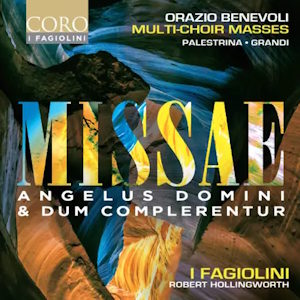
Alessandro Grandi (1590-1630)
Plorabo die ac nocte
Orazio Benevoli (1605-1672)
Missa Angelus Domini a 12
Giovanni Pierluigi da Palestrina (1525-1594)
Dum complerentur dies Pentecostes a 6
Orazio Benevoli
Missa Dum complerentur a 16
I Fagiolini/Robert Hollingworth
rec. 2025, Church of St Jude-on-the-Hill, Hampstead Garden Suburb, London
Texts and translations included
Reviewed as a download
Coro COR16219 [67]
Orazio Benevoli is one of the better-known composers of the Baroque period. However, his reputation is largely based on a misattribution: for a long time he was considered the composer of the 53-part Missa Salisburgensis, which today is thought to have been written by Heinrich Ignaz Franz Biber. As a result, Benevoli has never sunk into oblivion, although his music is not that often performed and for a very practical reason: a large part of his oeuvre consists of masses and other liturgical music for up to 48 voices, making them hard to perform on a regular basis.
Benevoli was born and died in Rome; he was just 18 years of age when he was appointed maestro di cappella of S Maria in Trastevere. In 1630 he moved to San Spirito in Sassia, where he took a similar position as successor to Gregorio Allegri. From 1638 to 1644 he acted as maestro di cappella of S Luigi dei Francesi. From 1644 to 1646 he was in Vienna, and in 1646 he became maestro di cappella of Cappella Giulia at S Pietro, as successor to Virgilio Mazzocchi, one of Rome’s main composers of sacred music. Despite his prominent position in Rome, very few of Benevoli’s compositions were published in his lifetime.
In recent years several recordings of masses have been released. Hervé Niquet recorded the Missa Si Deus pro nobis (Alpha, 2018), and the present disc is the last in a series of three with masses, performed under the direction of Robert Hollingworth. He started with the Missa Tu es Petrus for 40 voices, based on the famous motet by Giovanni Pierluigi da Palestrina (review). The second recording was devoted to the Missa Maria prodigio celeste (or Missa Benevola) for 16 voices (review). The last recording includes two masses: the Missa Angelus Domini and the Missa Dum complerentur. The latter’s title indicates that it was intended for Whitsun (Pentecost), and Hollingworth assumes that the former was written for Easter.
However, the problem is that he could not find the motet which Benevoli may have used as the inspiration for his mass. The words “Angelus Domini” are not conclusive with regard to the text of this motet. “If the missing motet model was for Easter, the next words would have to be ‘descendit de caelo’ (‘the Angel of the Lord descended from Heaven’ [and rolled away the stone]). This text is a perfect fit for the music that follows in Kyrie I (where motet models are always quoted most faithfully) (…)”, Hollingworth writes in his liner-notes. One should not expect much text illustration in the way of musical figures in such music; it especially aimed at displaying the splendour of the musical establishment, and – finally – of the church. Such music cannot be understood without a reference to the Counter-Reformation.
However, the writing for several choirs offered different opportunities to highlight elements in the text – for instance, by joining them. That happens in the Gloria of the Missa Angelus Domini on the words “Adoramus te” (we adore you) and the name “Jesu Christe”. The ‘Amen’ is something special, as it offers “a short ‘mule’. This is a cantus firmus technique in which a soprano melody at the end of the Gloria is slowed down, lower parts moving rapidly beneath it”; this technique was a Roman speciality. As in the Catholic doctrine, the incarnation is the heart of the Credo; this passage is always given special attention, here by a slow tempo, which contrasts strongly with the lively setting of the part on the resurrection and the remainder of the Credo. The fact that the ‘Et resurrexit’ is set for reduced voices, more in particular the six higher ones – another way to single out a passage in the text – may confirm that this mass was intended for Easter. The repetition of the words “non erit finis” ([his kingdom] will not end) is a different kind of text illustration.
It is notable that the two last sections are short. In accordance with Roman habits, the Benedictus is omitted, as is the third Agnus Dei, ending with a prayer for peace.
As compensation for the lack of a motet which includes the material Benevoli may have used for his mass, it is preceded by a sacred concerto for four voices by Alessandro Grandi: Plorabo die ac nocte. It is about the two Mary’s wandering around Jesus’ tomb on Easter morning. Included is a phrase that refers to one of the Tenebrae Responsories: “Videte omnes populi” – See, ye people, if there is any sorrow like my sorrow. It is a technically demanding work, as all the voices cover a wide tessitura.
The Missa Dum complerentur is based on Palestrina’s motet for Whitsun: “And when the day of Pentecost was fully come, they were all with one accord saying: Alleluia.” Palestrina was still held in high esteem in Benevoli’s time; for the Church his music was still the standard, and some composers wrote music in his style. Benevoli does not quote Palestrina’s motet frequently or in a very clearly audible way, but the Kyrie opens with the same motif of three notes as the motet. The Christe eleison is set for high voices. In the Gloria Benevoli joins the four choirs for crucial passages, very much like in the Gloria in the previous mass. In the Credo the ‘Et incarnatus est’ is again the heart. Hollingworth confirms what has been said above about the connection between text and music. “Listening to this in both our live performances and the editing process, I’ve been struck by how trying to follow every detail doesn’t quite work, given that there are 15 lines being sung – often in the same register. Instead, one becomes very aware of the whole (…)”. This seems a good direction for listening to polychoral music. In the Crucifixus Benevoli borrows a motif of a rising fourth from the second part of Palestrina’s motet.
Again, the ‘Amen’ is unusual. “This compositional tour de force starts in triple time but with repeated phrases of five pulses (not three or six), a beautifully irregular tessellation. Each part enters on a different beat of the bar, a pattern then confusingly (at least for the singers) not copied by the following choir. The four choirs overlap to overwhelming effect and just as a more regular sequence starts to reveal itself, there is a final ‘missed step’ in the bass (if you were dancing, you’d fall over at this point [11’02]) before the final glorious bars.”
Hollingworth also makes some important comments on performance practice, in particular the pitch. He points out that the latter could strongly vary, between one town and the other, and even within a town. The pitch of the organ was the starting point to which other instruments had to adapt. “In Rome by the mid-17th century organ pitches were lower and we’ve transposed Missa Angelus Domini down a tone, bringing the ranges to a more comfortable level for the four historical voice types found throughout the 16th and first half of the 17th century: low soprano, high tenor (called alto), baritone (called tenor) and bass.” In the Missa Dum complerentur Benevoli makes use of chiavette, which indicates that a transposition is needed to reach a pitch that fits the common voice types; that is what has been done here.
The recording makes a very good start with Grandi’s sacred concerto. It is one of his finest pieces; Grandi is still a bit underestimated, but he was no less brilliant than Monteverdi, who was jealous of him for a reason. The high level of this performance stands throughout the recording. The two masses receive excellent performances. The good blending of the voices is absolutely essential here. This third Benevoli disc makes a glorious conclusion to an important and highly interesting project.
Johan van Veen
http://www.musica-dei-donum.org
https://twitter.com/johanvanveen
https://bsky.app/profile/musicadeidonum.bsky.social
Buying this recording via the link below generates revenue for MWI, which helps the site remain free













