
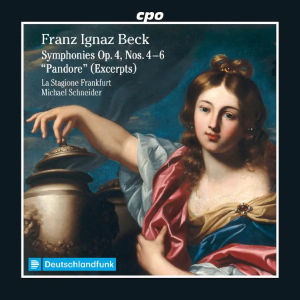
Franz Ignaz Beck (1734-1809)
Symphony in D major, Op. 4, No. 4 (1766)
Symphony in G major, Op. 4, No. 5 (1766)
Symphony in E flat major, Op. 4, No. 6 (1766)
Pandore: Overture (c1786)
La Stagione Frankfurt / Michael Schneider
rec. 2025, Evangelische Festburgkirche Frankfurt am Main, Germany
cpo 555 786-2 [59]
This disc is the fourth and final part of a project by the cpo label – pursued sporadically since 1995! – to record the twelve ‘mature’ symphonies by Beck (review of the three earlier instalments here). He was an almost exact contemporary of Haydn, having been born just two years after him, and dying in the same year. But he appears to have written no more symphonies after 1766, when the Opus 4 set was published, and so his total of around thirty works in the genre stem from an early phase in its history.
Although Beck lived and worked for much of his life in France, where these works were composed and published, they clearly display the stylistic influence of the Mannheim school, unsurprisingly given that he had been born and was brought up there. Those traits are on keen display in Michael Schneider’s readings with La Stagione Frankfurt here, particularly in the dramatic crescendi and the high, tense energy they impart to the long tremolando sequences which Beck is fond of writing. Even though the latter may be harmonically static, or even come to abrupt general pauses, the ensemble maintain an almost devil-may-care momentum through the music that looks ahead to the irrepressible vigour of Beethoven’s symphonies, over three decades in the future. The fast triplets in the central section of No. 5’s Presto finale put one in mind of the febrile force of Beethoven’s Second. The upper strings sometimes have a wiry, sharp sonority which also gives an acidulous edge to some passages.
Slow movements maintain tension and contrast of their own, No. 3’s leisurely, elegant Andante with gossamer strings, and the Adagio of No. 5 with warm sounding flutes and horns, and some portamento on wide upward leaps in the violins. No. 4’s is especially striking, with an opening section of spooky sotto voce strings and tinkling harpsichord giving way to a minor key fugue. Like the similar movements which end some of Haydn’s slightly later Opus 20 String Quartets, the strings’ silvery timbre creates a sense of mysterious, pent-up energy which is satisfyingly discharged in the eruption of the following Minuetto.
A few extracts from Beck’s French melodrama Pandore – about the story of Prometheus and Pandora – fill up the disc, the most substantial being a vivid account of its Overture, which precedes three other short movements which were designed to connect scenes of the spoken play. Limited in purpose as this music is, it seems a pity that the whole score wasn’t recorded.
Those who collected cpo’s first three instalments of Beck’s later Symphonies will want to complete the set with this release. Other listeners who are fans of 18th century music more generally will also be rewarded by these Symphonies. They are of above average quality for such works of their time and come from a composer who didn’t feature in Chandos’s symphonic surveys in its Contemporaries of Mozart series, so their exposure here is welcome.
Curtis Rogers
Buying this recording via the link below generates revenue for MWI, which helps the site remain free













