
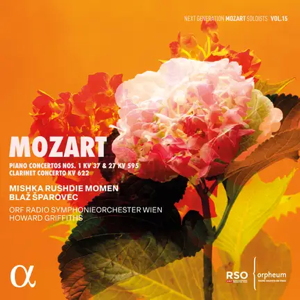
Wolfgang Amadeus Mozart (1756-1791)
Next Generation Mozart Soloists vol. 15
Clarinet Concerto KV 622
Piano Concertos No.1 KV 37, No.27 KV 595
Blaž Šparovec (clarinet), Mishka Rushdie Momen (piano), ORF Radio Symphonieorchester Wien / Howard Griffiths
rec. 2023, ORF Radio Kulturhaus (Funkhaus), Studio 6/Großer Sendesaal, Vienna, Austria
Alpha Classics ALPHA1236 [73]
The “Next Generation” series of recordings on the Alpha label conducted by Howard Griffiths has been generally well received here on MusicWeb; this latest issue presents an intriguing contrast between the first and last of Mozart’s piano concertos, written when he was eleven years old and a few days short of thirty-five respectively, plus an established masterwork in the clarinet concerto, also written in his last year, just a couple of months before his untimely death. It is one of Mozart’s most sheerly beautiful works, showcasing everything which denotes him as a genius, perfect in its tripartite brevity.
Soloist Blaž Šparovec uses basset clarinet with the lower note extension and the warmth and depth of his tone are very satisfying, especially in the opening of the Adagio when he dips into the so-called “chalumeau” register which sounds like a bassoon; in a sense this really allows the instrument to sing because it is equivalent to a mezzo-soprano descending into her lower register. He and Griffiths are a little brisker, in the modern manner, than former exponents such as Thea King and Jeffrey Tate, but so agile and precise, phrasing very musically and never sounding in the least rushed. The Rondo finale is relaxed and joyful, the orchestral accompaniment light on its feet and the direction flexible. The ornamented coda is especially invigorating, exploiting both the player’s dexterity and the range of the instrument.
The little early piano concerto is fifteen minutes of sparkling invention with a driven, moto perpetuo feeling to its opening. The stately central Andante is astonishingly mature in its affect; I particularly like the wistful minor key interlude. Admittedly, Mozart borrowed the main themes from other composers but all three movements are indistinguishable in mood and content from similar movements in much later works.
We leap forward a generation for the last piano concerto and I am immediately struck by the pellucid, tintinnabular timbre of the Bösendorfer employed here; its bell-like tones complement the generally celebratory mood of this recital and reinforce the surprisingly cheerful demeanour of No. 27, whereby a certain serenity prevails over any sense of valedictory melancholy. In a way, that links with the youthful optimism of the first concerto and validates the aptness of the pairing. The Larghetto is played in a disarmingly direct style, disinclined to sentimentality with a minimum of vibrato from the strings and the finale is similarly insouciant with spirited, fluid playing from the soloist. There is, of course, any number of recommendable recordings of this concerto – I favour Gilels, Kissin and Uchida – but within the context of this neatly devised programme, this is an enjoyable as any. The sound is very clear and immediate and the balance perfect.
Ralph Moore
Buying this recording via the link below generates revenue for MWI, which helps the site remain free













