
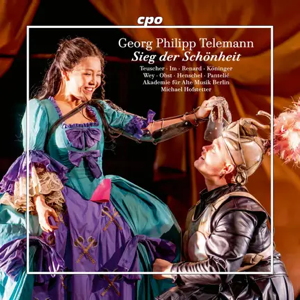
Georg Philipp Telemann (1681-1767)
Sieg der Schönheit, Singspiel in Three Acts (1728)
Lydia Teuscher (soprano): Eudoxia
Sunhae Im (soprano): Placidia
Emilie Renard (mezzo-soprano): Melite
Dominik Köninger (baritone): Gensericus
Akademie für Alte Musik Berlin / Michael Hofstetter
rec. 2024, Viehbörse Magdeburg, Germany
cpo 555 693-2 [3 CDs: 156]
Telemann’s Sieg der Schönheit was his first opera composed after taking on the post of Music Director and Kantor at the Hamburg Johanneum, marking a significant new beginning after a reorganisation for local opera at the Gänsemarkt theatre. Wolfgang Hirschmann’s booklet notes provide plenty of historical context and anecdote around this and the first production of an opera into which Telemann clearly threw all of his energies.
The plots of Baroque opera are almost invariably impossibly convoluted, but without going into too much detail the opera is set at the time of the second sack of Rome by the Vandal prince Genseric in 455AD. Genseric now seeks to win the heart of the Roman emperor’s widow Eudoxia, while his son Honoricus fancies Eudoxia’s daughter Pulcheria. The Vandal prince Helmige has no interest in the affections of the Roman servant Melita, but instead pursues Placida, who is already engaged to the Roman Olybrius. There are plenty of devious plans, disguises, imprisonments and peril, but this is a comic German-language Singspiel which avoids extended Italianate set piece arias and therefore moves along relatively quickly over its three acts, concluding with a resolution of all complications and a happy finale for all concerned.
This recording was made after a well-received production at Theater Magdeburg and appears to be a world premiere on CD of the complete opera. The libretto is not printed in the booklet but is available online via a QR code. There are a few photos that show lavish costumes and outrageous period hairstyles from the March 2024 production during the 26th Magdeburg Telemann Festival, but this recording was made in June of that year. The advantage of this not being a live recording is the lack of footsteps clumping up and down the stage and other noises, though there is an impression of animation and joy in performance throughout, and there is plenty of playing around with the perspective when it comes to the voices so this sound production still retains a ‘live’ feel.
As is to be expected the orchestral accompaniment from the Akademie für Alte Musik Berlin is crisp and alert to period sonorities and is very fine indeed. There is sparing use of trumpets, horns and timpani for tuttis and military effects, but winds and continuo more or less equal the total number of strings so there might be an argument for a little more oomph in that section. This is a minor point however, and the recording is full and packs plenty of punch, inviting you to tweak your volume up to 11 for the full on-stage experience.
Telemann certainly appears to have had good singers at his disposal and all of the cast rise to his challenges. Lydia Teuscher’s high notes as Eudoxia are admirable, as are Sunhae Im’s staccato effects as Placidia in her Act I aria Deiner Wangen Milch und Blut. Anna Willerding is given some impossibly long lines as Pulcherio but pushes through gallantly. As this is comic opera the men are typically dopey, with plenty of heroic pretensions that convince no-one. All of these personalities are well portrayed and the acting is distinctive. Tenor Ludwig Obst as Helmiges can be a bit shouty but this suits the entitled arrogance of his character, and the bass of Johannes Stermann as Trasimundas is suitably weighty, but it is the female voices that carry most of the dramatic force of this opera. Telemann’s instinct for good theatre means there are enough contrasts to keep us engaged, with occasional tender ariosa moments of beauty, recitatives that don’t go on for too long. Effective use of the orchestra keeps everything floating along on well-oiled wheels towards the gathering together of all narrative threads by the final celebratory chorus.
With expert and passionately involving performance, superb recording and a nicely presented and well documented box set there is very little to criticise about this significant release. All fans of good period opera should acquire it without hesitation.
Dominy Clements
Other cast
Marko Pantelić (baritone): Olybrius
Anna Willerding (soprano): Pulcheria
Terry Wey (countertenor): Honoricus
Ludwig Obst (tenor): Helmiges
Johannes Stermann (bass): Trasimundus
Dietrich Henschel (baritone): Turpino
Buying this recording via the link below generates revenue for MWI, which helps the site remain free













