
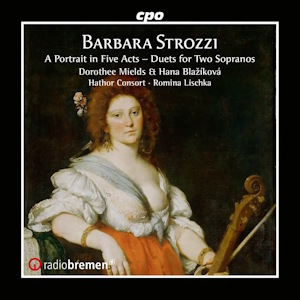
Barbara Strozzi (1619-1677)
A Portrait in Five Acts – Duets for Two Sopranos
Dorothee Mields; Hanna Blažíková (sopranos)
Hathor Consort/Romina Lischka
rec. 2021, Sendesaal Bremen, Germany
Texts and translations included
cpo 555 510-2 [81]
The recent interest in bringing to light the music of nearly forgotten female composers throughout the centuries has yielded a number of pleasing explorations of previously neglected bodies of work. One of the shining names to have been rediscovered is that of the early 17th century musician and composer Barbara Strozzi. Despite her status as an illegitimate female child, her wealthy father, Giulio Strozzi, took a great interest in his daughter’s education. He arranged for her to study composition with the famous Francesco Cavalli when she was only 12 years old. Her natural talent bore fruit under Cavalli’s tutelage, which the ever increasing discography of recordings devoted to her bears witness.
From cpo comes this interesting release of duets which derives from the eight collections of madrigals and cantatas that were published during the composer’s lifetime. A number of these pieces seem to have been intended for a solo voice, if any arrangements have been made the booklet makes no mention of it. Listening to this disc one confronts the pure simple beauty of Strozzi’s vocal lines, which inundate the senses with the listener coming away from the experience feeling both cleansed and refreshed.
A great deal of the credit here is due to the simple, yet beautifully rendered accompaniments by the Hathor Consort, led by Romina Lischka, who also plays the treble and bass viols. Lischka is an experienced and tasteful musician who has impressed me in the past on two significant and unique discs: Fuga Libera’s Call to Prayer (review), and Heinrich Albert’s Pumpkin Hut (released on Ramée – 1913), this last one also with the musicians of the Hathor Consort. On this album the Consort musicians have been transparently recorded by the engineers, the vocalists similarly well-captured in a natural ambience.
The two sopranos here have bright bell-like voices with the capacity to soar gently and sweetly above the staff. The listener will have a hard time trying to differentiate which soprano is which; perhaps a clearly attributed solo or two would have helped in that regard. As it is, the clarity and fresh sounds one hears on this recording make for a refreshing 80 minutes’ worth of listening.
The division of the duets into five “acts” seems arbitrary and rather pointless. The vocal pieces are all similar enough that no such manufactured dramatic grouping is really helpful. In addition there are three examples of instrumental only numbers which appear to have been composed as a vocal piece because the words for two of them have been included in the booklet. Inexplicably there is one piece of music included by another composer, Bartolomeo de Selma y Salaverde (1595-1640). Other than the attribution in the track listing, no mention of this is made in the booklet notes.
There is no doubt in my mind that this is a disc deserving of praise. The generous timing gives the listener much to enjoy. However, sitting through the disc all at once does bring brief periods of monotony at times. I doubt whether these duets would have been experienced all together in the composer’s day. I happily would have had this extended to a second CD for the inclusion of more instrumental numbers to bring more variety to the program. It is because of this that this disc just misses out me giving it a full recommendation. The best way to hear this is broken up over about three listening periods. Yet do not allow this reservation to detract from what an excellent achievement this is, and new chance to acquaint oneself with one of the outstanding female composers of the 17th century. One wishes fervently that more of them had been permitted to flourish.
Mike Parr
Buying this recording via the link below generates revenue for MWI, which helps the site remain free
Contents
L’amante modesto, Op. 1/13
Mercé di voi, Op. 1/1
Lagrime mie, Op. 7/4 (instrumental)
Al battitor di bronzo, Op. 1/18
Begli occhi, Op. 3/9
L’eraclito amoroso, Op. 2/14
Godere e tacere, Op. 1/9
L’amante segreto, Op. 2/16
Il Romeo, Op. 2/13 (instrumental)
Moralità amorosa, Op. 3/2
Sospira, respira, Op. 6/17
Tradimento, Op. 7/9
Silentio nocivo, Op. 1/16
Cuore che reprime: Ardo in tacito foco, Op. 3/1
Dal pianto, Op. 1/21
Susanne un jour, Composed by Bartolomeo de Selma y Salaverde (1595 – 1640) (instrumental)
Libertà, Op. 1/10
Godere in gioventù, Op. 1/12
La vendetta, Op. 2/9
I baci, Op. 2/23













