
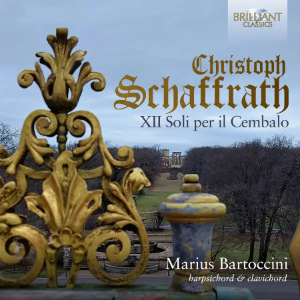
Christoph Schaffrath (1709-1763)
XII Soli per il cembalo
Marius Bartoccini (harpsichord, clavichord)
rec: 2025, Palazzo Annibaldeschi, Monte Compatri, Italy
Reviewed as a download
Brilliant Classics 97415 [135]
A time of change in musical aesthetics is always interesting. Compositions from such a period often mix old and new elements, and composers try to find their own way between them. The decades around 1750 are such a time. There is no lack of specimens of the mixture of styles in the oeuvre of composers who were the contemporaries of the sons of Bach. It is useful to mention them, as they were pupils of their father, and it took much effort to find their own way in composition.
They were all educated in keyboard playing, and so was Christoph Schaffrath. Although he certainly is not one of the ‘mainstream’ composers of our time, he is not an unknown quantity either. His chamber music in particular has been given some attention, and he also figures in anthologies of music written for or performed at the court of Frederick the Great. Schaffrath was already appointed as member of his chapel before Frederick was crowned king in 1740. An earlier attempt to become organist of the Sophienkirche in Dresden had failed, when Wilhelm Friedemann Bach got the job. From 1741 on he shared the position of the court’s harpsichordist with Carl Philipp Emanuel Bach. In this capacity he was surrounded by some of the finest musicians in Germany, like the flautist Quantz, the Graun brothers and the two Bendas, Franz and Georg. In 1744, he entered the service of Frederick’s sister, Princess Anna Amalia, an ardent lover and collector of music.
Schaffrath was a generally respected performer, who not only played as chamber musician at Anna Amalia’s court but also appeared in the homes of the aristocrats of Berlin. Friedrich Wilhelm Marpurg, composer and theorist, wrote about him that he “is known to the world by means of his beautiful compositions well-liked everywhere, some of the pieces written for the keyboard have become widely known in print”. Schaffrath wrote exclusively instrumental music, partly for other musicians at the Berlin court – like the gambist Ludwig Christian Hesse – but mostly for his own use. According to New Grove, Schaffrath composed at least thirteen keyboard concertos, but Marius Bartoccini, in the liner-notes to the disc reviewed here, mentions as many as 72.
The twelve sonatas which he has recorded have not been published and have been preserved in manuscript. That is to say, three of the sonatas are missing (Nos. 8, 10 and 11), whereas the last movement of the Sonata No. 7 in A is incomplete and for this recording Bartoccini completed it. He dates the sonatas between 1745 and 1763.
The time of composition indicates that they are intended for the harpsichord. The fortepiano had not fully established itself yet, and it is no surprise that the scores do not include any dynamic indications. However, that does not mean that they can’t be played on a fortepiano – for instance, a Silbermann. Bartoccini plays three sonatas on the clavichord, and that is a nice alternative.
The clavichord was the favourite instrument of Carl Philipp Emanuel Bach, but although they were colleagues, Schaffrath’s sonatas show little of his influence or of the Empfindamer Stil, of which Bach was one of the main exponents. Schaffrath’s sonatas are rather specimens of the galant idiom, which manifests itself in the fact that they are mostly in two parts, and that the left hand is often confined to the role of accompaniment. However, in comparison with other keyboard music in this idiom, Schaffrath’s sonatas show more stylistic variety. Whereas galant sonatas are mostly in major keys, four of the eight extant sonatas are in minor keys (as are three of the six Op. 2 sonatas, recorded by Borbála Dobozy; Hungaroton, 2008). There are also passages where the left hand’s role is elevated and is more than mere accompaniment. It is also notable that all the extant sonatas are in three movements, whereas two movements were most common in galant keyboard music.
In New Grove, it is observed that Schaffrath “also had a marked talent for counterpoint, a skill apparent not only in the occasional fugal movement (…) but also in the disciplined part-writing of orchestral works and in his frequent use of imitation.” These skills also come to the fore in the sonatas recorded by Bartoccini. This aspect of his compositional activities explains why he was engaged by Princess Anna Amalia, who had a rather conservative taste and a preference for baroque counterpoint.
It is interesting that Bartoccini shows some reservation with regard to the character of Schaffrath’s keyboard music. “While his keyboard virtuosity is first-rate, it lacks the metaphysical introspection found in the music of some of his colleagues”. This may well be one of the reasons that it is not given that much attention. However, in the hands of a skilled interpreter, who studies the scores and knows what it takes to bring them to life, it deserves more interest. Bartoccini is such an interpreter. One of the features of his performances is his treatment of tempo and rhythm. He takes quite some liberties, and these, giving the impression of improvisations, make his performances all the more interesting. I certainly would like to hear Schaffrath’s keyboard concertos. In the performances on the clavichord, Bartoccini effectively uses the instrument’s dynamic possibilities in the interest of a speechlike, rhetorical interpretation.
These imaginative performances make an eloquent case for Schaffrath’s keyboard music.
Johan van Veen
www.musica-dei-donum.org
twitter.com/johanvanveen
https://bsky.app/profile/musicadeidonum.bsky.social
Buying this recording via the link below generates revenue for MWI, which helps the site remain free
Contents
Sonata in C (CSWV H:1)
Sonata in A minor (CSWV H:34)
Sonata in G (CSWV H:24)*
Sonata in E minor (CSWV H:17)
Sonata in D (CSWV H:6)
Sonata in B minor (CSWV H:42)
Sonata in A (CSWV H:33)
Sonata in B flat (CSWV H:38)*
Sonata in D minor (CSWV H:8)*
* clavichord













