
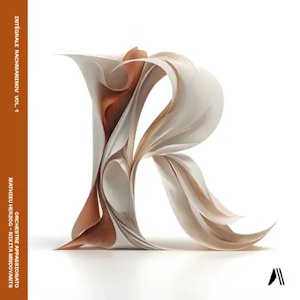
Sergei Rachmaninov (1873-1943)
Symphony No.1 in D minor Op.13 (1895)
Scherzo in D minor (1888)
Piano Concerto No.3 in D minor Op.30 (1909)
Nikita Mndoyants (piano), Orchestre Appassionato / Mathieu Herzog
rec. live, December 2025, La Seine Musicale, Paris, France
Appassionato APP008 [2 CDs: 87]
Here is the first recording in a series devoted to Rachmaninov’s orchestral output. Each release, derived from live concerts, will appear on Orchestre Appassionato’s own label. Strikingly, this is a chamber ensemble of about 40, while Rachmaninov’s symphonies usually require a full symphonic band. The photo of the orchestra at the concert suggests that it has been enlarged for the occasion, but the booklet does not mention augmentation. I make this point because the promotional material says: “Appassionato champions an approach to ensemble playing rooted in precision, clarity and mutual listening”. That is harder to achieve with an orchestra of 80, where half of the players are not regulars. The approach is further exemplified by a paragraph which describes conductor Mathieu Herzog’s attitude to Rachmaninov’s music.
“He approaches each score as a living narrative […] With Rachmaninov, he seeks an emotion that is sincere and free of excess: clarity beneath density, breath beneath form. Founder of Appassionato Orchestra, he imagines collective music-making as a space for dialogue, where each musician contributes to a shared colour and musical intent. He has conceived this Rachmaninov cycle as a way of sharing an artistic legacy, offering the public a sensitive and lucid reading – at once faithful and free.”
Rachmaninov wrote the filler here, Scherzo in D minor, when he was around fourteen. The work, which scurries along at a fair lick, might have been inspired by Mendelsohn’s Midsummer Night’s Dream. Unsurprisingly, it bears no resemblance to such early works as Prince Rostislav of 1891 or Caprice bohémien of 1894. Of the latter, Rachmaninov said in 1908 that just thinking about it “scared him”. It is interesting to speculate what he would have thought about his childhood Scherzo on an international record release. Mathieu Herzog’s claim – he wants his musicians to listen to each other to help achieve good ensemble – is borne out by their playing in this short work.
The First Symphony has been recorded many times since Eugene Ormandy and the Philadelphia Orchestra made its first LP outing in 1966. It is usually set down as part of a full cycle of Rachmaninov’s orchestral works, as was the case then. This version is quite fleet-of-foot, though it never sounds rushed. It is some three minutes faster than Yannick Nézet-Séguin’s Philadelphia recording (review), and some five minutes faster than Yevgeny Svetlanov’s 1992 recording. Now, I love Rachmaninov’s First. I regard it as his most original utterance, and I have developed very fixed preferences about performance, especially as regards the last movement.
There are two extremes of interpretive stance for this youthful work. Cool objectivity is exemplified by Dmitrij Kitaenko and the Gürzenich-Orchester Köln (review). The no-holds-barred type reaches out to every extreme of emotional pull – consider Yevgeny Svetlanov in his two Russian recordings.
The symphony is a young man’s work, full of emotional extremes. A reinterpretation from a middle-aged, rationalist standpoint runs the risk of partially neutralising the piece and diluting its effect. Kitaenko does just that, and succeeds in making the work boring, despite the superb recording and fine orchestral playing.
I make no secret of my preference for the Svetlanov school. Technically, his 1966 recording for Melodiya (review) is a typical Soviet effort of the period, harsh, upfront and barely able to cope with the intense climaxes. Yet the performance has such an overwhelming effect that I can easily forgive the engineering shortcomings – not something I do often.
Svetlanov’s 1992 successor, in a set of all three symphonies (review), has much better sound and the orchestra still sports the authentically raucous brass. Svetlanov has become a little more mannered, his interpretation slower. Even so, the lead-up to the coda is tremendously exciting, and the coda is crushing in its doom-laden impact – no gentle stroking of the tam-tam here. This performance again demonstrates totally committed music making!
My fears that Orchestre Appassionato might be under-powered were soon laid to rest. The weighty brass growl impressively in the opening bars. During the languorously oriental second subject of the movement, the strings are firm, full and unanimous, as they are during the fugal development section. At the climax of the development, the horns and trombones have a suitable effect in their marching rhythm. The whole of the first movement is very finely, at times excitingly, executed.
The scherzo second movement unusually dispenses with a contrasting trio: the central section is derived from the themes of the first movement. I have read that it has been admiringly quoted as anticipating Shostakovitch. Such a thought had never occurred to me, but in any case I have never found this movement to be an attraction in itself. The same holds in this performance, finely performed though it undoubtedly is.
The Larghetto slow movement contains one of Rachmaninov’s most beautiful melodies. Unlike the melody in the corresponding movement in the Second Symphony, he does not give it the full hyper-romantic string sound that made it so popular in André Previn’s first recording with the LSO (review). Instead, the lovely melody sounds almost chaste, and it certainly comes across that way here. It first appears on the clarinet, and is accompanied by two cellos when it reappears.
Rachmaninov’s music has often been performed with cuts, some sanctioned by the composer. He never got a chance to recommend cuts in this work. Had he been able to do so, I suspect that the middle section of this slow movement would have been a candidate. Long and gloomy, scored for lower strings and brass, it disrupts the piece.
And so, to the last movement. It must have sounded very advanced for its date, which probably contributed to Cesar Cui’s famed splenetic review. The opening Russian dance, colourfully scored, first alerted me to this symphony: in the 1960s, it was the theme for Panorama. I remember writing to the BBC to ask them what it was. I also remember I was annoyed to discover that the only available recording was the full-price Ormandy on CBS.
I wonder what would have happened had Rachmaninov decided to revise this movement. The sheer ferocity and rhythmic licence that he allows himself does not reappear until his final works, so maybe it is good that he did not set about a revision. There is a lovely string melody and the dramatic content. Eventually, the music reaches an excitingly driven climax capped by a loud stroke on the tam-tam, and then the symphony’s superb coda begins. It this crushing largo, the slow peroration involves a repetition of the work’s “vengeance” motif accompanied by the tam-tam to apocalyptic effect and ending in deep thuds on the bass drum. The balance of the tam-tam with the rest of the orchestra is just right. It is not so loud that it overwhelms everything else, and not so soft that the listener has to strain to hear it.
Like the rest of the performance, this movement is carried off with aplomb. The orchestra play with commendable precision and togethernes; Mathieu Herzog has clearly worked with them to achieve such results. They can easily stand alongside more established ensembles in what is quite a crowded field.
The second disc comprises the Piano Concerto No.3 with Moscow-born soloist Nikita Mndoyants, who won the prestigious 2016 Cleveland Competition. The brief biography says: “he seeks above all dialogue – an organic exchange with the orchestra, far from any form of display. His artistic rapport with Mathieu Herzog is grounded in a shared conviction: That of a Rachmaninov who sings, who is structured and profoundly human.”
I am inclined to think that any pianist who can perform Rachmaninov’s Third Concerto must indulge in display to some degree. Take the first-movement cadenza, which has always sounded to me to be an integral part of the movement, and which rises to a vertiginously difficult peak. It is beyond me how anyone could perform it to the sort of technical standard expected of today’s virtuosi without effecting pianistic display. As is nearly always the case nowadays, Mndoyants chose the shorter of the two cadenzas Rachmaninov composed.
Mndoyants presents the whole work competently. His undoubted technique allows him to shade the quieter moments with delicacy. He plays the more clangourous parts with no sign of strain or loss of clarity. He is aided by the really excellent live recording. It balances the piano and orchestra without giving the piano the sort of exaggerated presence sometimes employed to make the performance seem more exciting.
The slow movement has a fine sense of flow. Herzog navigates with grace the rise and fall of the lovely, elegiac opening melody. The entry of the piano is as unexpected as it is abrupt. As the piano takes centre stage, Rachmaninov generates an astonishing fount of melody derived from the opening bars of the movement. The piano rides the waves of sound, as if encouraging even greater streams of melody from all concerned. At the end of this passage, Rachmaninov has inserted a waltz-like section, whose discreet melody is given to the orchestra, with piano decorations. Mndoyants shows his sensitivity here, because it is easy for the soloist to overcome the orchestra if they play in too muscular a fashion.
The last movement crowns what is surely the ultimate in romantic virtuoso piano concertos. As such, it survived the anti-romantic movements of the fifties and sixties of the last century, when many academics and critics could not bring themselves to mention Rachmaninov without a dismissively sneering cast to their tones. Mndoyants executes the lead-in to this movement with poise, negotiating what follows with the necessary mix of power and musicality. It is easy for the listener to get carried away by the exultant waves of sound, as the Rachmaninovian melodic fountain pours forth. For all the booklet claims that the soloist eschews pianistic display, I would probably have enthusiastically applauded as much as anyone present. (I heard no other audience noise throughout the two discs.)
The booklet in the gatefold cardboard sleeve is in French and English, with no biographical information about Rachmaninov and little about the structure of the music. Instead, we get high-flown sentiments about artistic aims and vision, some of which I have included in this review.
Jim Westhead
Buying this recording via the link below generates revenue for MWI, which helps the site remain free














Could I point out that Ormandy’s 1966 recording of Rachmaninov’s First Symphony was not its “first outing on LP”, nor even the first in the west. On MWI itself, the Michael Herman discography lists a 1959 recording by Kurt Sanderling and the Leningrad PO. This is currently available from Forgotten Records, which also gives the date as 1959. There was apparently also an earlier recording by Sanderling and the Leningrad PO, made in the late 1940s not long after the reconstruction of the score. This can be heard on YouTube. Whether or not the two recordings are actually different, it/they demonstrably predate(s) the Ormandy. Nevertheless, I am just old enough to remember the stir caused by the Ormandy when it was issued. Melodiya recordings were hard to come by this side of the Iron Curtain but I recall at least one critic feeling that Ormandy cossetted the work unduly in comparison with Sanderling.
Moreover, the Herman discography also lists a 1951 recording by Jacques Rachmilovich and the Swedish Radio SO. This, too, is available from Forgotten Records. Herman lists various early issues (Mercury, Decca, Metronome) though I doubt if they stayed long in the catalogue. The 1955 Record Guide, for example, lists no recording of this symphony (or of the Second, for that matter).
I suppose none of these will be competitive today in sonic terms but thanks to Forgotten Records they are readily available for those interested in the early recorded history of this symphony.