
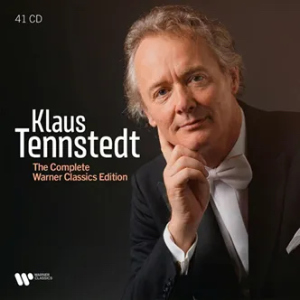
Klaus Tennstedt (conductor)
The Complete Warner Classics Edition
London Philharmonic Orchestra, Berlin Philharmonic,
Chicago Symphony Orchestra, Royal Concertgebouw Orchestra,
NDR Symphony Orchestra/Klaus Tennstedt
rec. live & studio 1977–92
Warner Classics 2685420144 [41 CDs]
The first thing to note is that most of the recordings here were previously released by EMI in two box sets: the complete Mahler symphonies, and Klaus Tennstedt: The Great EMI Recordings both of which I reviewed back in 2011 (see the links for both my responses and more details about the dates and locations). I was, in general, very convinced by and enthusiastic about Tennstedt’s readings; obviously there is the occasional caveat but I stand by my endorsement of the “Great Recordings” box as “a superb introduction for the novice to some of the cornerstones of the Romantic classical canon” and the Mahler set as “a wonderful testament to the devotion to Mahler of a conductor who came late to the composer but brought to his music the mature fruits of his own mental and bodily suffering.”
Furthermore, there are some additions to this new issue which were not in the 14-CD “Great EMI Recordings” box, and these are asterisked in the contents-by-composer list beneath this review. Nor did the Mahler box contain the “Songs from Des Knaben Wunderhorn” which is now given here. The most notable additions are the piano and violin concertos by Beethoven, Brahms Schuman and Bruch and the vocal Wagner excerpts with Jessye Norman (see PCG’s review). In my own review, I deemed that last collaboration as not the happiest or most successful of outings for either artist; indeed, my verdict was that “Tennstedt’s accompaniments to Jessye Norman’s Wagner recital album of the same era were uninspired.” However, see below under CD 12: I am now happy to ingest a large slice of humble pie and retract my former disdain.
Some of the earlier, analogue recordings such as the two Bruckner symphonies and the live Mahler recordings here have been remastered either by Warner Japan, as have the Grieg, Schumann and Brahms piano concertos by Art et Son in Paris. I comment on their sound below. All this for around a hundred pounds – not bad.
Certainly, I was intrigued to discover whether my responses had changed in the fifteen-year interim since I reviewed those two box sets; the practical problem for the reviewer such as I, is trying to listen to 41 discs and write a critique within a reasonable time-frame, so I must admit to having only dipped in to some recordings, especially as this has already been released and I wanted to give readers an overview as soon as possible.
To begin at the beginning, with the live Eroica from 1991 on the first disc, it is very driven and concentrated, without the exposition repeat, and I love the way the orchestra digs into phrases. The funeral march is very stately; the grim determination of the Scherzo is relieved by the bucolic horn Trio; the tripping fantasy of finale further lifts the mood as the LPO plays with lift and delicacy in the fugal and contrapuntal passages but the coda is fast and furious. Deserved applause is retained but otherwise there is no audience noise. The disc is capped with an account of A Night on a Bare Mountain which is similarly energised despite being studio-made, not live. The second disc contains studio recordings of the Eighth Symphony and the Pastoral and the third a medley of overtures; having relistened I have nothing to add to my first assessment: “the former is light, sprung and joyful, the latter weighty in traditional mode. Similarly, I find no fault with the overtures which seem to me to be models of concentrated propulsion.” I am particularly picky about performances of Egmont, my favourite overture, and have never found one to rival Kurt Masur’s with the Gewandhausorchester Leipzig, but this comes as close as makes no difference (and I love the electric storm cover).
Staying with Beethoven, CD 4 contains a live performance of the violin concerto from the Concertgebouw coupled with a studio recording of the Bruch. My esteemed colleague Jonathan Woolf was less than impressed back in 2008 (review); on the other hand Ursula Sagar reviewing the year before was much more enthused. At the risk of caricaturing the very British virtues of tolerance and diplomacy, I can see both sides and suggest that this is primarily a matter of taste – as is so often the case with this imprecise business of reviewing. I certainly do like Tennstedt’s commitment to bringing out the drama of the orchestral role; he is never a mere accompanist and I like Chung’s slim, shimmering tone and very “vocal” manner; nor do I mind the admittedly particularly slow and “sentimentalised” approach she and Tennstedt take to the Larghetto – although again, I can understand finding it excessive.
The Bruch concerto is considerably shorter and indeed more classically proportioned, the whole thing taking about the same time as just the first movement of Beethoven’s. My impression of Chung’s playing here is that she is freer and more impulsive, with more dynamic variation and a darker timbre than in the Beethoven – and I like it. The finale has a gypsy wildness and freedom on the part of both soloist and orchestra. The sonority of the LPO is remarkable and again, Tennstedt is an equal partner, not relegated to the back seat. Again, my colleagues are split, although both find faults which do not bother my less refined ears.
It is interesting to move directly to the same Beethoven work played by a very different soloist in Nigel Kennedy. It begins, unusually, with the orchestra tuning up and entrance applause. Tully Potter’s notes quote Tennstedt’s approbation of Kennedy: “I love that boy. He has ways of bringing out the dark, damnable side of music” – and the soloist is certainly quite indulgent in his tempi, taking nearly two minutes longer than Chung in the Larghetto so at least we aren’t saddled with two similar interpretations – and he lends it a mesmeric quality. There is no gainsaying Kennedy’s technical expertise or his commitment to a specific artistic vision; he is freer, less “classical” than Chung with a grainier tone and I enjoy both equally. The two Bach partitas are superb – and nothing to do with Tennstedt, obviously, just a great bonus.
The sixth CD gives us a very driven and emotive Schubert Great C-major symphony; the strings are constantly pushing on, the brass is very prominent and blaring. Tennstedt is not concerned with classical balance but more with drama. The second movement is similarly grim and dark and the Scherzo hardly exudes Viennese charm, while the finale is almost hysterically animated; it is certainly exciting even if it isn’t conventional – and the coda is electric.
CD 7 contains studio recordings of two indisputable masterpieces by Schumann: his Third Symphony, given here a performance to vie with Bernstein’s VPO account and the wonderfully exhilarating Konzertstück for four horns which remains the most recommendable recording; the BPO horn quartet is phenomenal. CD 8 gives us Schumann’s mighty Fourth Symphony coupled with Mendelssohn’s Italian Symphony, the stately magniloquent introduction of the former setting the tone for a flawless delivery of the whole, and the latter all quicksilver elegance.
The recording of the classic pairing of the Grieg and Schumann piano concertos on the ninth CD was new to me. They are both typically intense and turbulent, given symphonic weight over crystalline lyricism; if you like them traditionally grand and muscular, as I do, you will be well content – unless you seek a lighter, more transparent interpretative stance. Having said that, I find the treatment by Gutiérrez and Tennstedt of the Adagio in the Grieg to be highly sensitive and poetic with no hint of bombast. The remastered sound is remarkably clear and vivid.
CDs 10, 11 and 12 present all the Wagner excerpts. In my previous review, I say that the “disc of overtures and preludes is markedly more exciting than the disc of orchestral excerpts from the Ring. The playing in the latter is sometimes a tad stodgy” and considered his partnership with Norman “uninspired”. I was keen to re-hear those to ascertain whether those impressions would still obtain. I was perhaps too focused on the supposed faults of just the last track but I still do not find these extracts especially stirring – and the transition at 3:57 from the dawn music to the “Rhine Journey” in the Götterdämmerung is very clumsily and abruptly managed. I like Tennstedt in virtually everything here except for these Ring set pieces; I find that conductors such as Celibidache, Reiner and Szell generate much more tension and excitement in them than Tennstedt’s stolid renderings and I still consider the other Wagner overture disc superior. Revisiting the third disc with Jessye Norman has been interesting in that I am newly impressed by the numinous playing of the LPO in the Prelude to Tristan und Isolde and the way Tennstedt builds it over a long arc. I also like very much Norman’s sumptuous vocalism in the “Liebestod”; the climax is vocally and orchestrally immense. I certainly find myself warming more to the other numbers, too – perhaps with these artists having departed we now value them all the more but there is no getting away from the fact that things like “Elisabeth’s Prayer” from Tannhäuser are too placid despite the splendour of the vocalisation. Senta’s ballad is also too stately but the singing is marvellous and it’s a bonus to have the Ambrosian Opera Chorus as choral back-up; again, I am now inclined to respond much more generously to it. The central and longest item, however, is Brünnhilde’s “Immolation Scene” – and my goodness, the singing is something else, as is the playing of the LPO. We simply have no singer today who can match Norman for amplitude, security, beauty and even of tone throughout from her burnished lower register to her shining top B-flat. Tennstedt is a most attentive and considerate accompanist but unafraid to let the orchestra off the leash for the big moments despite the steadiness of his beat throughout. The apotheosis is glorious.
Bruckner and Tennstedt is essentially a match made in heaven and the two symphonies on CDs 13 (No. 4) and 14 (No. 8) are wholly satisfying. I designated his 1989 recording of the 1881 version of the Fourth with the LPO as one of my recommendations in my Bruckner Shortlist but I could just as easily have nominated this one with the BPO – indeed, Tim Perry speculates as much in his approving review of the EMI Gemini twofer containing both these symphonies and I refer you to his astute comments. For Tennstedt, playing Bruckner was always a spiritual journey of agony and ecstasy and the remastered sound quality complements his dedication.
Tennstedt’s studio recording of Brahms First Symphony on CD 15 is marginally more deliberate than my favourite live performances by Karajan in London and Ozawa with the Saito Kinen Orchestra but its weight and intensity are compelling, even if some understandably prefer his later live recording with the same orchestra which benefits from a little more spontaneity and release. CD 16 gives us a mighty, large-scale recording of Brahms’ Piano Concerto no. 1, very well remastered by Art et Son such that one would hardly think it wasn’t digital. As witnessed by all the Brahms recordings here, Tennstedt was always an infallibly inspired conductor of his music – as long as you favour really trenchant, “symphonic”, big-boned interpretations rather than a more delicate, “chamber-music” affect – and pianist Garrick Ohlsson clearly buys into that approach, playing with dark, emphatic tone, heavy on the left hand and always suggestive of a dark, brooding masculine strength and psychological turmoil. The Adagio is gravely melancholy, the finale grimly persistent such that the triumph after the glittering cadenza is hard won.
Just as we have two recordings of the Beethoven violin concerto, on CDs 17 and 18 we are given two of Brahms’ masterwork in that genre, separated by eleven years and performed by two very different soloists. Kennedy’s playing is noticeably more lyrical and spacious than Ulf Hoelscher’s in the first movement by three minutes and his tone much richer and warmer, with a wider tonal palette. Similarly, Tennstedt feels like much more of a presence in the later recording, the digital sound, too, is much more “present” and the LPO plays with more upholstered, seductive tone than the rather dryly and remotely recorded NDR SO. In truth, I cannot see myself ever reaching for the Hoelscher recording when I have the option of Kennedy – but then again, I am a devotee of the lush “Anne-Sophie Mutter” sound over more astringent practitioners. Hoelscher plays the Adagio nicely, but Kennedy’s somewhat more spacious account is sublime – however, some might prefer the more nasal, characterful, but uncredited oboist in the German performance to David Theodore’s smoother, more conventional tone in London.
I spent some time in my original review outlining the virtues of Tennstedt’s Brahms Requiem on CDs 19 and 20, so do not propose to elaborate further beyond quoting my findings here:
“…amongst the most daringly slow items here is the Brahms Requiem, which takes risks with etiolated tempi but stays this side of the stodginess that mars Rattle’s account with the BPO. I think it’s a grand interpretation, far preferable to Gardiner’s perkiness and in the tradition of Klemperer, Previn and – my favourite versions – Karajan. As is so often the case with Tennstedt, the metronome will tell you that the speeds are abnormally slow yet he injects momentum and tension when required. A key point for me is “Aber des Herrn Wort” which takes off as it should and the contribution of the two soloists is superb: both Jörma Hynninen and Jessye Norman have big, V8 voices whose majesty and might suit Tennstedt’s sepulchral conception.”
Waltraud Meier’s Alto Rhapsody does not compete in terms of vocal trenchancy to versions by Janet Baker, Kathleen Ferrier or Christa Ludwig but the Schicksalslied is beautifully performed, rather more spaciously than is usual.
On CD 21 is a warhorse, Dvorák’s “New World” symphony, given what I called a “marvellously fluid and flexible performance.”
CDs 22 to 38 are all Mahler; I have already reviewed, as per the link above to the Mahler box set, the studio recordings of symphonies 1 to 9, Das Lied von der Erde and the live recordings of symphonies 5, 6 and 7; I have no reason to revise my comments so shall just make a few supplementary observations and leave it there.
There were initially complaints from some quarters regarding the sound of the studio recording of No. 1. It is the earliest recording here and analogue; it was remastered by Warner Japan in 2020 and now sounds fine to me. The live 1990 performance from Chicago was similarly remastered in 2024 and also sounds good, although the improvement means that the occasional cough is more apparent. I briefly commented on it in my review of the “Great Recordings” box and reproduce those comments here, as I stand by them:
“…I can understand doubts about the live Mahler symphony. This extends some five or six minutes beyond the norm – although some of that is vociferous applause at the end. Tennstedt uses the extra time to underline a coarser, more menacing mood than he evoked in his more delicate 1978 recording, yet the climax of the fourth movement is heroic, giving full scope to the Chicago brass, and the audience reaction is appropriately enthusiastic. This account by no means bored me and I suspect its measured majesty will grow on me with time.”
I confess to not having revisited it often enough since to test the last speculation but having done so now, I feel the same.
I did not mention in that earlier review the late Edith Mathis’ lovely contribution to the final of the “Resurrection” symphony, matching Doris Soffel for poise, purity and steadiness; revisiting it has reminded me how ringing and magnificent is the peroration of that recording. Sample the last five minutes to hear what I mean; the choir is inspired. I expressed some disappointment at Ortrun Wenkel’s contribution to the Third and her basic tone remains, to my ears, “ordinary” – but she will do. Regarding preference for the live or studio Fifth, the remastered sound of the later, live performance might have given it the sonic edge, especially as the studio recording seemed slightly duller – but that, too, has been remastered and I can only say that both are wonderful accounts. Both performances of the Sixth and the Seventh are very fine although a few slips involving some cracking of the trumpets in the live performance of the former might irk some listeners.
I have long found the Ninth Symphony here to be a comparative weakness in this set and wanted to check that verdict. In my original review, I write, “It is a big, grand, gloomy account which lacks Bernstein’s élan and often simply goes slack. Rhythms lose the pulse and despite some glorious playing and impressive moments, the conception is too diffuse and the momentum stalls.” Having listened recently to several very successful recordings of this symphony by such as Bychkov and Bertini, both of whom take longer than Tennstedt’s 86 minutes, at 87 and 89 minutes respectively, I am now less inclined to find fault with Tennstedt here and have perhaps acquired more patience with, and tolerance for, the application of a Brucknerian type of “heavenly length” (excuse the amalgam of sources) to Mahler’s Ninth. I should, however, also point out Warner have adopted the same strategy as Pentatone of putting well over eighty minutes of music on a single CD – and some equipment will not tolerate that, refusing to play the fourth track.
The Des Knaben Wunderhorn songs on CD 38 are a new addition but by now an established classic. Weikl and Popp are in best voice and characterise vividly; Tennstedt’s accompaniment is fierce, bold and released. It is here where texts will most be missed if you are not familiar with the poems set. Weikl is not afraid to break the line and interject expressive effects for dramatic purposes, as after all, these are folk songs not Lieder, and it is particularly good to have another souvenir of Popp’s unique timbre and manner, as she was taken far too young.
CD39 is all-Strauss: Also sprach Zarathustra and Don Juan. I praise the former in my survey thus:
“Given that this is early digital, the sound here is really good: the acoustic is broad – what I hear as more “concert hall sound” rather than spotlit. The sonority of the organ in the opening fanfare is particularly impressive and at true pitch. Furthermore, Tennstedt’s manner with it is one of the closest to that of Strauss himself and Karajan, although overall the performance is somewhat slower than theirs at 35 minutes and I find myself wishing for a little more momentum than the prevailing sense of dreamy mysticism Tennstedt creates. The playing of the LPO is superb – really rich and dense in textures; they were soon to become “his” orchestra, as he succeeded Solti the following year after this recording and it was a mutual love affair resulting in some wonderful concerts and studio recordings. You might prefer Tennstedt’s patrician manner with this music; he accentuates its “spiritual” aspect – and given its philosophical basis that must be valid as an approach. The playing of the opening of “Von der Wissenschaft” is preternaturally ppp but the dynamic contrasts Tennstedt demands are rather effective – and different. The climax of “The Convalescent” is grand, ponderous and massive but its second half and “Das Tanzlied” are playful and sparkling, so this is by no means a uniformly sententious interpretation. As you might expect, the conclusion is ethereal.”
I should add that he is also one of those conductors more faithful to the score in his rendering of the opening blast; again, I quote from my survey, this time from the introduction:
“After the grumbling three-note figure of a low-C rising a fifth to G then to top C, signalling the “Nature motif”, there is a little accented semiquaver/sixteenth note E before the E-flat. Some conductors emphasise and elongate it, so we hear “DAH-daaah”, whereas others, like Karajan and Tennstedt, are more faithful to the letter of the score and we hear a much shorter E with almost equal weight on the two notes.”
Don Juan is given a thoroughly animated performance, the love interlude tenderly played and the suspenseful passages full of tension.
The penultimate disc in this set contains more Strauss: Four Last Songs and Tod und Verklärung. I assessed the former in my survey and quote that verdict here as I have no reason to revise it:
“I owned this recording many years ago on vinyl and did not prize it then as much as I should have and now do; I was under the spell of versions by Janowitz and Norman but now better appreciate Lucia Popp’s gleaming, glittering soprano. It is true that her words are not always distinct, she occasionally indulges in the little “squeezing” mannerism that marred her attack on certain notes and her voice is at times just a shade light and fluttery for the biggest moments but the music lies well within her capabilities despite her being a lighter, lyric soprano – and the most important things in the singing of Strauss, a sustained legato and sense of line, are wholly intact.
Furthermore, we have the inestimable advantage of Klaus Tennstedt directing his own orchestra, the London Philharmonic, who play most sensitively, sharing Popp’s feeling for the ebb and flow of this glorious music without indulging in any overt pulling about of its shape, despite the comparative leisureliness of his tempi.”
Tod und Verklärung is given a performance both subtle and energised by turns; the opening is delicate and lyrical, the succeeding tempestuous passage notable for the contribution of the timpanist. Tennstedt is daring in his use of rubato and the music flows with organic freedom. This is expansive at twenty-six minutes but also driven and the chorale climax at 13:30 is magnificent, as is the mighty and mysterious concluding apotheosis. The playing by the LPO rivals Karajan’s BPO for breadth and splendour and the digital sound is especially well balanced and satisfying.
The cube box and booklet wrongly designate the apt pairing of the Kodály and Prokofiev recordings on the final disc as live but they were studio-made, in Abbey Road. The music here represents something of a departure from the prevailing 19C Romantic and early 20C late-Romantic fare central to Tennstedt’s repertoire but it is vividly played and recorded, even if some find him too serious and weighty in what are essentially often spiky and even ironic works – but Kodály’s opera from which the suite is drawn treats folk hero Háry János affectionately rather than satirically and the music of the Lieutenant Kijé Suite is certainly given a lighter touch than the Kodály, bringing out Prokofiev’s melodic invention and sparkling orchestration, and I detect no lack of wit or charm.
Documentation is minimal: the CD listings, an introductory note by Tully Potter translated into German and French and some black and white photos are all that is provided – no texts for Brahms’ Requiem, Alto Rhapsody and Schicksalslied, the Wagner excerpts sung by Jessye Norman, Mahler’s Third, Fourth and Eight symphonies or Strauss’ Vier letzte Lieder – the usual parsimonious cheeseparing.
If, like me, you already owned the two box sets referred to in my introduction, this new set – available at a very reasonable, but still considerable, outlay – will not be worth acquiring unless you are desperate to consolidate and free up a little more shelf space, especially as the additional, re-mastered items can be bought separately for less. However, if you are new to the genius of Tennstedt, or lacking a collection of his oeuvre containing seminal Romantic repertoire, this represents a very desirable purchase.
Ralph Moore
Buying this recording via the link below generates revenue for MWI, which helps the site remain free

Contents
Johann Sebastian Bach:
Violin Partita No. 3 in E Major, BWV 1006: I. Preludio (live)*
Violin Sonata No. 3 in C Major, BWV 1005: IV. Allegro assai (live)*
Nigel Kennedy (violin)
Ludwig van Beethoven
Symphony No. 3 (“Eroica” – live),
Symphony No. 6 (“Pastoral”)
Symphony No. 8
Violin Concerto Op. 61 (two live recordings)*
Kyung-Wha Chung (violin) & Nigel Kennedy (violin)
London Philharmonic Orchestra
Fidelio Overture
Leonore Overture No. 3
Creatures of Prometheus Overture
Coriolan Overture
Egmont Overture
London Philharmonic Orchestra
Johannes Brahms
Symphony No. 1
London Philharmonic Orchestra
Piano Concerto No. 1*
Garrick Ohlsson (piano)
London Philharmonic Orchestra
Violin Concerto (two recordings)*
Nigel Kennedy (violin) & Ulf Hoelscher (violin)
London Philharmonic Orchestra
Ein deutsches Requiem
Jessye Norman (soprano) & Jorma Hynninen (baritone)
London Philharmonic Choir; BBC Symphony Chorus
London Philharmonic Orchestra
Alto Rhapsody*
Waltraud Meier (mezzo-soprano)
Schicksalslied*
London Philharmonic Choir
London Philharmonic Orchestra
Max Bruch: Violin Concerto No. 1*
Ulf Hoelscher (violin)
NDR Symphony Orchestra
Anton Bruckner
Symphony No. 4
Berlin Philharmonic
Symphony No. 8
London Philharmonic Orchestra
Antonín Dvořák: Symphony No. 9 “From the New World”
Berlin Philharmonic
Edvard Grieg: Piano Concerto*
Horacio Gutiérrez (piano)
NDR Symphony Orchestra
Zoltán Kodály: Háry János Suite
London Philharmonic Orchestra
Gustav Mahler
Symphony No. 1
Symphony No. 2
Symphony No. 3
Symphony No. 4
Symphony No. 5
Symphony No. 6
Symphony No. 7
Symphony No. 8
Symphony No. 9
Symphony No. 10 (Adagio)
London Philharmonic Orchestra
(see my earlier review for details of singers and choirs)
Live recordings of Nos. 1, (Chicago Symphony Orchestra) 5, 6 & 7 (London Philharmonic Orchestra)
Das Lied von der Erde
Agnes Baltsa (mezzo) & Klaus König (tenor)
London Philharmonic Orchestra
Songs from Des Knaben Wunderhorn*
Lucia Popp (soprano) & Bernd Weikl (baritone)
London Philharmonic Orchestra
Felix Mendelssohn: Symphony No. 4 “Italian”
Berlin Philharmonic
Modest Mussorgsky: A Night on a Bare Mountain (orch. Rimsky-Korsakov)
London Philharmonic Orchestra
Sergei Prokofiev: Lieutenant Kijé Suite London Philharmonic Orchestra
Franz Schubert: Symphony No. 9 “Great”
Berlin Philharmonic
Robert Schumann
Symphony No. 3 ‘Rhenish’
Symphony No, 4
Berlin Philharmonic
Piano Concerto*
Horacio Gutiérrez (piano)
NDR Symphony Orchestra
Konzertstück for Four Horns and Orchestra
Norbert Hauptmann, Manfred Klier, Christopher Kohler, Gerd Seifert (horns)
Berlin Philharmonic
Richard Strauss
Also sprach Zarathustra
Don Juan
Tod und Verklärung
Vier letzte Lieder*
Lucia Popp (soprano)
London Philharmonic Orchestra
Richard Wagner
Orchestral excerpts and scenes from:
Die Walküre:
Ride of the Valkyries
Wotan’s Farewell and Magic Fire Music
Götterdämmerung:
Dawn and Siegfried’s Rhine Journey
Siegfried’s Death and Funeral March
Das Rheingold – Entry of the Gods into Valhalla
Siegfried – Forest Murmurs
Tannhäuser: Overture
Rienzi: Overture
Lohengrin:
Act 1 Prelude
Act III Prelude
Die Meistersinger von Nürnberg – Act 1 Prelude
London Philharmonic Orchestra
Tristan und Isolde*
Act I: Prelude
Act 3: Liebestod “Mild und leise wie er lächelt” (Isolde)
Tannhäuser
Act II: “Dich, teure Halle, grüß ich wieder” (Elisabeth) [Dresden Version]
Act III: Elisabeth’s Prayer “Allmacht’ge Jungfrau, hör mein Flehen!” (Elisabeth) [Dresden Version]
Der fliegende Holländer,
Act 2: Ballade “Johohoe! Traft ihr das Schiff im Meere an” (Senta, Chor)
Götterdämmerung
Act III: Immolation Scene “Starke Scheite schichtet mir dort” (Brünnhilde)
Jessye Norman (soprano)
London Philharmonic Orchestra
Recording venues
No.1 Studio, Abbey Road, Kingsway Hall, Walthamstow Town Hall, Watford Town Hall & Royal Festival Hall (live Mahler 5, 6 & 7), London; Philharmonie, Berlin; Orchestra Hall, Chicago (live Mahler 1); Groote Zaal, Concertgebouw, Amsterdam (Beethoven Violin Concerto; Chung); Alte Schloss, Kiel (Beethoven Violin Concerto; Kennedy); Friedrich-Ebert-Halle, Hamburg (Brahms Violin Concerto), Germany













