
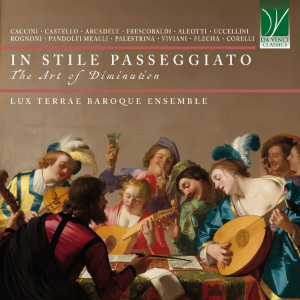
In Stile Passeggiato – The Art of Diminution
Lux Terrae Baroque Ensemble
rec. 2025, Chiesa Sant’Antonio Abate, Vacciago, Italy
Reviewed as a download
Da Vinci Classics C01156 [67]
The art of ornamentation is one of the basic features of pre-romantic music. It was one of the issues which made a fundamental difference between historical and traditional performance practice in the early days of the revival of early music. The importance of ornamentation manifests itself in the many treatises on this subject which were published from the late 16th century until well into the 18th century. In addition, it was an important subject in treatises of a more general content.
From the mid-16th to the mid-17th century a special kind of ornamentation was particularly popular. It has found its way in a genre known as ‘diminutions’, in English also called ‘divisions’ and in Italian ‘passaggi’. One of the writers on this subject was Silvestro Ganassi (1492-1550), who stated: “Diminution is nothing other than the variation of a naturally bare and simple sequence of notes”. The playing of diminutions – and ornamentation in general – was part of the art of improvisation. However, this art needed to be learned, and this explains the many treatises. The instructions were illuminated by melodic formulas to which several diminutions were added, which readers could study and apply to music of their own choice. Most treatises also included complete sets of diminutions on popular tunes or pre-existing compositions, such as madrigals and motets.
In the course of time many recordings have been released which included diminutions that can be found in the various treatises, such as those by Ricardo Rognoni, Girolamo dalla Casa and Giovanni Bassano. A more recent trend is that performers use these treatises for what they are intended for: to create diminutions of their own and this disc is one of those. In the programme written-out sonatas alternate with diminutions on pre-existing vocal pieces of the 16th and early 17th centuries.
There are several kinds of diminutions. The most common is the one presented here, in which the subject is the upper voice of a vocal piece. The longer notes of such a part are broken up into smaller and faster ones, moving around the original line. The liner-notes suggest that this genre was specifically intended for the violin, but that is not correct. This kind of diminutions could be played on any instrument, such as the violin, the recorder, the cornett or a plucked or keyboard instrument. As the Lux Terrae Baroque Ensemble consists of violin (Neyza Copa), cello (Issei Watanabe) and keyboard (Gabriele Marzella, playing harpsichord and organ), the violin takes central stage. In Flecha’s Alza doglioso it is the cello that plays the diminutions.
The nice thing about this practice is not only that treatises are used according to the intentions of the authors, but also that the subjects of diminutions are often different from what we find in the treatises. Some pieces were very popular, such as Cipriano de Rore’s madrigal Ancor che col partite and Palestrina’s madrigal Vestiva i colli. Here we have different pieces that are taken as subjects for diminutions. I cannot remember having heard Arcadelt’s Il bianco e dolce cigno with diminutions. His Ancidetemi pur is probably more frequently used as such. Vittoria Aleotti is even little-known as a composer; she was a child prodigy on the harpsichord, and aged fourteen entered a convent where she continued her musical education. Her only collection of music is a book of madrigals which was published in 1593.
Palestrina still makes his appearance in the programme, but then with a different piece: the motet Scapulis suis. Both sacred and secular works could be taken as subjects of diminutions. Alza doglioso, already mentioned above, is attributed to Matteo Flecha ‘the Elder’ in the tracklist; he is best-known for his ensaladas. However, this piece is part of a collection of madrigals by his nephew, which was published in 1568. The latest piece to which diminutions are added is a madrigal by Francesca Caccini, the daughter of Giulio, who was one of the pioneers of the seconda pratica.
The diminutions alternate with written-out sonatas. Stylistically they are not fundamentally different from the diminutions, as both the written-out embellishments and those added by the performers are very much like those used in diminutions. The sonatas show the development of instrumental music in Italy in the course of the 17th century. The earlier pieces, from the first half of the century, are specimens of what Athanasius Kircher called the stylus phantasticus. Such pieces consist of various sections of contrasting tempo and metre which follow each other attacca. With time the sections of a sonata were more formally separated. Early examples are the Sonata La Stella by Pandolfi Mealli and Viviani’s Sonata I. This development finds its conclusion in the famous Sonatas Op. 5 by Arcangelo Corelli.
Whereas the choice of subjects for diminutions is quite original, the selection of sonatas could have been a little more adventurous. Pandolfi Mealli’s sonatas are part of the standard repertoire, and that also goes for Castello and Uccellini. Viviani is the main exception.
However, that does not diminish the value of this production in any way. The practice of playing diminutions of one’s own making – wrongly called “newly conceived works” on the reverse – is the main issue here, and Neyza Copa makes a very good impression. She has internalized this practice, and this recording should encourage other performers to follow this route. This is a most useful way to ‘extend’ the repertoire, as it were, and demonstrate the art of diminution as it was intended by the authors of treatises around 1600. The fine playing of the sonatas is a bonus.
I need to say something about the string instruments. Neyza Copa plays a violin of the late 19th century, “after Antonio Stradivari”, as the booklet says. I assume it has been turned into a baroque violin at some moment, because it sounds very much sounds such an instrument. The same goes for the cello, which is also from the 19th century. That said, the use of a ‘baroque cello’, as we know it today, is anachronistic in the repertoire from before about 1680, as only at that time the cello makes its appearance. Before that, parts for a bass string instrument were usually intended for viola da gamba or bass violin.
All in all, this is a disc that deserves the interest of anyone interested in 17th-century music. It is a model of creativity and the playing of all three performers is very enjoyable.
Johan van Veen
www.musica-dei-donum.org
twitter.com/johanvanveen
https://bsky.app/profile/musicadeidonum.bsky.social
Buying this recording via the link below generates revenue for MWI, which helps the site remain free
Contents
Francesca Caccini (1587-c1641)
Non so se quel sorriso – in stile passeggiato
Dario Castello (c1590-c1658)
Sonata I [Libro II]
Jacques Arcadelt (c1507-1568)
Il bianco e dolce cigno – in stile passeggiato
Girolamo Frescobaldi (1583-1643)
Toccata per spinettino e violino
Vittoria Aleotti (c1575-after 1620)
O dolce eterno amore – in stile passeggiato
Marco Uccellini (c1603-1680)
Sonata IX [op. 4]
Francesco Rognoni (c1550-c1626)
La Porzia
Jacques Arcadelt
Ancidetemi pur – in stile passeggiato
Giovanni Antonio Pandolfi Mealli (c1620-c1669)
Sonata V La Stella in d minor, op. 4,5
Giovanni Pierluigi da Palestrina (c1525-1594)
Scapulis suis – in stile passeggiato
Giovanni Buonaventura Viviani (1638-1693)
Sonata I [op. 4]
Matheo Flecha (II) (c1530-1604)
Alza doglioso – in stile passeggiato
Arcangelo Corelli (1653-1713)
Sonata in F, op. 5,4













