
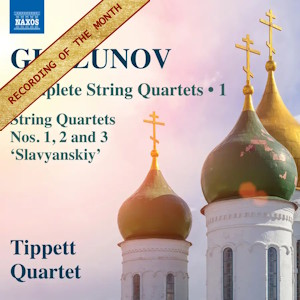
Alexander Glazunov (1865–1936)
String Quartet No. 1 in D major, Op. 1 (1881–1882)
String Quartet No. 2 in F major, Op. 10 (1884)
String Quartet No. 3 in G major, Op. 26 “The Slavonic” (1886–1888)
Tippett Quartet
rec. 2024, St George’s Headstone, Harrow, London, UK
Naxos 8.574716 [81]
This really excellent release is all the more appealing because it is a tantalising Volume 1 of a series. The Tippett Quartet has a large and diverse discography: varied repertoire played with stunning individual technique alongside collective musical stylishness and empathy. All those qualities are on display here, helped in no small part by Michael Ponder’s excellent engineering and production.
I have always enjoyed Glazunov’s music but I know his symphonies, orchestral works and ballets far better than his chamber music. Of his seven numbered quartets, I only heard the best-known No.3 ‘Slavonic’ and No.5 – courtesy of an old Shostakovich Quartet recording, latterly on Alto. As might be expected, those performances are thoroughly idiomatic and exciting. All credit to the Tippetts that they find an even better balance between fiery Romanticism and precision.
If this will over time become a complete cycle, then there is very little competition. The only currently available cycle appears to be by the Dutch Utrecht Quartet on MDG. The final volume in that series was released about 13 years ago. (I have not heard any of those discs but the reviews seem to be universally positive.) One hopes that the Tippett cycle will include, as the MDG set does, the unnumbered Suite, Novelettes, Elegy, excerpts featuring Glazunov’s contribution to Les Vendredis,and perhaps the great String Quintet with second cello. Naxos released the latter – in a lovely performance by the Fine Arts Quartet – some twent years ago, coupled with the charming Novelettes. There appear to be further un-numbered fragments that a truly complete survey might include.
As a Glazunov string quartet newcomer, I appreciated the fact that this volume follows the chronological order. This makes for a very generous 81:23 playing time, and charts Glazunov’s explosive musical development. String Quartet No.1 is his Op.1, written when he was in his mid-teens. (It won a Glinka prize.) I am not sure I can think of any other OP.1 so precociously confident, except Korngold’s teenage works which are genuinely prodigious. What is striking is the certainty of Glazunov’s handling of his musical material, and his innate understanding of string writing individually and collectively.
Just recently I reviewed a wholly enjoyable collection of Charles Wood’s string quartets on SOMM; they too showed a craftsman’s appreciation of the instruments. But somehow the older Wood stayed just on the side of academic sobriety, whereas Glazunov, even at a young age, is already pushing the boundaries. It is worth noting that the seven quartets straddle his entire creative life. He wrote the final quartet as Op.107; the last opus number he gave a work was 110.
Richard Whitehouse’s succinct but useful liner makes the valid point – which applies to much of Glazunov’s music – that it seeks a fusion of “nationalist sentiment with classicist discipline”. The former is clearly present, explicitly so in the third quartet, but Glazunov’s music rarely dives deeply into the world of Slavic melancholy that has made the music of his student Rachmaninoff so enduringly popular. Neither was Glazunov recruited into the “Mighty Handful” by Balakirev to promote Russian Nationalism in music. The first quartet is a strikingly impressive student work. Glazunov favours a traditional four-movement form in all three works here, although he varies the scale of the various movements and the interchangeability of the inner slow or fast sections.
Whitehouse rightly points to the shade of Borodin in the first quartet, especially the scherzo – a movement that often proves to be a highlight in Glazunov’s piece. It is striking how Glazunov manages to transcend any sense of this being a student work. For all the presence of ‘influences’, the young composer is forging his own path. The Tippett Quartet’s playing is excellent for all it is worth, with dynamic vibrant energy. They make the most of stamping drone-like figurations whilst also maximising the effect of the range of textures and figurations that Glazunov writes. This is top-notch quartet playing.
If Op.1 is impressive, then the progress in just two years to Op.10 is very marked. Again to quote Whitehouse, there is “an appreciable advance over its predecessor in terms of formal integration as well as its expressive range”. This is also the most substantial of these three works: a big-boned 30:37 compared to 22:23 for No.1 and 27:53 for No.3. Once more, I find myself doing a double-take to realise Glazunov was not yet out of his teens when he wrote this. There is a verystriking compositional confidence, almost playfulness. This is very apparent in the second-movement scherzo where a novel 9/8 (played as 2+2+2+3) melts into a flowing second subject that in turn is gracefully decorated by the first violin. In passages like this, which are tricky to navigate both technically and musically, the Tippetts show their high skill levels with fluent ease and poise. This music would fail with any sense of effort – none is apparent here.
The longest movement, the third, is marked Adagio molto – an impresively lyrical and powerful piece of music. The performing trick here is to sustain the level of building intensity across the long-arching phrases. The Tippetts achieve it without any forcing of tone or mannered point-making. It is far harder to create this sense of a long line than might be imagined. The finale is less intense; the main theme has the feel of a gentrified folk tune. This is not one Glazunov’s festive finales but it gradually builds to an energetic conclusion. There may be a little more of a sense of musical “working out” in this movement than elsewhere in the work. Still, it is impossible not to be impressed by such skill in a teenaged composer.
The String Quartet No.3 ‘Slavonic’ had to wait until its creator was all of 21, and it took some two years to complete. In relative terms, this is probably Glazunov’s best-known chamber work. It takes its nickname from the extended 11:24 finale subtitled “Une fête slave”. Most of the themes in this work have more of a nationalistic accent. It all culminates in the sparkling closing festival, played here with tremendous verve and collective brilliance.
All along, Glazunov revels in folk-influenced themes and idioms unusual in his works. The scherzo movement here is replaced by an Alla mazurka,full of instrumental drones and swaying rhythms. The internal balances of the musical material is well gauged by the quartet, who find a perfect balance between dynamism and precision. The closing pages of the work display these qualities perfectly: the music inexorably builds to an ever more exhilarating and virtuosic conclusion. This rousing conclusion is a perfect ending to this rewarding disc. Throughout the programme, Michael Ponder has achieved a near-perfect balance across all four instruments, within the supportive but pleasingly neutral acoustic of St. George’s Headstone in Harrow.
This is not just an enjoyable recording of delightful music. This is a masterclass in the art of string quartet playing – and recording. The hope must be that further volumes in this series will follow quickly.
Nick Barnard
Previous review: David Barker
Buying this recording via the link below generates revenue for MWI, which helps the site remain free













