
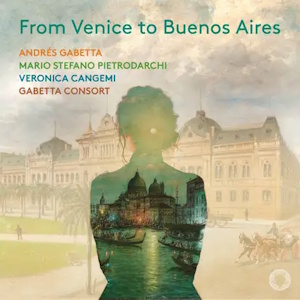
From Venice to Buenos Aires
Mario Stefano Pietrodarchi (bandoneon, accordion)
Veronica Cangemi (soprano)
Gabetta Consort/Andrés Gabetta (violin)
rec. 2024, Picasso Platz, Sinfonieorchester Basel, Switzerland
Texts in Spanish included
Reviewed as lossless download
Pentatone PTC5187503 [56]
The opening paragraph of the booklet notes describe the exodus of people from Italy between 1880 and 1930, many going to Argentina. This is one of the premises upon which this album is built. Given that the Italian works included here are from the early 18th and 21st centuries, I’m not entirely convinced. The other thematic element, the Virgin Mary, also seems a tenuous one, as I’m struggling to see a connection to the Vivaldi concertos and the arias from operas by Bononcini and Vinci. Nevertheless, regardless of whether one is convinced by the suggested thematic ties, it is, of course, the music and the performances that are the important aspects.
My gold standard for Vivaldi violin concertos is Fabio Biondi and Europa Galante, an ensemble not known for moderate tempos, but Andrés Gabetta goes absolutely hell for leather in the outer movements, and the result is too hard-driven and relentless, and frankly a tiring listen.
Between the two concertos are two tangos, the first a blisteringly fast one from Piazzolla’s opera María de Buenos Aires, which at least complements the very fast Vivaldi that precedes it, and certainly demonstrates the dexterity of bandoneonist Mario Stefano Pietrodarchi. The second is a new composition by Italian film composer Luca Salvadori, and it is a mashup (to use modern terminology) of tango and Baroque concerto. It is undoubtedly written with the most sincere intentions, but it brought to my mind Gerard Hoffnung and PDQ Bach.
The program is organised so that the four orchestral/concertante works are placed first, and the five vocals complete the recording. I hate to keep banging on about the programming, but this strikes me as a surprising (and flawed) choice, making the album seem like two totally separate parts.
Salvadori’s other original work, Mater Maria, again mixes the old – a descending bass line – and new – elements of tango and habañera – but much more successfully this time. For me, it is the best work on the album, and soprano Veronica Cangemi projects the pain of a mother who has lost her child very well.
The two Baroque opera arias – by Bononcini and Vinci – are so far out of my normal listening that I feel incapable of commenting on them, beyond saying that Cangemi shows her versatility. Finally, there are two Piazzolla works, the first an aria from María de Buenos Aires, and I don’t think it suits Veronica Cangemi very well. The role of María is normally sung in a lower register and in a more earthy style than the high, very operatic soprano here. The final work, originally written by Piazzolla for oboe and piano, is arranged here, with an appropriate text, for soprano with bandoneon, violin and strings. Even with the bandoneon, it doesn’t sound like Piazzolla, too sweet and syrupy (something from an Andrew Lloyd Webber musical came to mind).
For a program of assorted small works, 56 minutes is not a generous runtime, and if you like this recording more than I did, you would think that surely another Vivaldi concerto or some more Piazzolla could have been included. This has been quite a disappointment, and demonstrates the perils of building a program around a non-musical theme.
David Barker
Buying this recording via the link below generates revenue for MWI, which helps the site remain free
Contents
Antonio Vivaldi (1678-1741)
Violin Concerto in D Major “per Anna Maria”, RV 213a
Astor Piazzolla (1921-1992)
Allegro dell’alba tangabile (arr. by Roberto Molinelli)
Luca Salvadori (b. 1958)
Ouverture Tango-Baroque
Antonio Vivaldi
Violin Concerto in D Major “Grosso Mogul”, RV 208
Luca Salvadori
Mater Maria
Giovanni Bononcini (1670-1747)
Astianatte: Difese mi giurasti
Astor Piazzolla
Milonga de la Anunciation (arr. by Roberto Molinelli)
Leonardo Vinci (1690-1730)
Siroe, re di Persia: Benché s’asconda
Astor Piazzolla
Ave María (arr. by Luca Salvadori)













