
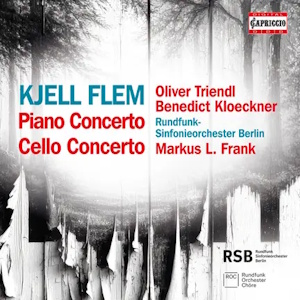
Kjell Flem (b.1943)
Piano Concerto (1992)
Cello Concerto (2005)
Oliver Triendl (piano); Benedict Kloeckner (cello)
Rundfunk-Sinfonieorchester Berlin/Markus L. Frank
rec. 2025, Berlin, Haus des Rundfunks
Capriccio C5565 [66]
Norwegian composer Kjell Flem has, through no fault of his own, had something of a low international profile. His academic ’lineage’ as a composer can be attributed to two of his most prominent teachers, Einar Englund and Einojuhani Rautavaara. In addition he has plied the musical trade winds as organist, pianist, music teacher and critic.
These two concertos are each in three movements. The one for piano has the much acclaimed and unfailingly adventurous Oliver Triendl as soloist. The music here gravitates between expressions of a sweet natural world disposition (Rautavaara Cantus Arcticus) and a flailing storm of hammered activity from both piano and orchestra. Aqueous crystalline trills are crooned and then rise to romantic heights and to horizons dominated by black clouds and swirling maelstroms. Flem calls on Triendl’s considerable virtuoso capabilities as if they were special drawing rights of the type also traded by Ronald Stevenson and John Ogdon. Moments of kinetic and crowned grandeur, as in the finale, are not in short supply. Crude parallels include the Bliss Piano Concerto, the Shostakovich Second and Silvestrov’s Postludium; a fractured ‘bag’, I know, but these works give some idea of the Flem soundworld. This Piano Concerto was written at the request of Håkon Austbø.
The Cello Concerto is often redolent of the cello concertos by Bridge, Sallinen and Shostakovich (No. 1). It’s a passionate work, of that we are left in no doubt, but atmospheric also. Flem weaves druidic tranced scenes and gleaming be-dewed webs; he interpolates these among passionate expostulations. As in the piano concerto, Flem also sets up strongly rhythmic iterated patterns which drive the emotional ‘plot’ forward. Kloeckner, like Triendl, seems in complete sympathy with Flem and conductor and orchestra match their commitment.
The booklet essay, in German and English is by Oliver Triendl himself and the English translation has been done by a name familiar here: Jens F Laurson.
As for audio side, the music is put across with exceptional clarity and atmosphere across a wide soundstage.
Flem’s music is accessible, more than aware of its late 20th century roots as well as being engaging at emotional and intellectual levels. The writing is sharply chiselled, awed yet also opening the doors to fine veined textures which find strange parallels with the magically emotional work of Laurence Whistler.
Rob Barnett
Buying this recording via the link below generates revenue for MWI, which helps the site remain free













