
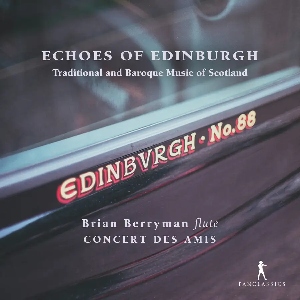
Echoes of Edinburgh – Traditional and Baroque Music of Scotland
Brian Berryman (transverse flute)
Concert des Amis
rec. 2023, Edelhof-Kapelle, Hanover-Ricklingen
Reviewed as a download
Pan Classics PC11467 [74]
Most ‘classical’ music performed today in churches and concert halls all over the world and recorded on disc belongs among the category of what is called ‘art music’. It was written by composers and has come down to us in fixed form, either in manuscript or in printed editions. However, in the course of history, much music – probably even most – was sung and played by people who did not use any written notes; many of them were probably not even able to read music. Improvisation was the name of the game, and music was informally handed down from one generation to another. It had no fixed form, and in the course of time, both texts and music often changed considerably. In most cases their original forms are not known, unless at some time such music was written down.
Whereas today the two scenes are largely separated, and concerts and recordings which bring them together are usually called ‘cross-over’, in earlier times they were much more naturally connected. Composers used traditional songs and tunes for variations, such as English composers of the late 16th and early 17th centuries in keyboard music, much of which is included in the Fitzwilliam Virginal Book. In the 18th century Georg Philipp Telemann was strongly impressed by traditional music from Poland and Moravia, and reworked what he had heard in his own instrumental music.
The 18th century saw a growing interest in folk music. That was partly inspired by the Enlightenment which was in favour of more ‘naturalness’. It was the time when Nature was seen as the source of Truth: the closer a man got to Nature, the closer he got to the Truth. It explains the attraction of exotic cultures, often associated with the ‘noble savage’, especially those outside Europe – one can think here of Rameau’s Les Indes galantes. However, the Enlightenment also discovered the folklore of European cultures.
This disc brings us to Scotland. In the first half of the 18th century a Scottish renaissance took place. This was partly politically motivated. In 1707 Scotland and England became one kingdom under the name of ‘Great-Britain’ as a result of the Act of Union. Many Scots considered this an attempt at assimilation, at the cost of their own identity. It encouraged representatives of Scottish culture to try to keep alive or to bring back what was considered typically Scottish. This resulted in the publication of a number of collections of Scottish songs. Some of these included melodies, but others only mentioned the titles of melodies to which the texts could be sung. These collections are also the sources for the arrangements by some of the major composers of the classical period, Haydn and Beethoven.
The present disc covers a period of about a century, from arrangements by James Oswald and Francesco Barsanti to collections of settings in traditional style by James Scott Skinner. In between them is a collection that was published by Robert Mackintosh. In this disc’s programme the tunes and dances selected from his collection are divided into a number of ‘sets’, in which they are played attacca. We find here the forms that are typical of Scottish traditional music. A number of them are called reel. New Grove gives this definition of a reel: “An indigenous and probably very ancient Scottish dance. The reel contains two basic dance elements: a setting step danced on the spot, and a ‘travelling’ figure, i.e. movement in a particular pattern.” Reel is a collective term; the dance can take different identities. One of them is the strathspey: “A Scottish dance, a Reel of slower tempo, allowing the use of more elaborate steps both in the setting step and in the travelling figure. It usually leads into another reel without a break, or vice versa. It is written in common time, crotchet = 160 to 168, or slower. Musically, the strathspey is characterized by its dotted quaver–semiquaver rhythm and the inversion of this, the ‘Scotch snap'”.
Both in the tracks devoted to Mackintosh’s collection and in that which includes pieces published by Skinner we find some settings by Patrick MacDonald, from a printed edition of 1784 (A Collection of Highland Vocal Airs).
The most remarkable part of this disc is the music written by two composers of ‘art music’: James Oswald and Francesco Barsanti. Oswald was born in Crail, and educated at the cello. His first job was that of dancing teacher. In 1735 he settled in Edinburgh, where he was active as a cellist and teacher, but also as a composer and publisher. His first great success was A Collection of Curious Scots Tunes of 1742, witness the large number of subscriptions. In 1741 he moved to London; the next year saw the publication of a set of songs under the title Colin’s Kisses. Around 1745 he again earned great success with a collection of music: the first two volumes of The Caledonian Pocket Companion, including simple monophonic tunes for every kind of instrument. They were later followed by ten further volumes; they were often reprinted and circulated long after his death. The recognition of his place in music life was crowned when he was appointed Chamber Composer to George III. In the 1750s Oswald composed a substantial amount of chamber music, which shows that he was fluent in the Italian and the French style.
In 1755 Oswald published Airs for the Spring/Summer/Autumn/Winter, which the next year were reprinted under the title Airs for the 4 Seasons. Originally scored for transverse flute or violin with basso continuo, the reprint included an optional second part for a treble instrument. A second set of Airs was published in 1761, and reprinted around 1765, but that seems to be lost. Each sonata bears a title: the name of a flower connected to one of the seasons; here flos adonis, thistle, bachelor’s button and marvel of Peru. The movements have the titles one expects to see in art music. The Flos Adonis, for instance, consists of allegro con brio, aria (amoroso) and giga (vivace). However, in the fast movements one can find Scottish traditional dance music. “An ‘allegro’ can be a thinly disguised jig or reel made acceptable to polite society” (Brian Berryman in his liner-notes).
Given Oswald’s Scottish descent, his interest in Scottish music cannot surprise. That is different with Barsanti. He arrived in London in 1714, together with his friend Francesco Geminiani; both were from Lucca. For a number of years, he played the flute and the oboe in the orchestra of the Italian opera. In 1735 he married a woman from Scotland. He developed a special liking for Scottish tunes which he arranged or incorporated into his compositions. He found aristocratic patrons in Scotland and composed some of his best music, his Concerti grossi op. 3 and his Overtures op. 4. In 1743 he returned to London where he started to work as a viola player. From that time, he gave up writing any original compositions. When he died in 1772, he was poor and almost completely forgotten.
Rather than exploring his collection Old Scots Songs of 1742, Berryman turned to the Overtures Op. 4. These nine pieces for strings and basso continuo – the first violin part of which is played here on the transverse flute – are also traditional Italian concertos at first sight. However, the themes of the second (fugal) sections of the opening overtures are often taken from a folk song. Their titles are revealed in the bass part of the original print of 1745. In the Overtura Prima, for instance, the theme is the melody of Richmond Hill, a popular dance tune which first appeared in the collection The Dancing Master, published by John Playford in 1695.
The performers are all educated in the early music scene, and play almost exclusively ‘art music’. By entering the world of folk music – albeit of the same period as the music they usually play – they bring the past to life. Berryman, in his liner-notes, states: “Scotland’s musical scene in the eighteenth century makes no clear distinction. Traditional musicians were often literate and held positions in local orchestras, a violinist in the Edinburgh Musical Society orchestra would supplement his income as a fiddler in the best dance band in town. (…) Composers of sonatas and composers of dance tunes moved in similar circles, enjoyed each other’s company and in the case of Robert Mackintosh (c.1745-1807), were one in the same person”.
Today performers have to make an effort to convince in the ‘other’ genre, and the performers on this disc succeed with flying colours. Never one gets the impression that we are listening to performers who have moved to unknown territory. Brian Berryman plays the main role, sometimes acting on his own, and he plays with flair and fantasy. In some pieces he adds a part of his own making, and he also plays variations on a given piece. That is all in accordance with the very nature of this repertoire. His colleagues are his perfect partners. I just wondered about the participation of a bodhrán. This is a single-headed frame drum, which in New Grove is associated with Ireland. Was it also part of traditional music in Scotland? The liner-notes don’t mention it, but it is probably an adoption.
This is a very enjoyable and entertaining, and from a historical point of view interesting disc. It should appeal to both lovers of early ‘art music’ and fans of folk music, especially those who are interested in earlier stages in the history of this genre.
Johan van Veen
www.musica-dei-donum.org
twitter.com/johanvanveen
https://bsky.app/profile/musicadeidonum.bsky.social
Contents
Robert Mackintosh (c1745-1807)
[Lady Charlotte Set]
Lady Catherine Stewart Strathspey
Lady Charlotte Goold’s Reel
Miss Mary Garden of Troup’s Reel
Lady Charlotte Lennox Reel
James Oswald (1710-1769)
The Flos Adonis
James Scott Skinner (1843-1927)
[Tullochgorum Set]
My love has deceived me (from: Patrick MacDonald Collection)
Variation (Brian Berryman)
Tullochgorum with Variations
Francesco Barsanti (1690-1770)
Overtura prima in A minor, op. 4,1
Robert Mackintosh
[Wat Ye Set]
Wat ye who met the streen (Slow)
The Reel
Lord Chief Baron’s Favourite
Honourable Mrs. Maules’ Reel
Miss E. Macleod’s Reel
Francesco Barsanti
Overtura seconda in D minor, op. 4,2
James Oswald
The Thistle
Robert Mackintosh
[Wet & Cold Set]
Wet & Cold Are My People (from: Patrick MacDonald Collection)
The Calledonian Hunt’s delight
Kiss the Lass you like best
The Lads of Dunce
Lady Mary Montague’s Reel
There is no luck about the House
Francesco Barsanti
Overtura sesta in G, op. 4,6
James Oswald
The Batchelor’s Button
James Scott Skinner
[The Skinner Set]
The Haughs O’ Cromdale. Strathspey
Highland Whisky (strathspey)
Talisker (strathspey)
Angus Campbell. Reel
The De’il Amang the Tailors (variations: James Scott Skinner)
James Oswald
The Marvel of Peru
Francesco Barsanti
Overtura nona in G, op. 4,9
Buying this recording via the link below generates revenue for MWI, which helps the site remain free













