
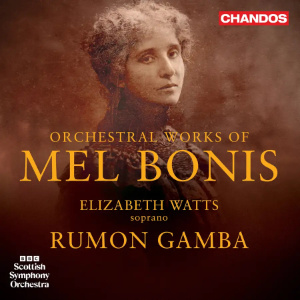
Mel Bonis (1858-1937)
Orchestral Works
BBC Scottish Symphony Orchestra/Rumon Gamba
Elizabeth Watts (soprano)
rec. 2025, Grand Hall, City Halls, Glasgow
Chandos CHSA5381 SACD [59]
Until recently, I for one had never heard of Mel Bonis, but her re-admittance into the history of music has for me been a revelation and this new release adds to the interest in and fascination with it.
As with so many female composers, her opportunities to compose for orchestra were often lacking, so songs, piano music and chamber works were the main portion of what seems to be a catalogue of over three hundred opus numbers. Curiously, this Chandos release has emerged just a few weeks after one on cpo (555 752-2 – review) conducted by Joseph Bastian; sadly, I have not yet heard it, but it contains exactly the same music. Some of the works have also appeared in recent times on other recordings.
What immediately strikes me is the quality of her orchestration and I wasn’t too surprised to read in the excellent booklet essay by Nigel Simeone that for over a year she had taken lesson from Charles Koechlin. The delicate way she uses the orchestra is clear right from the first track with the Trois Femmes de légende. This is very French music, not just the orchestration but also the harmonies. Each character is sensitively brought to life, and one realizes that with its shimmering textures and subtle use of percussion, Debussy is not far off the horizon.
A number of pieces started life as salon-type piano solos or duets, such as, for example, Trois Danses in which she harks back to an earlier period without writing pastiche, with a Bourrée, a Pavane, and a Sarabande. Two songs are also recorded: the witty and slightly eccentric setting of Le Chat sur le toit (I wonder if that’s where Milhaud got his idea from) and the wonderous Nöel de la Vierge Marie, which sets a poem by Madeleine Pape-Carpentier. Its delicate, sensuous beauty made me think that only a woman, especially one with Bonis’ background, could have set these words so perceptively but perhaps I’m being controversial. These songs are very contrasted, and Elizabeth Watts brings them to life with absolute conviction.
There are delightful miniatures like Les Gitanos, the earliest work here originally for solo piano, and Danse sacrée which may always have been meant as an orchestral piece but was also arranged for piano. I especially enjoyed Two movements from ‘Suite orientale’, which is not especially oriental in many ways, and is in fact rather French, but the delicacy of touch in the development of the subtle melody and the changing harmonic framework is a sheer delight.
Rumon Gamba is a truly amazing conductor and his devotion to bringing to our attention music by overlooked female composers is one of the chief joys of much that is being made available at present. This music is delightful – not earth-shattering, but beautifully conceived, orchestrated and presented by all concerned.
Gary Higginson
Buying this recording via the link below generates revenue for MWI, which helps the site remain free
Contents
Trois Femmes de légende (c.1909)
Suite en forme de Valses (1898)
Two Movements from ‘Suite orientale’ Op 48 (1900)
Le Chat sur le toit Op 93 no 2 (1912)
Trois Danses (1904-09)
Nöel de la vierge Marie op 54 no 2 (1901/5)
Danse sacrée Op 37 no 3 (1898)
Les Gitanos Op 15 no 3 (1891)













