
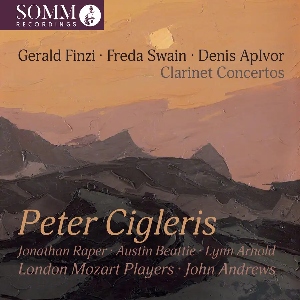
Denis ApIvor (1916-2004)
Concertante for clarinet, piano and percussion, Op.7a (c.1947)
Freda Swain (1902-1985)
Lumine naturi, Concertino for clarinet with string orchestra and (one) horn (1948)
Gerald Finzi (1901-1956)
Concerto for clarinet and strings, Op.31 (1949)
Peter Cigleris (clarinet)
Jonathan Raper (timpani), Austin Beattie (percussion), Lynn Arnold (piano)
London Mozart Players/John Andrews
rec. 2025, St George’s Headstone, Harrow, London
SOMM Recordings SOMMCD0722 [71]
Here is another typically impressive release from SOMM Recordings: interesting repertoire very well performed and beautifully presented. But even in the midst of such collective excellence the particular palm must go to clarinettist Peter Cigleris. It strikes me that his fluent technique and limpid, unforced beautiful tone are simply ideal in this type of repertoire. The result is a genuine joy to listen to.
The generous programme juxtaposes the best known of all British clarinet concertos with two premiere recordings. There is always something of a dilemma for programme planners: entice collectors with unknown works or ‘ease them in’ with familiar ones? I am not sure that the solution here is ideal for reasons I will address later – but I do not have a better answer either!
The disc opens with a work by the least familiar composer; Denis ApIvor. Robert Matthew-Walker’s booklet note, typically informative about the composers and the repertoire, lacks any detail about ApIvor’s later life. He wrote the Concertante for clarinet, piano and percussionwhile he was on active service in the British Army (Royal Army Medical Corps) in India during World War II. His day job was as a consultant anaesthetist, which he continued after the War in parallel to composing. For more information, MWI has a biography here.
There also is a useful, quite detailed, Wikipedia article about him. It reveals a significant number of compositions across most genres, including five symphonies, four operas and seven ballets. It also says that the work offered here exists in a revision with strings, harp and celesta accompaniment. Make no mistake, the original chamber version played here is excellent. But – given that the London Mozart Players accompany the rest of the programme – I wonder why the orchestral score was not chosen: probably budgetary? The version here is for solo clarinet, piano, timpani and one percussion. Matthew-Walker suggests Bartók’s Sonata for two pianos and percussionand Contrasts as models/inspiration; that seems pretty clear. ApIvor is not that adventurous in his choice of percussion. He sticks with basic instruments albeit deployed to good effect. All four players are excellent. Pianist Lynn Arnold deserves special mention for a part that is at least the equal of the clarinet’s.
The work in the standard three-movement fast-slow-fast format runs for around twenty minute. The stand-out features, perfectly caught by the actual recording here, are the clarity and precision of the writing. (Perhaps the original scoring emphasises this aspect over the ‘lusher’ string and harp?) Producer Michael Ponder and Engineer/Editor Adaq Khan have balanced the disparate elements perfectly. Even the potentially overwhelming bass drum is ideally present but balanced. There is also a neo-classical objectivity in the score. French or German contemporaries seem to be the sources of kinship – rather than any whiff of the English Pastoral School. All three movements have a distinct character sharply delineated. All in all, this genuinely impressive achievement has the listener curious to hear more of ApIvor’s work. I do not know quite how – away from a disc like this – any concert programmer could include this work except in tandem with Bartók’s works mentioned before. As far as I can tell, this appears to be ApIvor’s only commercially recorded work in the current – or past! – catalogue.
By that measure, Freda Swain is positively well-known. Those other great stalwarts of under-appreciated British composers, Dutton and Toccata, have produced several discs devoted to Swain’s chamber and keyboard works. This is the first time a more substantial score has been recorded. Matthew-Walker makes a valid point: if Swain’s name is familiar at all, it is via her significant body of teaching or ‘lighter’ works. He considers her Lumine naturi [By the light of Nature] – Concertino for clarinet with string orchestra and (one) hornto be among her major works. He is clearly a passionate advocate of Swain’s music in general, and this work in particular: “[…] will undoubtedly come as nothing less than a revelation for very many people”.
Once again, I cannot imagine finer advocacy for this work than it receives from Peter Cigleris, now joined by the London Mozart Players and John Andrews. The title draws on the writings of Algernon Blackwood; each movement is headed by a quotation from his works. Matthew-Walker points out that the work was completed in the depths of the harsh winter of 1947-1948. Once more, to seek any kind of pastoral imagery here would be quite wrong; Hindemith is rightly cited as a similar musical voice. The piece, in a fairly standard three-movement form runs for around twenty-four minutes.
I have to say I do not quite share all of Matthew-Walker’s unbridled enthusiasm. For sure, there is an individuality and an impressive musical voice, but I also hear a sense of Swain working just a little too hard to make her forceful musical points. The LMP play very well, but the counterpoint and the harmony sound a little dense and cluttered. Sitting alongside the near-contemporaneous Finzi, Swain’s piece struggles to achieve the emotional and musical clarity that in no small part makes Finzi’s concerto a genuine masterpiece. Finzi wears his technique with nonchalant ease, with Swain it feels just a little too forced. The central Lento movimento is beautifully poised, and Cigleris’s elegant weightless musical line is a consistent delight. It is genuinely valuable to be able to hear a major score played and recorded so sympathetically.
As indeed it is to hear Finzi’s most often performed orchestral score in such a fine performance. As ever, before listening to this performance I wondered if yet another recording was necessary, especially given that just about every great clarinet player – and certainly every great British player – has recorded the work. Credit therefore once again to Cigleris and his fellow musicians: this performance is the equal of all those esteemed predecessors. The especial genius of Finzi is the pellucid beauty of the writing. Every note, every expressive phrase is perfectly wrought. One thing that Cigleris underlines especially effectively is the vocal quality of the solo part. I am not sure I have ever had the sense that each of the movements is quite such a song-without-words as it is presented here. This work clearly echoes the English Pastoral tradition but in such a refined and elevated way that any accusations of cowpats or muddy fields seem crass. By any measure, this is a masterpiece. It is no shame that alongside it Swain’s concertino emerges as a highly competent, very enjoyable, yet ultimately lesser work.
So here we have yet another SOMM release very fine in every respect. The sheer calibre of the playing rather disarmed my initial concerns that another Finzi concerto was surplus to requirements. Personally, I have yet to be convinced by Freda Swain’s piece but Denis ApIvor intrigues.
Nick Barnard
Previous review: Jonathan Woolf
Buying this recording via the link below generates revenue for MWI, which helps the site remain free













