
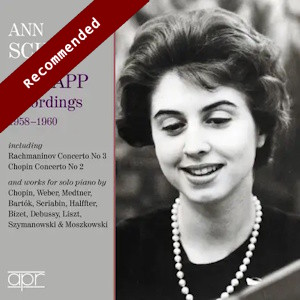
Ann Schein (piano)
The Kapp Recordings 1958-1960
Vienna State Opera Orchestra/Sir Eugene Goosens
rec. 1958-60, New York City; Musikverein, Vienna, Austria (concertos)
APR 7320 [3 CDs: 212]
It was just a short while after I received this set that I heard of Ann Schein’s passing at the age of 86. She was born into a musical family in November 1939. Her grandfather was the leader of a family orchestra that came to America to play at the Chicago World’s Fair in 1893. From age four to thirteen, Ann studied with Bessie Bracken Gunn. With a strong grounding and natural talent, she needed a teacher who could guide her next steps. She chose Mieczysław Munz, a Busoni pupil and a formidable pianist whose career was curtailed somewhat by a problem with his right hand. (His extant recordings – on Americus Records AMR20021022 – are a joy to listen to.)
Munz kept Ann Schein busy: Beethoven’s two concertos and his Appassionata and Waldstein sonatas, then Rachmaninov’s D minor concerto. She played the concerto with the Peabody Conservatory Orchestra in January 1956, and in 1960 made her professional debut with the work. It was a recording of the Peabody performance that convinced David Kapp of Kapp records to offer her a contract. She recorded five LPs between 1958 and 1960, all faithfully reproduced here.
Schein’s first LP, her calling card for Kapp Records, was Études: a selection from Chopin’s études alongside pieces by Liszt and by later composers influenced by the Pole’s writing. Her Chopin is brilliant and utterly assured, flexible and dazzling as required. If the third of the op.25 set is perhaps a little sturdy, she is magical in the modest A flat Nouvelle étude. She allows the left hand to judiciously, and briefly, sing in duet. She shapes the phrases of the tricky repeated note étude from op.10 as if she has all the time in the world and is not performing wonders of dexterity. The lightness of touch in this and in Nos.8 and 10 from the same set are characteristic of much of the playing across all five LPs.
Schein captures magnificently the mercurial changes of mood in Debussy’s arpeggio étude. There follow the haunting B flat minor studies by Szymanowski and Scriabin. They are flanked by two Horowitz favourites, Moszkowski’s quicksilver F major Étude de Virtuosité, delivered with panache, and Scriabin’s sorrowful C sharp minor étude. Virtuosic Liszt and Rachmaninov’s E flat minor étude-tableau act as a warm-up for the latter’s D minor Concerto.
Schein followed this with more Chopin: the four Scherzi recorded in March and April 1959 in RCA’s New York Studios. At just a few months shy of twenty, she plays the Scherzi very well indeed, and they all show what a developed artist she was. I am most impressed with the third. What held me spellbound were the technical precision and clarity, common to all her playing, and a way with the chorale playing in the middle.
Schein’s third outing was A Piano Invitation to the Dance, a collection of 19th and 20th century dances. Even more so that her études LP, the recording explores interesting nooks. What better to open with than Tausig’s wonderful concert version of Weber’s Invitation to the Dance? Sheplays with a casual disdain for the difficulties, and pays attention to the many moments of great delicacy. Schein retains original Weber in one place to contrast with Tausig’s version in the repeat; she even includes a couple of features from Godowsky’s transcription.
Few pianists at the time played Medtner, so it is good to have his Danza Festiva in a sparkling performance – as good as any I have heard. Halffter’s Scarlatti-inspired Danza de la Pastora is another welcome rarity. Next comes vividly characterised playing in Bartók’s Romanian Folk Dances; what gorgeous touch and hypnotic mood she achieves in the third dance. You will notice the left speaker come alive as Rachmaninov’s elegant transcription of Bizet’s Minuet begins.
These LPs were issued when mono was changing over to stereo. Although a rare stereo copy of this LP was found, the first side was actually in mono, so this is how we hear the works from Weber to Bartók. Everything else on these three CDs is stereo. Schein matches the extravagant writing in the Rachmaninov transcription with insoucient ease. Her Chopin collection includes a fleet “minute waltz” with little surges of dynamics. I could also hear such surges in her playing of the op.25 no.1 étude and two mazurkas, lilting and passionate by turns.
The least successful item is the Polonaise-Fantasy that ends this dance recital. Schein, otherwise in supreme command of mood and idiom, does not quite seem to know where exactly the piece is going. The polonaise sections are generally too rushed and oddly perfunctory, and her lines in some sections are delivered in rather stentorian manner. There are moments that work well but overall this is a far cry from the imaginative playing that we hear everywhere else on these three discs.
Two final LPs introduced Schein in concertos. Both were recorded in Vienna with Vienna State Opera Orchestra under Sir Eugene Goossens. Inevitably, she played Rachmaninov’s D minor concerto that served her so well in her formative years and beyond. Many twenty-year-olds would take the opportunity to throw down the gauntlet and show that they were the master of this lion of a piece. Not Schein: she clearly demonstrates her mastery without resorting to extravagant gestures or hard-driven tempi. Her tempi are actually not at all slow, but she still finds plenty of time to breathe through phrases and maintain clarity of fingerwork.
The scherzo poco più mosso passage towards the end of the slow movement is just one example of Schein’s lightness of touch. It is not the series of steely-edged, machine-gun repeated notes one often hears. It is an exciting performance. Schein finds an excellent partner in Goossens, as she does in Chopin’s F minor concerto from the same session. It has the same qualities – lightness of touch, poise, singing line and breadth of phrasing – that one hears throughout this collection. In the passagework after the second subject of the first movement, she is not afraid to hold the tempo back just fractionally. She only pushes on fifteen bars later in the lead-up to the orchestra’s central tutti; that creates a wonderful sense of momentum before the climax. It is a minor detail among many, but it makes for a very satisfying whole. The D flat nocturne that filled the Chopin concerto disc is no less special.
I had not heard of Schein prior to this set, so I am happy on two counts: first, that David Kapp took a chance on a young pianist; second, that Mike Spring assisted by Jonathan Summers has brought these nearly seventy-year-old LPs out of obscurity to a new generation in a marvellous fashion. They must sound as fresh as on the day they were issued.
Rob Challinor
Other review: Jonathan Woolf
Buying this recording via the link below generates revenue for MWI, which helps the site remain free
Contents
Frédéric Chopin (1810-1849)
Piano Concerto No.2 in F Minor Op.21 (1829-1830)
Nocturne No.8 in D Flat Major Op.27 No.2 (1835-1836)
rec. January 1960 Musikverein, Vienna (KAPP6001)
Scherzo No.1 in B Minor Op.20 (1831-1835)
Scherzo No.2 in B Flat Minor Op.31 (1836-1837)
Scherzo No.3 in C Sharp Minor Op.39 (1839-1840)
Scherzo No.4 in E Major Op.54 (1842-1843)
rec. 31 March/1 April, 1959 RCA Studios, New York (KAPP9040)
Carl Maria von Weber (1786-1826)
Invitation to the Dance Op.65 (1819, arr. Carl Tausig)
Nikolai Medtner (1879-1951)
Danza Festiva No.3 from Forgotten Melodies I Op.38 (1919-1922)
Ernesto Halffter (1905-1989)
Danza de la Pastora from the ballet Sonatina
Béla Bartók (1881-1945)
Romanian Folk Dances Sz.56 (1915)
Georges Bizet (1838-1875)
Minuet from L’arlésienne Suite No.1 (1872/1900 rev. 1922, arr. Sergei Rachmaninov)
Frédéric Chopin
Waltz in D Flat Major Op.64 No.1 (1847)
Mazurka in A Flat Major Op.59 No.2 (1845-1846)
Mazurka in F Sharp Minor Op.59 No.3 (1845-1846)
Polonaise-Fantasy in A Flat Major Op.61 (1846)
Études Op.25 Nos.1, 2, 3, 9 (1832-1836)
Nouvelle étude in A Flat Major KKIIb/3 (1839)
Études Op.10 Nos.4, 10, 7, 8, 12 (1829-1832)
rec. 24 April, 1958 New York (KAPP9023)
Claude Debussy (1862-1918)
Étude Pour les arpèges composés L.143 No.11 (1915)
Karol Szymanowski (1882-1937)
Étude in B Flat Minor Op.4 No.3 (1900-1902)
Moritz Moszkowski (1854-1925)
Étude de Virtuosité in F Major Op.72 No.6 (1903)
Alexander Scriabin (1872-1915)
Étude in B Flat Minor Op.8 No.11 (1894)
Étude in C Sharp Minor No.1 from Trois Morceaux Op.2 (1887)
Franz Liszt (1811-1886)
Gnomonreigen No.2 from Zwei Konzertetüden S.145 (1862-1863)
Sergei Rachmaninov (1873-1943)
Étude-Tableau in E Flat Minor Op.33 No.6 (1911)
Piano Concerto No.3 in D Minor Op.30 (1909)
rec. 24 April, 1958 New York (KAPP9023)
rec. January 1960 Musikverein, Vienna (KAPP6000)













