
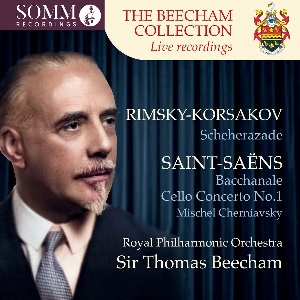
Camille Saint-Saëns (1835-1921)
Samson et Dalila: Bacchanale, Act III Scene 2 (1877)
Cello Concerto No.1 in A minor, Op.33 (1872)
Nikolai Rimsky-Korsakov (1844-1908)
Scheherazade, Op.35 (1888)
Mischel Cherniavsky (cello)
Royal Philharmonic Orchestra/Sir Thomas Beecham
rec. 21 March 1957 (Scheherazade), 19 October 1958 (Concerto), 24 April 1960 (Bacchanale), Royal Festival Hall, London
The Beecham Collection Live Recordings
SOMM Recordings SOMM-BEECHAM34 [70]
Forming Beecham concerts on CD from disparate source material is something that’s served Somm well. This latest release in ‘The Beecham Collection’ of live recordings is drawn from three Royal Festival Hall concerts, one of which derives from his last London performance in 1960, less than two months before he suffered the cerebral thrombosis that led to his withdrawal from concert giving.
It’s from this concert that we get the disc opener, a driven, orgiastic performance of one of his potboiler favourites, the Bacchanale from Saint-Saëns’ Samson et Dalila. His stereo recording, which is now in the big Warner box, was recorded at Kingsway Hall during 1958-59 but the nearest surviving performance I can find is the Maida Vale broadcast of November 1959 in the ICA Classics box. Both are, of course, superb but this Royal Festival Hall performance is incendiary with the band slinking and slithering alluringly and the percussion pounding dramatically. It’s far quicker than his other performances – 6:30 plus applause, which is not, in itself, significant but does exemplify the adrenalin of a live concert.
Those who know of Beecham’s wartime sojourn in Seattle may have come across the preserved recordings he made there, some of which have been issued on Pristine Audio. One featured the cellist Mischel Cherniavsky in a decidedly off-beat and eccentrically phrased performance of the Dvořák Concerto. In his booklet notes the ever-astute Nigel Simeone alludes to this performance terming it, quite correctly, ‘startlingly wayward’. Cherniavsky had been a member of a famous trio with his brothers, Leo and Jan, dating back to the early 1900s so by 1958 he was something of a veteran in his mid-60s. He and Beecham knew each other socially and clearly formed a sympathetic duo but no one would claim that by this time he was a first-class soloist. He is an effective stylist in the Cello Concerto No.1 in A minor but his vibrato is slowish, his slides equally slow and very marked, and his tone is rather guttural too. He is at his best in the concerto’s ruminative passages but because of a besetting lack of tonal colour this is more a pleasing souvenir of his collaboration with Beecham rather than a startling example of cellistic legerdemain.
After Beecham’s leader, Arthur Leavins, had been eased out of the RPO following some typically Beechamesque machinations, Steven Staryk, sitting at the desk behind Leavins, took his place. He was in time to record Scheherazade in March 1957 at Kingsway Hall sessions that took place a couple of days before this concert and about a week before the final recording session on 28 March. Finely played and exciting though it is, Beecham’s recorded version has sometimes been judged – and found wanting – for its occasional lack of vitality. Not here. He is zestier in every movement except the last which he takes at the same tempo he adopted in the studio. The veil of relative caution that hung over the studio recording is swept aside in this magnificent reading – more volatile, more expressive, more voluptuous and more of everything. The RPO’s famed winds and brass are at the apex of their powers and the percussion registers viscerally too. The only demerit, strangely, is Staryk but not for his playing, which is dancing, fanciful and brilliantly conceived. It’s rather that he has not been recorded with as much fidelity as other orchestral principals. Maybe the microphones were over the body of the orchestra so giving him a more disembodied, distant quality. It’s not a major demerit but I should note it.
This production is a first-class demonstration that, as so often, concerts generate an intensity that is not always replicated in the studio. Beecham admirers need not hesitate.
Jonathan Woolf
Previous review John Quinn
Buying this recording via the link below generates revenue for MWI, which helps the site remain free













