
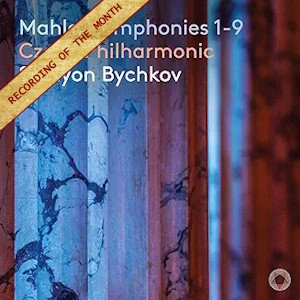
Gustav Mahler (1860-1911)
Symphonies 1-9
Czech Philharmonic/Semyon Bychkov
rec. 2018-25, Dvořák Hall, Rudolfinum, Prague
Texts not included
Pentatone PTC5187490 [11 CDs: 709]
Pentatone released the first five symphonies in Semyon Bychkov’s Mahler cycle individually between 2022 and 2025. Now, they have released the remaining four symphonies. However, people who have been collecting the evolving cycle in CD form should note that symphonies 6 – 9 will only be released either as individual downloads or in this 11-disc box of CDs. That, I think, is a pity.
It’s very appropriate that Semyon Bychkov has recorded these symphonies with the Czech Philharmonic; as the Pentatone press release points out, the orchestra gave a number of Mahler’s major works during the composer’s lifetime. They performed the Second in 1903, the Fifth in 1905 under Leo Blech, and the Fourth in 1907. Mahler himself conducted them in no fewer than three of his symphonies. As we shall see, they gave the premiere of the Seventh under his baton; he also led them in performances of the First and Third symphonies.
Bychkov has been the Chief Conductor and Music Director of the Czech Philharmonic since the 2018-19 season and this Mahler cycle has evolved during those years. It will be noted that his cycle doesn’t include even the Adagio of the Tenth symphony, let alone one of the performing versions of the whole symphony; that’s regrettable, though Bychkov is far from the first conductor to record a Mahler cycle that does not include the Tenth. Much more regrettable is the absence of Das Lied von der Erde. Based on what he has achieved with the nine symphonies, I think Mahler’s great song symphony would be highly suited to Bychkov’s gifts. Perhaps before he steps down from his role with the CPO at the end of the 2027-28 season he will find an opportunity to perform and record the work with the orchestra; it would be an enticing supplement to his symphony cycle. In fact, I see that the work is to be performed during the CPO’s 2026/27 season, which has just been announced, but it will be Daniel Harding rather than Bychkov who will be on the rostrum
I have reviewed each of the first five releases in the series individually. I hope readers will understand if I provide just a brief summary of my thoughts on those performances, together with a link to each review; I’ll consider the four new releases in rather more detail.
I found a lot to like in Bychkov’s performance of the First symphony. Bychkov and his orchestra make the work sound fresh. The music is interpreted idiomatically and with great understanding by Bychkov while the playing of the Czech Philharmonic is beyond reproach. In the last analysis, I don’t think that Bychkov makes the music leap off the page in the way that conductors such as Leonard Bernstein (his Amsterdam recording), Yannick Nézet-Séguin or Klaus Tennstedt achieve. However, this Czech performance has a lot going for it. My detailed review is here.
Though it was the third recording released by Pentatone, Bychkov’s traversal of the ‘Resurrection’ symphony is the earliest performance in this cycle; indeed, I think I’m right in saying that it was with this symphony that he inaugurated his term as Music Director of the CPO. Thers’s a great deal to admire in this performance. I found the first movement compelling and the third movement receives an outstanding performance. Elisabeth Kulman sings ‘Urlicht’ in an unaffected, touching fashion. Bychkov’s reading of the huge fifth movement is full of drama and incident. His soloists – Christiane Karg is the soprano – are impressive and the Prague Philharmonic Choir make a fine contribution. The Czech Philharmonic are on terrific form for the man who at that time was their new chief. The symphony is contained on a single CD with a playing time of 86:52. My full review is here.
The Third symphony was the most recent of the five individual releases in this cycle; it appeared in 2025. Bychkov’s approach to the immense first movement impressed me very much. It may lack some of the swagger of Bernstein’s celebrated 1961 New York recording but Bychkov is still very convincing. I enjoyed his way with the next two movements and I admired the singing of Catriona Morison in a very atmospheric account of the fourth movement. In the Adagio finale, Bychkov’s conducting brings out the solemnity in the music, but never at the expense of momentum. In my original review, I commented that the CPO’s playing was magnificent in the preceding movements but in this finale they went to a higher level; I described the playing as “sovereign”. My detailed review of this fine performance of the Third is here.
The Fourth was the first symphony that Pentatone released, back in 2022. I was very taken with the affectionate way in which Bychkov shapes the opening movement. After a piquant performance of the second movement, Bychkov’s patient unfolding of the third movement is impressive; he gives the music an ideal amount of space. The soloist in the fourth movement is Chen Reiss; she sings very well and without artifice. I summed up my detailed review of the recording thus: “Superb playing, expert, idiomatic conducting and lovely recorded sound combine to make this a distinguished version”.
Bychkov’s recording of the Fifth symphony was released in 2023. The opening funeral march is purposeful and in the second movement the emotional contrasts are successfully brought out. The big central Scherzo receives a captivating performance, which features an outstanding contribution from the CPO’s principal horn, Jan Vobořil. Bychkov leads a tender performance of the celebrated Adagietto in which the CPO string section plays gorgeously. I found his performance completely persuasive; he lingers just enough to bring out the sense of longing in the music without ever overplaying his hand. The performance is capped by a celebratory, exuberant account of the Rondo finale. My full review of this excellent account of the Fifth is here.
The remaining symphonies come in performances that I’ve not previously heard. The Sixth symphony is accommodated on a single CD with an extraordinary playing time of 85:56. This is one of three single-disc performances in this set with playing times of around 85 to 87 minutes – the others are the ‘Resurrection’ and Ninth symphonies. I know that playing times of above 80 minutes can cause problems on some players; all I can say is that this disc – and the other two that I’ve referenced – played flawlessly on my equipment and, despite the long playing time, there was no loss of recording quality either. Bychkov’s core tempo for the first movement is brisk but by no means excessively so. When the ‘Alma’ theme appears, he and the orchestra invest the music with ardour. The dreamy, nostalgic epidotes with cowbells (from 12:40) is beautifully done; the bells are heard in an ideal perspective. Bychkov follows the example of many other conductors in placing the Scherzo second and the Andante third. His reading of the Scherzo has plenty of edge and the altväterisch music is delicately done; the playing is characterful. The performance of the Andante moderato movement is simply outstanding. Bychkov and his players bring great tenderness to the opening pages – there’s very sensitive string playing to enjoy while the contributions of the woodwinds and principal horn are distinguished. From 5:00 onwards the music calls for more passion; conductor and orchestra respond accordingly. The main climax (from 11:11) is warm and then tenderness returns for the movement’s close. But then we’re plunged into the dark tragedy of the huge finale. The slow introduction is anguished; every detail in Mahler’s highly calculated scoring comes out. Once the Allegro begins, everything is sharply pointed; there’s passion and dynamism in the performance. As the movement unfolded, I admired more and more the playing of the CPO; the orchestra is absolutely superb, offering playing that is as fine and as acute as any I’ve previously experienced in this hugely challenging music. The first hammer blow (13:33) makes a great impact and the passage that follows is tumultuous. The second hammer blow (18:20) is just as potent and much of what follows is a seething musical cauldron. The final climax arrives at 28:50; there’s no hammer, of course, but there might as well have been. The black, desolate coda is bleakly intoned by the CPO brass before the final catharsis leaves the listener drained. This is a gripping account of the finale to end a tremendous traversal of the symphony as a whole.
The Seventh symphony has a particular place in the annals of the Czech Philharmonic; it was that orchestra which, just twelve years after its foundation, gave the first performance of the work, under Mahler’s direction, in 1908. Bychkov grabbed my attention from the start. After the dark, weighty introduction to the first movement, the Allegro (from 3:23) is bracing. A little later, when the music becomes more lyrical, Bychkov ensures it’s played broadly and with affection, yet he doesn’t sacrifice momentum. At 9:20, little trumpet fanfares usher in an extraordinary extended episode (to 13:59); here, the music is nocturnal and full of strange atmosphere. Hereabouts, Bychkov conducts very expressively and exhibits his great ear for detail; the CPO plays this dark musical tapestry superbly. Eventually, the march resumes and builds to a mighty last climax (21:20). Bychkov holds the entire structure together very connivingly; this is a compelling traversal of the movement. Gavin Plumley righty refers to the first Nachtmusik as “eerie”. Mahler’s night march is the product of a highly fertile imagination; the music is packed with pithy inner detail and in this performance every little nuance is acutely observed thanks to the ultra-precise playing of the CPO. The central Scherzo carries the unusual marking Schattenhaft (shadowy). I think Gavin Plumley hits the nail on the head when he says that this movement lies “on the edge of madness”. In this performance, the bizarre nature of Mahler’s weird waltz really comes out. Again, the CPO plays with great precision yet without shedding excess light on this shadowy music. Bychkov conveys the nostalgic sweetness of Nachtmusik II into which dark clouds occasionally intrude. The Rondo finale is exuberant and exhilarating. In this movement, Mahler really let his hair down, even more so than in the Rondo which concludes the Fifth. The number and variety of episodes make this into something of a musical kaleidoscope. If Maher here displays his compositional virtuosity, so do the members of the CPO display their collective and individual virtuosity. Somehow, as the musical ideas tumble out one after another, Bychkov knits everything together most effectively. I found a great deal to relish and admire in this account of the Seventh
Though it’s not explicitly stated in the Pentatone documentation, I was told by the label some time ago that the recordings in this cycle were from live performances. I understand from the label’s press release that the Eighth symphony was given as part of the 2025 Prague Spring, though I wonder if a venue larger than the Dvořák Hall of the Rudolfinum was used; perhaps the recording itself was made there, but under studio conditions. The first part, ‘Veni, Creator Spiritus’, gets off to an auspicious start; the organ sounds a throaty roar and the choirs launch the work strongly. At their first entry (‘Imple superna gratia’), the solo team make a very good impression. At times in this episode some may think Bychkov is a bit too spacious but I’m convinced. ‘Accende’ and the music that follows is headlong and exciting; the children’s choir cuts through well. This whole passage is very exciting and achieves a terrific climax at the return of ‘Veni, Creator Spiritus’. The ‘Gloria’ is a tremendous culmination. Bychkov takes the last couple of pages very broadly, surely testing the lung power of his singers, but the effect is overwhelming.
The long orchestral introduction to Part II is full of tension; the CPO play this episode marvellously. When the male voices of the chorus begin to sing, I admire both their discipline and accuracy. Adam Plachetka is a fine Pater Ecstaticus; his top register is particularly impressive. I’m afraid I always find the music for the Pater Profundus solo uningratiating; David Steffens does it well, though; he and the orchestra deliver a big, bold account of the music. The third male soloist is David Butt Philip as Doctor Marianus. The tessitura is often cruelly taxing in ‘Höchste Herrscherin der Welt’ but Butt Philip is equal to the task and I liked the ardour with which he invests the passage beginning ‘Jungfrau, rein im schönsten Sinnen’. In the subsequent lengthy section, which focuses on female voices, all the four principal soloists impress: Sarah Wegener as Magna Peccatrix; Kateřina Knӗžiková as Una Poenitentium; Stefanie Irányi as Mulier Samaritana; and Jennifer Johnston as Maria Aegyptiaca. The female chorus and children also make fine contributions, singing with pleasing freshness. Bychkov conducts this section very well; the music has life and an attractive spring. The last soloist from whom we hear is Miriam Kutrowatz as Mater Gloriosa. She sings her short, crucial solo with great clarity, though in an ideal world I would have liked her voice to be a bit more distanced. David Butt Philip makes ‘Blicket auf’ an important summons and the choral/orchestral passage which follows is fervent. The chorus begins ‘Alles vergängliche’ with just the right blend of hush and tonal firmness. From here on, Bychkov builds the extended ensemble passage most impressively and the last three or four minutes are majestic and full of commitment. The final orchestral peroration is imposingly sonorous. This is a very impressive account of the Eighth.
Around the time that this boxed set reached me. I discovered a most interesting interview which Semyon Bychkov gave to the Presto Classical website in 2022 around the time of the initial release in his cycle: the Fourth symphony. In the interview he discussed the part that Mahler’s music has played in his life and how, over time, he has got to grips with it, though, wisely, he has taken his time in doing so. As an example, I was intrigued to read there that, earlier in his career, he cancelled planned performances of the Ninth Symphony no fewer than four times because, as the concerts approached, he didn’t feel ready. That will have been disappointing for the audiences, but it shows refreshing humility and self-awareness on Bychkov’s part The interview is well worth reading and I will append a link to it at the end of this review.
This performance of the Ninth symphony comes on a single CD which plays for 86:57. Let it be said straightaway that any reticence which Bychkov felt about performing this great work earlier in his career was, by the time of this recording in November 2021, irrelevant; this is a masterly account of the symphony. The huge first movement is, arguably, Mahler’s greatest single achievement. Here, the movement unfolds spaciously and patiently. The various climaxes are emotionally potent but Bychkov never overplays his hand. It’s clear that great care has been taken in rehearsal; the CPO’s playing is magnificent. The quality of the playing and Bychkov’s attention to detail and structural grasp mean that the stature of the music is underlined. As I listened, I was thrilled by the amount of detail which is audible in a very natural way. At the culmination of a deeply impressive account of the movement, the coda (from 24:58), in which Mahler mixes acceptance and melancholy, is exquisitely done. The second movement is, for the most part, steady, sturdy and tangy, though Bychkov’s approach by no means precludes reflective nostalgia where required. The playing of the CPO is ideal in its piquancy. The Rondo-Burleske has bite and demonic energy right from the outset. At 5:50 a shining, silver-toned trumpet ushers in the slower, nostalgic episode. This provides a much-needed reflective respite, though Bychkov doesn’t drag it self-indulgently; he ensures that the music flows well. At 8:25, a tangy Till Eulenspiegel-like clarinet tries to re-establish the Rondo; after a few “false starts”, the Rondo explodes out of the blocks (at 10:20). From here on, the fast and furious way the music is delivered evokes nightmarish gargoyles.; the playing has edge-of-the-seat intensity. Years ago, when he was still with the City of Birmingham Symphony Orchestra, I attended a performance where Simon Rattle took the finale of the Ninth almost attacca after the Rondo-Burleske. At the time, I thought this was a fascinating approach, and in some ways I still do, but after Bychkov’s account of the third movement one really needs to catch one’s breath. He leads a measured, beautiful performance of the opening paragraphs; the music is deeply felt. The sophistication of the CPO’s musicianship is exemplified at 4:18 when the contrabassoon and double basses steal in, playing in unison; here, and when the violins join them, there’s a breathtaking hush. The passage that follows has such a delicacy to it that you almost feel the playing is tentative – though it isn’t, of course. Eventually, Bychkov arrives at the movement’s climax (15:48); this is huge and heartfelt. Thereafter, as Mahler moves on, passionately, from that climax (16:45-18:07), the CPO horn section rings out gloriously and the strings are richly eloquent. The last few minutes of music are performed with exquisite refinement; the Adagissimo takes one’s breath away, so slender are the threads of sound from the orchestra. I love attending live concerts but experiencing the wonderful end of this performance without any risk of distraction, however slight, from fellow audience members demonstrates in spades the benefits of an audio recording. This is a superb, deeply satisfying and very moving account of the last movement of the Ninth; it sets the seal on a great performance of the symphony. I just wish there was more. At the start of this review, I expressed my regret that there is no recording of Das Lied von der Erde in this cycle; that regret is all the more sharp after hearing Bychkov and the CPO in the Ninth.
Notwithstanding the absence of Das Lied, Semyon Bychkov and the Czech Philharmonic have given us a very significant Mahler cycle. It’s clear from the interview which Bychkov gave to Presto Classical that he has bided his time with Mahler, not rushing his fences, unlike one or two younger maestros one could name. However, it’s clear from these performances that by the early 2020s he was ideally equipped in every respect to set down for posterity his thoughts on these masterpieces. It’s also clear that in choosing to record them with the Czech Philharmonic he has picked the ideal orchestra. In the aforementioned interview Bychkov comments that most of the members of the CPO are Czech, thanks in no small measure to a steady supply of talented young players coming through the Czech Philharmonic Youth Orchestra. The collective sound nowadays isn’t what it was in the Ančerl era – that distinctive East European brass and horn timbre is a thing of the past, as is the special tang in the woodwind tone – but even so I have the impression of a Central European sound and Mahler’s music comes across in an authentic fashion. Throughout this cycle, the playing of the CPO is absolutely superb. All in all, this Mahler cycle represents a major achievement. Though the performances are consistently excellent, I’d particularly single out Bychkov’s accounts of the Third, Sixth, Eighth and Ninth symphonies.
In my review of the Second symphony, referenced above, I felt obliged to mention that a colleague and one or two Musicweb readers had expressed some reservations about the recorded sound. I suspect this reflects the fact that hi-fi systems – and one’s own ears – will produce different results. I have listened to some of these recordings through loudspeakers and some through headphones and I’ve been consistently impressed. With the exception of the Fourth symphony, the same producer and engineer – Holger Urbach and Stephan Rey – have been responsible for all the recordings. I think that they – and the team who engineered the Fourth – have done an excellent job. Without exception, the recordings have been well balanced, full of detail and with admirable presence. Mahler’s music and the superb musicians have been well served by the engineering teams.
I have one or two reservations about the documentation accompanying this set. Though the individual releases of symphonies 2, 3 and 4 included the sung German texts and English translations these are absent from the boxed set; that’s an especially regrettable omission when it comes to the Eighth. Each of the first five symphonies were accompanied by good essays by Gavin Plumley. For the boxed set he has written a different essay. It’s what I might call through-composed in the sense that it covers all nine symphonies in order. That’s a good approach and the essay is valuable but he hasn’t been allocated sufficient space and the essay, which is in English only, has only a few paragraphs per symphony.
But don’t let that deter you. This is a very rewarding Mahler cycle.
You can read Semyon Bychkov’s Presto Classical interview about Mahler’s music and the conductor’s work with the Czech Philharmonic here.
Other review: Ralph Moore
Contents
All recordings made in the Dvořák Hall of the Rudolfinum, Prague, Czech Republic
Symphony No 1 in D major, “Titan” (1884-1888)
Czech Philharmonic/Semyon Bychkov
rec. live, 12-15 October, 2021,
Symphony No 2 in C minor, “Resurrection” (1888-1894)
Christiane Karg (soprano); Elisabeth Kulman (alto)
Prague Philharmonic Choir
Czech Philharmonic/Semyon Bychkov
rec. live, 22 November & 3-7 December, 2018
Symphony No 3 in D minor (1895-1896)
Catriona Morison (mezzo-soprano)
Prague Philharmonic Choir; Pueri gaudentes
Czech Philharmonic / Semyon Bychkov
rec. 30 January – 3 February, 2024
Symphony No 4 in G major (1899-1901)
Chen Reiss (soprano)
Czech Philharmonic / Semyon Bychkov
rec. live, 20-26, August 2020
Symphony No 5 in C-sharp minor (1901-02)
Czech Philharmonic/Semyon Bychkov
rec. live 8-11 December, 2021
Symphony No 6 in A minor, ‘Tragic’ (1903-04)
Czech Philharmonic/Semyon Bychkov
rec. 6-10 June, 2023
Symphony No 7 in E minor (1904-05)
Czech Philharmonic/Semyon Bychkov
rec. 1-5 November, 2022
Symphony No 8 in E-flat major, ‘Symphony of a Thousand’ (1906-07)
Sarah Wegener, Kateřina Knӗžiková, Miriam Kutrowatz (sopranos); Stefanie Irányi, Jennifer Johnston (mezzo-sopranos); David Butt Philip (tenor); Adam Plachetka (baritone); David Steffens (bass)
Prague Philharmonic Choir; Czech Philharmonic of Brno; Prague Philharmonic Children’s Choir
Czech Philharmonic/Semyon Bychkov
rec. 5-10 June, 2025
Symphony No 9 in D major (1909-10)
Czech Philharmonic/Semyon Bychkov
rec. 2-7 November, 2021
Buying this recording via the link below generates revenue for MWI, which helps the site remain free













