
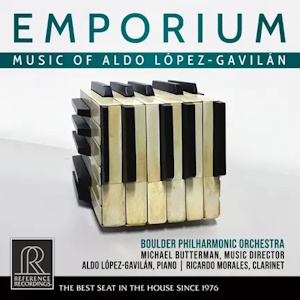
Aldo López-Gavilán (b.1979)
Emporium for piano and orchestra
Clarinet Concerto
Hechizos (Spells) for piano
Aldo López-Gavilán (piano); Ricardo Morales (clarinet)
Boulder Philharmonic Orchestra/Michael Butterman
rec. 2024, Macky Auditorium Concert Hall, Boulder, Colorado, USA
Reference Recordings RR-1545ACD [70]
This Cuban composer, from an intensely musical dynasty, is not cut from anyone’s avant-garde cloth. His career has had him conducting many of the USA’s orchestras, though not as yet the international first rankers. As to his invention, it is catchy, his ideas are approachable and his ear for mind-snaring orchestration is unquestionable.
Emporium, in three movements, brings into profitable collision sophisticated film music and catchy, incessantly romantic material: Beethoven, Saint-Saëns and a bracing splash of Shostakovich. The whole has an indubitably feel-good signature. There is also a Central American fragrance and tang in the mix. The music is compelling evidence that this composer can write title music with the facility of a Carl Davis or a John Addison. The second movement is slower and mulls over the briskly expressed idea at the core of the first movement. It does this in a sincere way and with a touch of Ashokan Farewell in the weave. The finale, which strives for the heights of victorious expression, is propulsive; that is accentuated by an upfront “wall of sound” balance. This is memorable stuff: think the Magnificent Seven theme mediated with Queen’s Bohemian Rhapsody. The orchestra slams along in an elemental storm and a sigh. This is a concert performance and the audience whoop it to the rafters but are blessedly silent during the music.
The Clarinet Concerto, played by Ricardo Morales, begins with a dolorous solo. The score has less power than Emporium. Along the way López-Gavilándelivershalf shuddering sorrow and half comforting lullaby. There’s also a splash of jazz – pointillist and reiterative. The solo clarinet is unafraid of reminiscing around the wild and woolly aspects of Michael Nyman’s Where the Bee dances. An autumnal middle movement has a very appealing amorous melody that would charm the birds from the trees. The scatty-jazzy finale finally gathers itself for a whistle-able melody – that is if you can whistle that fast. Things end with a mighty yawning sunset that is aglow with all the sundown hues. Again, there’s applause at the end.
The final work Hechizos (Spells) spans 19 minutes and three movements. It is a piano solo. This takes in a tour of Ravel – first a subtle Pavane for some witch-like spright. Notes float like dazzling, slowly whirled nets with a dose of hypnosis doled out in repetition and lullaby. It’s like a mesmerising meeting between William Baines meets Claude Debussy. The final Incantations puts away sleepy things. It pirouettes and steps it out with finesse and dynamism. I can see this ‘suite’ making a place for itself in young artist competitions and piano-lion demonstrations.
The liner essays are is by the composer and by Stephen Cook. They are in a handsome picture-bedecked booklet (a Reference Recordings tradition). Good and comprehensive as they may be, they still manage to avoid saying when this music was written. Otherwise, they are helpful on the detail and are pitched at the right level for a general readership.
The composer and orchestra and, in the Clarinet Concerto, Ricardo Morales, parade all the brilliance you could ask or imagine. Butterman, clearly something of a populist communicator, has many classical music television broadcasts under his belt; a bit like Leonard Bernstein
This SACD hybrid sets out premiere recordings of this composer’s works.
Take an armchair and enjoy a plenipotentiary’s sound-picture.
Robert Barnett
Buying this recording via the link below generates revenue for MWI, which helps the site remain free













