
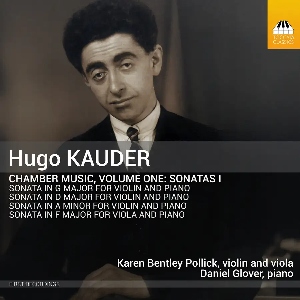
Hugo Kauder (1888-1972)
Chamber Music Volume 1
Violin Sonata in G major (1913-14)
Violin Sonata in D major (1919)
Violin Sonata in A minor (1920 rev. 1965)
Viola Sonata in F major (1918)
Karen Bentley Pollick (violin, viola)
Daniel Glover (piano)
rec. 2025, Scoring Stage, Skywalker Sound, Skywalker Ranch, Nicosia, USA
Toccata Classics TOCC0782 [73]
Hugo Kauder was one of the many ‘provincials’ in the Czech Lands who was to gravitate to Vienna, the Imperial capital, to further his career, something he did in 1905. He had a penchant for Franco-Flemish music – Josquin des Prez was a particular academic enthusiasm – but also pursued life as a violist in a leading string quartet and as an orchestral violinist. He was in Mahler’s orbit via friendship with Karl Weigl, Mahler’s répétiteur at the Court Opera for several years, and also played at Schoenberg’s Society for Private Musical Performance.
Toccata’s first disc in a Kauder chamber music series focuses on his four string sonatas, written between 1913 and 1920 – though this last sonata is heard in its 1965 revision. It shows a broadly traditional ethos though one subject to some stylistic flux. The Sonata in G major, for instance, composed during 1913-14, is the most clearly Brahmsian in a lyrical, unhurried way though I found elements of the first movement rather discursive. The surprise is the central movement, a Cabaret-style Intermezzo, cleverly developed, very approachable and immensely appealing. In the finale Kauder employs variations on a chorale-like theme, each variation offering contrast and variety including one of a decidedly Semitic nature. The sonata ends gently, a lesson well learned from Brahms.
The one-movement, brief, almost aphoristic, Sonata in D major (1919) – it lasts six minutes – offers quicksilver mood changes in a generally light-hearted, fanciful style, far removed from any academic exercise. This was followed the following year by the Sonata in A minor, a large-scale three-movement work that presents a fuller exploration of Kauder’s compositional skill. In fact in 1921 Kauder orchestrated it, with the addition of a Mahlerian Scherzo, and this has been recorded by Leon Botstein on Avie as the Symphony in A. The first movement has a tendency to be quite clotted but both instruments have equally strong roles – the piano is certainly not subservient. – whilst the slow movement develops into a rarefied and rather beautiful Processional. The gaunt Passacaglia of the finale, sustained over ten minutes, and possibly reflecting once more the influence of Brahms (especially the finale of the Fourth Symphony) generates an insistent, acerbic quality, strongly syncopated, and ending with tart chords.
Kauder’s Viola Sonata dates from 1918 and is, by comparison, a much more relaxed example of his art, which reaches almost arcadian heights in the first of the two movements where Kauder’s gift for ingratiating lyricism is at its most marked. His propensity for variational form is apparent in the second movement, the sonata’s finale, which features a succession of changes of mood and texture – the variations are alternately playful, ingenious and hint at the Chassidic. The variations end, appropriately, gently.
There were times, particularly in the G major Sonata, when I felt the piano was slightly over-recorded in relation to the violin but that may be the result of Kauder’s propensity toward pianistic independence and amplitude. As a result, it possibly exaggerates the relative thinness of violinist Karen Bentley Pollick’s tone. Some of the writing tests intonation. She plays both violin and viola in the recital, though she’s a better violinist.
These are all premiere recordings. The booklet essays are excellent and tell us a great deal about Kauder, his milieu and his post-Viennese life in exile in the USA.
Jonathan Woolf
Buying this recording via the link below generates revenue for MWI, which helps the site remain free













