
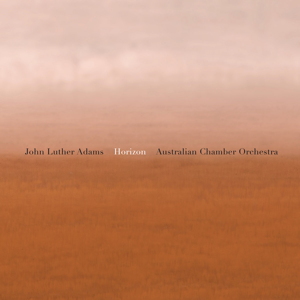
John Luther Adams (b. 1953)
Horizon (2025)
Australian Chamber Orchestra/Richard Tognetti
rec. 2025, The Concourse, Chatswood, Sydney, Australia
Reviewed from a WAV download: 44.1 kHz/16-bit
ABC Classic ABCL0137 [41]
Somewhere in the southern Pacific, a man stands at a ship’s railing and contemplates throwing himself overboard. The pull is sudden and almost overwhelming, and he recognises it. He remembers an old maritime word, ‘Calenture’, which names the rapture of fevered sailors who mistook the sea for cool meadows and stepped into their graves. He breathes, steadies himself on the line where water meets sky, sits down, and returns to the score open in front of him. The title at the top of the page is Horizon. This is John Luther Adams, telling the story himself in the booklet essay that accompanies this remarkable new recording, and the episode marks the moment of the work’s composition.
‘Remarkable’ is an overused word in music criticism, but no other will quite do for Adams. For something like fifty years now he has been writing music that holds no obvious analogue in the work of any of his contemporaries. It’s neither minimalist nor post-minimalist nor process-driven in any received sense, but rather a slow, attentive listening to landscapes and weather systems translated into orchestral textures of extraordinary patience and inner motion. Become Ocean, the Pulitzer winner of 2014, is the work most readers will know; the Become trilogy as a whole, An Atlas of Deep Time, Canticles of the Holy Wind, and the outdoor performance pieces all constitute one of the most singular bodies of work in contemporary American music. Adams left Alaska in 2014 after almost forty years there, and has since lived in the Sonoran, Atacama and Chihuahuan deserts. He now lives in the Red Centre of Australia. Geography is not incidental to him.
Horizon is the first major work to come out of his Australian residency, and it is also, in an essential way, a memorial. The booklet essay — which is a substantial piece of literary writing in its own right, and one of the most affecting things Adams has published — is framed around his forty-year friendship with the writer Barry Lopez, who died in 2020. Adams’s piece takes its title from Lopez’s 2019 book of the same name, and the essay traces the long arc of their conversation from a snowy walk above Adams’s Alaskan studio in the early nineties, when Lopez first sketched the book aloud, to that final South Pacific morning at the railing. Lopez’s Horizon is a vast and unsparing reckoning with the state of the world, and Adams’s piece carries something of that book’s gravity into a different medium. Lopez is everywhere in it.
The work is a diptych, two movements, each precisely twenty minutes and twenty-three seconds long. The exactness is the first thing one notices. Adams is drawing on a distinction he attributes to Lopez: that there are, in our experience of the world, two horizons rather than one. The visible horizon is what we can actually see from where we stand, hemmed in by trees and buildings and ridge lines. The true horizon is the complete circle where sky meets earth or sea, the one most of us almost never see whole. Hence Visible Horizon and True Horizon are the titles of the two movements.
The pieces can be heard as two contrasting arches. Visible Horizon moves outward from quiet beginnings into a single sustained climax just before the ten-minute mark — a passage of frenzied bowing and high trilling, that gradually slows and disperses as the energy bleeds away. The texture is dominated by the lower-mid orchestral register. The harmony holds to a narrow band of pitches throughout, modal in a way that feels slightly austere; one feels closed in, hemmed about, the view exactly as Adams describes the visible horizon, fenced by what stands between us and the line of the sky. True Horizon presents the inverse motion. Its arch has a different symmetry, and at almost exactly the same ten-minute point the texture does not climax but collapses into a few seconds of near silence, flanked on either side by a repeated detached unison A. Where Visible Horizon arrives at its centre at an event, True Horizon arrives at an absence. This is the formal stroke that makes the piece. The two ten-minute centres are mirror images: in one, the closed view is pierced by something seen; in the other, what hems us in simply drops away and the full circle stands open. Adams has built Lopez’s distinction into the architecture of the music itself.
About the performance there is little to say beyond what one has come to expect from the ACO under Tognetti, which is to say everything. The playing has the concentrated precision and latent power that have become this orchestra’s signature, and beneath the surface of both movements one senses a shared understanding of where the music is going long before it gets there. It is music that requires patience from its players above all, and they give it without hesitation.
In the central passage of the booklet essay, Adams sets out the artist’s task in the present moment as a movement through three stages: first the honest articulation of mourning, then the search for whatever consolation might lie on its far side, and beyond that, some still more distant possibility he is willing to call redemption. He speaks of his music wanting, in his own simple phrase, ‘to be of use’ to people he will never meet, the next generations who may yet build a culture he will not live to see. Horizon is the most direct realisation he has yet given us of that ethical programme. It’s a piece that does not flinch from elegy, nor retreat into despair. It feels to me as if it stands at the threshold of something that lies beyond both. This performance demonstrates, with the kind of clarity that only the finest players can give it, how completely Adams has done what he set out to do.
Dominic Hartley
Availability: Bandcamp













