
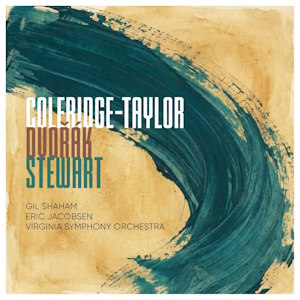
Samuel Coleridge-Taylor (1875-1912)
Violin Concerto in G minor, Op.80 (1912)
Antonín Dvořák (1841-1904)
Violin Concerto in A minor, Op.53 (1883)
Curtis Stewart (b.1980)
The Famous People: F Harper
Gil Shaham (violin)
Virginia Symphony Orchestra/Eric Jacobsen
rec. 2023, The Sandler Center for the Performing Arts, Virginia Beach, USA
Canary Classics CC27 [66]
This isn’t the first time that these two concertos have been coupled. Philippe Graffin recorded them with the Johannesburg Philharmonic and Michael Hankinson on Avie. There are two other recordings of the Coleridge-Taylor known to me – those by Anthony Marwood, coupled with the Arthur Somervell Concerto on Hyperion and Lorraine McAslan’s recording with Nicholas Braithwaite on Lyrita, alongside Julius Harrison’s Bredon Hill. All of which shows that the Concerto has gained increasing traction, as they say, in the market, even if the recordings haven’t necessarily generated live performances.
Shaham is teamed with the Virginia Symphony Orchestra which enjoys an imposing acoustic in the Sandler Center for the Performing Arts, Virginia Beach – there’s ripe sonic mass without a lack of definition, which is all to the good. The fine conductor is Eric Jacobsen. For all the work’s eloquence I find the first movement is its weakest point. It can be a bit lumpy and can lurch around and there’s largely consensus about timings in this opening movement. The slow movement redeems this weakness, offering charm and warmth and Shaham draws these elements together magically, never giving way to sentimentality. Graffin takes this slow movement at a relaxed tempo but McAslan, Marwood and Shaham take it a minute quicker and I prefer their tempi, I have to say. The finale is played with clarity, directness and striding, rather Elgarian, confidence. The balance between Shaham and the orchestra is well managed and the liveliness and energy of the music are conveyed eloquently. Shaham doesn’t indulge things here and he’s considerably quicker than the competition – a good two minutes quicker than McAslan for instance – which tightens Coleridge-Taylor’s slight sprawl. Again, I admire his decision making. The Coleridge-Taylor Concerto should be enjoyed for what it offers, not for what it doesn’t – that’s to say not heaven-storming virtuosity or sacred musing, but rather engaging tunefulness, outstanding orchestration and lyric warmth.
Coleridge-Taylor was a violinist so would have known the Dvořák Concerto which had received its British premiere in London in 1886 and had already appeared at the Proms twice before Coleridge-Taylor’s death, in 1899 and 1904. It makes an apt coupling, as its fusion of the lyric and the dynamic are similarly evident. There are now, thankfully, so many great recordings of the concerto, from the 1930s onwards that it’s all but impossible to make a definitive recommendation. What I can say about Shaham’s playing is that his employment of rubati is distinctive and subtle, his dynamics are deftly employed, and he keeps the music, once again, moving forward, ensuring no slackness. Some orchestral detail can be a touch muddy but otherwise this is another fine performance, which ends very emphatically.
The disc ends with Curtis Stewart’s The Famous People: F. Harper, a short piece based on Dvořák’s Slavonic Dance, Op.46 No.2 but which is ‘fused with traditional American Slave dances – the Ring Shout, Juba, Cakewalk, Pigeon Wing, Buck and Wing…’ in the composer’s own words. At five minutes it manages to pack in some genial and exciting dances, but it is largely surplus to requirements in a concerto disc of this kind.
Jonathan Woolf
Buying this recording via the link below generates revenue for MWI, which helps the site remain free













