
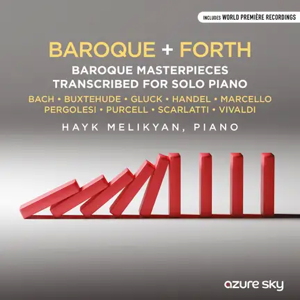
Baroque + Forth
Baroque masterpieces transcribed for solo piano
Hayk Melikyan (piano)
rec. 2025, Komitas Museum-Institute, Yerevan, Armenia
Azure Sky AZ1022 [57]
Hayk Melikyan follows up his 2025 release of Bach transcriptions, Bach + Forth (Azure Sky AZ1005) with this disc of the wider baroque world, still including Bach. Older transcriptions by familiar names, Ferruccio Busoni and Wilhelm Kempff amongst them, are supplemented by four transcriptions of vocal items by Melikyan himself. Also included is a transcription by Bach, the adagio from Alessandro Marcello’s oboe concerto in D minor, a timeless movement that could be said to have set the scene for future transcribers from Alkan and d’Albert to Zadora and Zimerman.
One might think that the rather sedate and sustained aria Lascia ch’io pianga would not make an ideal choice for piano transcription but Melikyan skilfully weaves a fluid but subtle web of broken chords around Handel’s lovely melody while a change of register and resonant deep bass notes for the da capo bring a wonderfully rich texture. He couples it with Wilhelm Kempff’s noble transcription of the stately minuet in G minor with its gentle and delicious dissonances. Kempff is also represented by In dulce jubilo with its hints of carillon and the chorale prelude Befiehl du deine Wege though from what I can tell Kempff actually transcribed the organ chorale prelude Herzlich tut mich verlangen. They share the same familiar melody, one that is found several times in the St Matthew Passion, but Befiehl du deine Wege is the chorale BWV.270 not the chorale prelude BWV.727 that Kempff actually transcribed.
Staying with Bach there are two of Busoni’s masterful transcriptions. Busoni transcribed the entire Toccata, adagio and fugue but like Myra Hess Melikyan plays the heart-wrenching adagio separately. From the ten chorale preludes he chooses the sonorous Advent hymn Nun komm’ der Heiden Heiland, matching the richness of the timbre with beautifully voiced lines and fine tone from his Shigeru Kawai piano. The transcriptions of Alexander Siloti, Rachmaninov’s first cousin, are not at all well known but feature a large number of Bach’s works and venture into romantic territory, Glazunov, Tchaikowsky, Rachmaninov, Johann Strauss and even further with Ravel’s Kaddisch. They are usually relatively straightforward arrangements but can sound sublime in the right hands – think Emil Gilels in the B minor organ prelude. His version of the Andante from the A minor violin sonata is close to this in beauty and a good choice for those who perhaps find Godowsky’s version too lush. Dido’s lament captures the desolate despair very effectively while demonstrating its romantic roots with grand doubled octave bass lines.
Melikyan returns to Kempff for the melody and dance of the blessed spirits from Gluck’s Orfeo ed Euridice. Other pianists have transcribed these. Abram Chasins and Alexander Siloti chose the melody as did Giovanni Sgambati whose version was once a popular encore while Ignaz Friedman made an intricate arrangement of the dance. Kempff creates a lovely sound in the dance with an almost bell-like timbre while maintaining the relative simplicity and charm of the original. The transcriptions of Bach evidently influenced his pupil, Egon Petri who made many arrangements of Bach and other baroque composers. Melikyan includes his transcription of a chorale prelude by Buxtehude, a quietly reflective work but one rich in contrapuntal textures.
The recital closes with three more vocal transcriptions by Melikyan starting with Pergolesi’s noble quando corpus morietur that develops in intensity as Melikyan adds a subtle held bass note which, hushed as it is, adds a wonderful resonance. The chirpy sento il seno from Vivaldi’s Giustino belies the loss in the heart of the singer; do not cry my heart as your tears do not ease my ache. It is something of a study in playing a legato line within a staccato accompaniment and brings a welcome change of timbre to the recital. It is apt that for the final transcription Armenian pianist Melikyan has chosen an aria from Tigrane by Alessandro Scarlatti considering that Tigrane was an Armenian military commander, son of the Persian Queen Tomyris, though neither realise this until the end of the opera. This gently flowing aria, ably evoking the soft breeze of the title, is sung by Meroe who ends up marrying Tigrane once familial complications are sorted out.
Melikyan’s own transcriptions make a welcome addition to the canon and fit well amongst the others, rare and familiar, in this well planned recital. He doesn’t always charm in the way that Kempff does in his playing and I find his dance of the blessed sprits too fast and a bit abrupt but otherwise he impresses with his fine lines, balance of voicing and intensity in what is for the most part quite a serious recital.
Rob Challinor
Buying this recording via the link below generates revenue for MWI, which helps the site remain free

Contents
George Frideric Handel (1685-1759)
Lascia ch’io pianga from Rinaldo HWV.7 (1711, arr. Hayk Melikyan)
Minuet in G Minor HWV.434 No.4 from Suite de pièce Vol. 2 No. 1 (1710-1717? , arr. Wilhelm Kempff)
Dieterich Buxtehude (1637-1707)
Nun bitten wir den heiligen Geist BuxWV.208 (arr. Egon Petri)
Johann Michael Bach (1648-1694)
In dulci jubilo BWV.751 (arr. Wilhelm Kempff)
Johann Sebastian Bach (1685-1750)
Befiehl du deine Wege BWV.727 (arr. Wilhelm Kempff)
Adagio from Toccata, adagio and fugue BWV.564 (1708-17, arr. Ferruccio Busoni)
Nun komm’ der Heiden Heiland BWV.659 (c.1740)
Andante from the Violin Sonata in A Minor BWV.1003 (1720, arr. Alexander Siloti)
Henry Purcell (1659-1695)
When I am laid in earth from Dido and Aeneas Z.626 (1683-1688, arr. Alexander Siloti)
Christoph Willibald Gluck (1714-1787)
Orpheus’ klage – Reigen seligen Geister from Orfeo ed Euridice (1762, arr. Wilhelm Kempff)
Alessandro Marcello (1673-1747)
Adagio from Oboe Concerto in D Minor BWV.974 (1715, arr. Johann Sebastian Bach)
Giovanni Battista Pergolesi (1710-1736)
Quando corpus morietur from Stabat Mater P.77 (1736, arr. Hayk Melikyan)
Antonio Vivaldi (1678-1741)
Sento il seno from Il Giustino RV.717 (1724, arr. Hayk Melikyan)
Alessandro Scarlatti (1660-1725)
Sussurando il venticello from Tigrane (1715, arr. Hayk Melikyan)













