
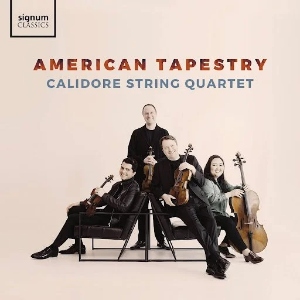
American Tapestry
Samuel Barber (1910-1981)
String Quartet,Op.11 (1935-1936)
Wynton Marsalis (b. 1961)
At the Octoroon Balls (1998): Movements 3-5
John Williams (b. 1932)
With Malice Toward None from Lincoln (2012)
Erich Wolfgang Korngold (1897-1975)
String Quartet No.3 in D major, Op.34 (1945)
Calidore String Quartet
rec. 2023, GenevieveW. Gore Hall, Louise and David Roselle Center for the Arts, University of Delaware, Newark, USA
Signum Classics SIGCD970 [71]
American Tapestry is a somewhat misleading title – one of the composers arrived as an “adoptee” in the late 1930s – but the pieces fit well together as a programme. Two major quartets surround shorter works, all four in exemplary accounts.
Samuel Barber’s String Quartet may be best known for its Molto adagio middle movement in the composer’s popular arrangement for string orchestra. He composed the quartet when he was in Europe to receive the esteemed Rome prize. He revised the outer movements until 1943 when the Budapest String Quartet gave its official first performance at the Library of Congress. He orchestrated the middle movement in 1938 as the Adagio for Strings following Toscanini’s premiere performance with the New York Philharmonic. It has remained his most popular piece in that form ever since.
The String Quartet begins with a dramatic Molto allegro e appassionato that contains a lyrical second subject, quite as beautiful as the Molto adagio second movement. A very short finale sums up the work. The Calidore Quartet’s fine account does not overindulge in the romantic passages of the piece. Their performance compares well with the account by the Emerson Quartet on DG coupled with Charles Ives’s two quartets.
I had not been familiar with Wynton Marsalis’s At the Octoroon Balls, his first string quartet. There are seven movements in all, and the Calidore perform three of them here. While I would have liked to hear the whole work, these movements are satisfyingly complete in themselves. The rhythmic and jazzy third movement, Creole Contradanzas, depicts Eighteenth- and early Nineteenth-century Creole balls. In contrast, the fourth movement, Mary Gone, is an African-American lament on the issue of slavery. As one would expect, the music is rather solemn and dark. The opening chorale is to be played in moaning manner, according to Marsalis. One can detect that with the strings’ portamento. There also is an animated solo cello part, and afolksy one for the viola, so it is not all dark and melancholy.
The fifth movement, Hellbound Highball,could not be more different. It is a jazzy depiction of a train bound for hell! Very rhythmic and chugging in its forward motion, it slows down and then speeds up much as a train would. Other effects, such as train whistle sounds and cello groans, are all done here with relish. It is quite virtuosic and fun. The Calidore do the music proud and whet one’s appetite for the other movements.
I reviewed John Williams’s With Malice Toward None from the film Lincoln in his version for cello and strings. Now he has arranged it specifically for the Calidore Quartet. The piece comes as a significant calm after the Marsalis piece. It begins with a gorgeous cello solo before the full quartet take over. This prayer for peace, needed now more than ever, gets an exquisite account here.
Erich Korngold’s third and final quartet concludes this fascinating programme. He dedicated it to Bruno Walter, who also emigrated to Los Angeles. The Third String Quartet is a major work that utilizes tunes from a few of Korngold’s movie scores, but so well integrated in the music that one is likely unaware oftheir provenance. The quartet is in the standard four movements, starting with an Allegro moderato in sonata form. Highly chromatic, it frequently shifts from atonality to tonal romanticism. There follows a lively atonal but captivating scherzo and a contrasting trio, whose theme was taken from the film Between Two Worlds.
The third movement, Sostenuto: Like a Folk Tune, opens with a pensive and melancholy theme in E flat minor; the music is borrowed from the 1941 film The Sea Wolf. The movement contains some notable tremolo writing, and builds in its intensity from atonal to tonal and back. The Finale quickly turns jolly in a major key, becoming folksy and jazzy – quite toe-tapping! It uses material from Devotion, a film about the Brontë sisters. Violinist Elicia Silverstein, in her booklet note, finds here something “Stravinsky-esque in the folksy, neo-classicism”. I detect a bit of Pulcinella-like rhythm, as well as an American feel.
This recording has considerable competition, including the recent Pacifica Quartet account on Cedille of Korngold’s string quartets and other chamber works (review). I have not heard that, but to me the Calidore clearly have the measure of the music.
All told, this is a well-planned and enjoyable release. The performance and recording are excellent. If the programme appeals, do not hesitate to add this to your chamber music collection.
Leslie Wright
Buying this recording via the link below generates revenue for MWI, which helps the site remain free













