
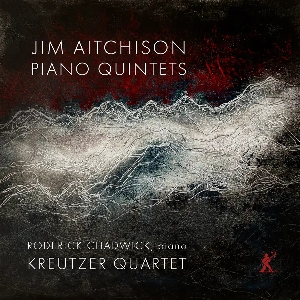
Jim Aitchison
Piano Quintet No. 1 Margarete (2023)
Piano Quintet No. 2 Transience Patterns (2024)
Roderick Chadwick (piano)
Kreutzer Quartet
rec. 2024, Angela Burgess Recital Hall, Royal Academy of Music, London
Métier MEX77141 [67]
Aitchison and Metier stride up to the listener with two recent, uncompromising piano quintets that were written in adjacent years. Of late, Aitchison has written a clarinet quintet for Linda Merrick and the very same Kreutzers who are here deployed for the present Metier project.
The composer has been much gripped by responses to the visual arts. In this connection he has worked with and or been inspired by Richard Deacon, John Hoyland, Antony Gormley, Doris Salcedo, Mark Rothko, Anish Kapoor, Gerhard Richter and Anthony Caro.
Aitchison has been fortunate in his choice of musicians for the present project. The Kreutzer Quartet includes familiar and well respected names, amongst which are the gifted and multi-faceted violinists Mihailo Trandafilovski and Peter Sheppard Skaerved.
The Piano Quintet No 1 (2023) is in three movements and emerges from the composer’s response to Anselm Kiefer’s 1981 painting, ‘Margarete’ The quintet opens with a deeply serious de profundis Prelude and Chorale. This is unhurried, dreaming, gently discordant and tentative. Sometimes granitic, the music seems to evoke a psychological vortex slowly turning and twisting. The second movement is fragmented. There are no long melodic lines: rather a splatter of figures, dissonance and fragmentation. The finale is a dance fugue which at first makes dour progress and then attains a nightmareish gallop: the wolf pack bares its teeth. Dissonance pounds away but then stoops and relaxes to gain breath. A decelerando into a grim mood murmurs but delivers no blessing.
The Piano Quintet No 2 Transience Patterns (2024) reflects Aitchison’sreaction to “the passage from dark to partial light at Tremenheere Sculpture Gardens after an experience of James Turrell’s Aqua Oscura installation.” It is surely typical of this composer that this work addresses the seasons but omits summer. There is a Prelude followed by four sets of variations on the Brahms chorale Mir Lacheit. The Prelude is a brief slow benediction – more the equivalent of a matte charcoal sketch. The following “Blind Tide” (II) is a dour essay – a groaning dissection of the human predicament. A dense weave of saturated sound emerges and a rare tenderness moves like a wraith in background. “Autumn” then tolls out and encompasses shadows of the Dies Irae. Winter is a fugue which is pecked out, rather than undulated, in a tempest of scattered note fragments. The finale turns to “Spring” but this is no buffeting breeze; rather a thoughtful prayer-sequence sliding into an oblivion that is patently authentic and sincere.
On the technical side the listener cannot help but be conscious of is good separation between left- and right-hand channels. This is subtly wide rather than exaggerated, As for the playing, it communicates with earnest candour and the frank undertow that comes with players who sound as if they have lived with the music rather than just read the score and parts.
The booklet notes are very full and are by the composer so there is no distorting ‘filter’ of another arbiter. The booklet itself is an object lesson in good design, in font size and in the choice of clean black on white.
Rob Barnett
Buying this recording via the link below generates revenue for MWI, which helps the site remain free













