
Georg Philipp Telemann (1681-1767)
12 Fantasias for Violin Solo, TW 40.14-40.25 (1735)
Maurice Clare (violin)
rec. 26-27 August 1974, in Nimbus’ Handsworth Wood Studio, Birmingham
Nimbus Rediscovered Recordings Series
Nimbus NI7118 [77]
Nimbus’ latest series of discs, released under the ‘Rediscovered’ marque, is artist-led and has thus far included recordings by Soulima Stravinsky, Ronald Smith, Shura Cherkassky and Martin Jones. Many were released on LP but have never appeared on CD whereas some, including the disc under review, were never issued at all.
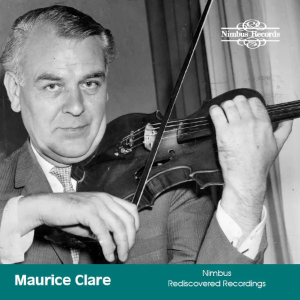
I suspect only violin-fanciers, a lonely but clement breed of collectors, far removed from the fractious worlds of pianophiles and opera-nuts, will now remember Maurice Clare. The Scottish fiddler (1914-1987) studied with Ševčík and Flesch, and finally with Enescu, making his debut in London in 1930. His tours in New Zealand led to an invitation to found a string orchestra, which was later to become the country’s National Symphony Orchestra, but after the War he returned to Britain to lead the Boyd Neel Orchestra. This is the context in which I know his name but unlike, say, Frederick Grinke, a previous leader, he made no solo recordings, so Clare is not well remembered, though he did give some premières – Milhaud’s Concertino du Printemps and a French radio broadcast of Rawsthorne’s Concerto No.1. He then moved to Australia, toured for the British Council, and returned to London in the 1970s.
On two successive days in August 1974 Nimbus recorded him in the company’s Handsworth Wood Studio in Birmingham in the Telemann Fantasias for Violin Solo. This was pretty esoteric repertoire for the time, and I suspect the impetus for a recording might have been Arthur Grumiaux’s Decca set, which was issued a few years earlier. Given the many recordings the Fantasias have received over the last couple of decades, it’s salutary to recall a time, as with so much Baroque opera, when there was a single set available, if that. Now, of course, you just snap your fingers and along come Rachel Podger, Fabio Biondi, Andrew Manze, Peter Sheppard Skaerved, Federico Guglielmo, Alina Ibragimova and many others.
Clare, however, shouldn’t be considered through the prism of historically-informed performance practice but rather in the context of Bach’s Sonatas and Partitas – and whilst the Fantasias are very different works altogether, Clare’s tone production and vibrato, as well as his expressive instincts, align him more in that direction. Grumiaux took 62 minutes whilst Clare takes 77. If one sees that as reflective of a typically heavier, more romantically-conceived and leisurely traversal, then think again, as both Podger and Manze, for instance, are equally elastic in tempi.
Clare differs from Grumiaux in his accenting and underlying rhythmic impetus in the dancing, often folk-infused Allegros. Clare’s Largos are statelier and more reserved, as well as being more heavily vibrated – steady, robust. Yet Clare finds some wit along the way – try the concluding Allegro of No.4 in D major – and plays cleanly with no slides. He brings liveliness to the Sicilianos – in No.6 especially – and sustained lyric eloquence to the central slow movements. If you want to gauge his expressive way with these works, you could do a lot worse than focus on the Largo of No.10 in D major. Throughout, this admirable player offers much to please the listener.
The sound is well judged, and there are inevitably brief studio noises from time to time. The notes are, as they say these days, person-focused and give us much useful biographical material about this now forgotten player. This release admirably salutes his memory.
Jonathan Woolf
Buying this recording via the link below generates revenue for MWI, which helps the site remain free














