
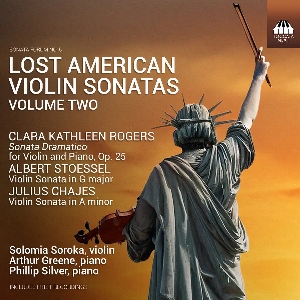
Lost American Violin Sonatas Volume 2
Clara Kathleen Rogers (1844-1931)
Sonata Dramatico, Op.25 (1888)
Albert Stoessel (1894-1943)
Violin Sonata in G major (c.1920)
Julius Chajes (1910-1985)
Violin Sonata in A minor (pub.1944)
Solomia Soroka (violin)
Phillip Silver (piano: Rogers, Stoessel)
Arthur Greene (piano: Chajes)
rec. 2019, Britton Recital Hall, University of Michigan School of Music, Theatre and Dance, Ann Arbor, USA
Toccata Next TOCN0049 [66]
This is the second disc in Toccata’s series of ‘Lost American Violin Sonatas’. The first volume focused on three German-trained composers born between 1857 and 1866 but the volume under review spreads its net wider chronologically and also geographically, as only one of the composers was American by birth.
Clara Rogers was British, the granddaughter of cellist Robert Lindley, one of the finest players of his time, and daughter of John Bartlett, composer of the opera The Mountain Sylph, which was well known enough to be parodied by G & S in Iolanthe. Though she composed when young – a movement of her String Quartet was championed by a fellow Leipzig Conservatoire classmate, Arthur Sullivan – she became an operatic singer retiring from the stage in her mid-30s when she married a Boston lawyer, moved to America and established musicales at her house. Her Violin Sonata is dated to 1888, which is the year it was premiered by Charles Martin Loeffler, no less, with Rogers herself taking the quite demanding piano part.
Though there are some transient Brahmsian elements, the most pervasive influence is Schumannesque-Mendelssohnian. The sonata possesses real lyric impulse, ripely late-Romantic and attractive, the piano’s decorative filigree adding a charming gloss. Violin counter-themes in the first movement are played with persuasive refinement by Solomia Soroka with deft dynamic variance. The slow movement offers long-breathed refinement with thematic material well distributed between the two instruments. The finale is marked ‘Allegro giojoso’, a rather unusual indication, but then so is the sonata itself which Rogers termed ‘Sonata Drammatico’ (Drammatica, surely?). Grammar aside. The fluid contrasts and noble themes in the finale are very attractive, and Rogers has the courage to end her work quietly.
Rogers’ sonata really is ‘lost’ in the sense that it is all-but-unknown but that of Albert Stoessel has at least been recorded, by David Danizon and Alex Maynegre-Torra on the Centaur label. It was written c.1920 and published the following year bearing a dedication to André Caplet, which should give an indication as to Stoessel’s musical affiliations. The aura here is Fauréan with a touch of Delius though as the opening movement develops it gets more heated and explicitly late-Romantic. The piano exudes an impressionist element, both instruments joining to generate open-hearted warmth. The slow movement offers introspection and expressive breadth and there’s a hint of tolling in the piano writing, sufficient to hint, perhaps, at some in memoriam element though this is never as explicit as, say, John Ireland’s Sonata No.2. In any case, the music turns back to the kind of soaring lyricism that irradiated the first movement. The finale is puckish and droll, with more than a whiff of American vernacular but also a charming ‘B’ section lied. Stoessel, who lived to 1943, did record on 78s and it would have been apt if an American label, maybe one of the smaller, specialist labels, had asked him to record his own sonata. Or, if not Stoessel, then someone like Eddy Brown, or Albert Spalding.
Julius Chajes’ Sonata, published in 1944 is, like Clara Rogers’ Sonata, previously unrecorded. Its two outer movements bookend two smaller central ones and the layout is a conventional four-movement one, its opening lyrical, pertly lively and warmly textured. The following Adagio, called ‘Mourner’s Prayer’, is brief but doleful, intense and rapt whilst the ensuing Scherzo is sparkling and taut. The finale is veiled in melancholy and there are definite slices of folkloric influence here, even to the extent of Chajes implying a cimbalom (at least to my ears) in his deft piano writing. However, after the introspection and mournfulness have been unveiled they are dissipated in a swirling fast dance which ends the work triumphantly.
As always, Toccata’s documentation is first-class. The recording quality in the Britton Recital Hall is clear but not quite icy – being critical, I prefer a rather less cool, objective acoustic with a touch more warmth. However, that’s hardly a reason not to consider this excellent disc in which, once again, Soroka shows her stylistic spurs aided by her husband Arthur Greene in the Chajes, and Philip Silver in the Rogers and Stoessel Sonatas – both excellent.
Jonathan Woolf
Buying this recording via the link below generates revenue for MWI, which helps the site remain free













