
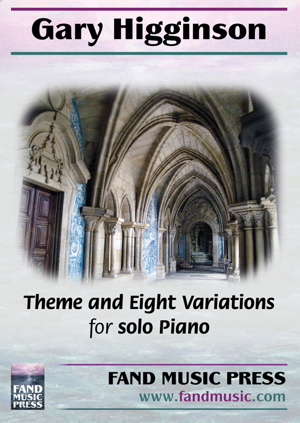
Theme and Eight Variations for Solo Piano
by Gary Higginson
Published 2025
13 pages
Fand Music Press
This is an attractively presented first publication of a substantial piano piece by Gary Higginson, originally composed early in 1972 and dedicated to his then teacher, the distinguished composer Edmund Rubbra (1901-1986). The work is presented in a revised version completed in 2025.
Gary Higginson must be one of the most prolific composers now active in Britain, with more than two hundred works to his name. His choral works are especially distinctive, but his range also extends to chamber and piano composition as well. As one of the best-known pupils of Edmund Rubbra, alongside such notable composers as Philip Sawyers and the late Christopher Gunning, Higginson has a growing reputation as one of the last creative artists to extend the English tonal tradition, remaining steadfast to the time-honoured virtues of good craftsmanship and direct communication with the listener.
I feel that any pianist tackling this work should be at least Grade 6 level. Much of the piano writing lies in the mid register, with clear, transparent textures and a pleasing mixture of homophonic and contrapuntal writing. The final coda adds lower bass notes to the texture, providing an effective sense of closure.
The theme on which these variations are based is a real charmer; it is wonderfully English and disarmingly wistful in character. As an enthusiast of Rubbra’s music, I was naturally curious to see if there were any traits of the older master, as this work was composed under his direct supervision. The informative note that prefixes the score points out that Rubbra asked his students to create variations on an original theme. Higginson states that he found the process initially quite challenging but that it later became “liberating”.
The first variation places a modified version of the theme in the bass, then proceeds to weave a contrapuntal web for several bars before returning to more homophonic textures. The second variation inverts the descending third of the original theme and then takes the music into calmer waters. Incidentally, the “calmo” marking is one used frequently by Rubbra (the adagio of his haunting Eleventh Symphony is marked “calmo e sereno”). This segues into a third variation where the music is especially like Rubbra, with a bassline that often moves in parallel fifths.
The fourth variation begins with ominous bass notes and builds to a powerful fortissimo climax before gliding into the more emotionally ambiguous fifth variation, which contains some interesting harmonic sidesteps. The sixth and seventh variations have passages that move in parallel fourths and fifths respectively and contain interesting echoes of Rubbra’s Tenth Symphony; Higginson’s seventh variation has distinct kinship with some of the more dance-like moments in that contemporaneous work. The final variation ends with a question mark, rather like Rubbra’s Eleventh Symphony. I was impressed by these final bars, which are both satisfying and unexpected.
Throughout the piece, the piano writing is beautifully idiomatic, with the outer extremities introduced sparingly but effectively. The variations are fascinating in the way that they echo the works Rubbra was working on at the time, yet have a distinct personality of their own.
The Theme and Eight Variations was originally performed by Robert Thompson at All Saint’s Church, West Bromwich, in July 1972, before being twice revised, first in 1990 and finally in 2025. It is interesting that the composer feels this is “the right time to have this work published as the style of the music is now more suited to our times than to the 1970s”. I completely agree with that.
I hope that this important new release introduces as many people as possible to the work of Gary Higginson and encourages them to delve deeper into his substantial and rewarding output
David Jennings
Availability: Fand Music Press













