
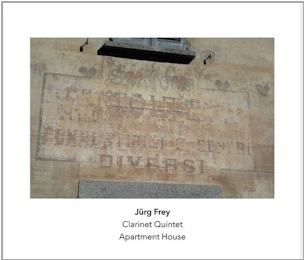
Jürg Frey (b. 1953)
Clarinet Quintet (2023–2025)
Apartment House
rec. 2025, City University, London
Reviewed as a WAV download: 44.1 kHz/16-bit
Another Timbre at256 [54]
For most of his career, Jürg Frey has been a clarinettist as well as a composer. Over fifty years he played across Europe and taught in Swiss schools, carrying the instrument’s character in both body and mind. As Philip Thomas memorably put it, to understand Frey’s music ‘is to know that underlying each event, each phrase, each rest, each relationship, is the beating heart of a performing musician.’ Around 2022, illness forced Frey to stop playing. He has spoken of this without regret, noting that while someone else can always pick up a clarinet, nobody else can write his music. The Clarinet Quintet, composed between 2023 and 2025, is the first major work for his own instrument that he has completed since that withdrawal. Whether it amounts to a farewell, a distillation of his performing experience, or simply the next piece he needed to write is a question best left open. What matters is the music itself.
And the music is quietly extraordinary. Over fifty-four minutes, five instruments pursue a conversation of such gentle purpose and unforced warmth that the effect is less like listening to a performance than overhearing one. The clarinet is not a soloist here. It is an equal participant, woven into the string texture, breathing with it. Frey knows exactly how to place a clarinet inside a quartet of strings so that it belongs there completely. The result is a work of deep, unshowy beauty.
When I reviewed Frey’s Je laisse à la nuit son poids d’ombre earlier this year I was struck by his ability to sustain a 52-minute span with an apparent effortlessness that disguised considerable craft. That piece deployed a large and colourful ensemble: strings, brass, woodwind, percussion, analogue synthesiser, two soprano voices. The Clarinet Quintet could hardly be more different in its means. Five acoustic instruments. No voices, no electronics, no percussion. The most familiar chamber instrumentation imaginable, the same combination that Mozart and Brahms chose. Where Je laisse achieved its atmosphere through timbral variety, the Quintet works with concentration: a narrow palette demanding close attention.
Frey has written about the piece in terms worth hearing directly. He describes the listener encountering a ‘paradoxical situation: it is music that seems to stand still, yet continues to move forward, and after 50 minutes we arrive at a place we could not have imagined at the beginning.’ This is an accurate account of how the Quintet feels. The harmonic world is tonal. The opening minutes possess a settled, sympathetic territory that seems to promise very little drama. And yet, listened to across its full span, the piece covers a remarkable amount of ground. The harmonies shift so gradually that the ear cannot quite locate the moment of change, but by the final pages the music has arrived somewhere altogether different from where it began.
The large-scale shape is worth describing. The first half builds slowly from spare, quiet phrases towards the most assertive passage in the entire work, around the ten-minute mark. From there it subsides, the textures thinning, the dynamic level dropping, until it reaches a passage of extraordinary delicacy around twenty-three minutes in. This is not silence, exactly, but something very close: a repeated, faint, single-instrument pizzicato. From this threshold the second half emerges with a different character. It is fuller, more sustained, the instruments more continuously present. The music ends with a long, unhurried withdrawal.
The sound world is distinctive. The strings play almost entirely in their middle and lower registers. The clarinet sits in its warmest range for much of the first half, rising higher and with more mobility thereafter. The overall effect is intimate and blended, without rhetoric or virtuoso display. The writing has an apparent simplicity: open strings, gentle dialogues between individual instruments, and passages where the clarinet drops out entirely and the strings converse alone. The clarinet’s subsequent return has a particular quality of arrival, each time slightly changed.
The tonal language avoids strong directional harmony, inhabiting a space that is settled without being static or predictable. The ear can rest inside each sound rather than being pushed forward to the next. In the second half there is an enrichment, the harmonic language broadening, admitting more colour. And the rhythmic profile shifts too. The strings move to shorter, more animated figures. The clarinet begins to play what sounds like fragments of melody, phrases that hint at a song we are never quite given in full. It is deeply affecting, partly because of how much restraint has preceded it.
What comparison helps here? The endorsements that accompany the album invoke Brahms and Schubert, and I understand why. But listening repeatedly I found myself drawn to an older sound-world. The strings, in their colour and the intervals they favour, reminded me at times of a viol consort. The clarinet became a complementary voice, not unlike a singer. Think of a Dowland song at its most tender and bittersweet. I don’t want to push the analogy too far, but there is something in the pace of the writing, the sense of each note being placed with care, and the melancholy that never quite declares itself, that made the connection feel real.
This is music for repeated listening, not because it is difficult to grasp but because each listening seems to open another layer. A phrase that seemed incidental on first hearing turns out to carry weight. A harmonic shift that passed unnoticed reveals itself as the pivot of an entire passage. And Apartment House are the ideal performers. Every detail of Frey’s quiet, apparently spontaneous conversation is rendered with care and naturalness. Heather Roche deserves particular praise. Her clarinet playing is beautifully integrated, sensitive to the strings around her, never imposing, always present. The recorded sound, captured by Simon Reynell at City University London, is superb. The balance places the listener close to the ensemble without any sense of clinical proximity.
This is a very fine addition to Another Timbre’s substantial Frey discography. I should note that I’ve been working from an advance copy without supplementary material. Another Timbre plan to publish an interview with Frey on their website in time for the CD release, and it will be worth seeking out. But the music truly speaks for itself with an eloquence that needs no commentary.
Availability: Another Timbre, BandcampPerformers
Heather Roche (clarinet)
Mira Benjamin and Chihiro Ono (violins)
Bridget Carey (viola)
Anton Lukoszevieze (cello)













