
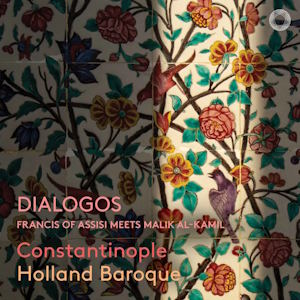
Dialogos
Constantinople
Holland Baroque
rec. 2025, Pieterskerk, Utrecht, The Netherlands
Pentatone PTC5187493 SACD [58]
Current events in the Persian Gulf are a result of a breakdown in dialogue between three regimes. As we are all experiencing however, the knock-on effects are being felt all around the world. I reached for this CD as an antidote to the depressing cycle of headlines and forecasts coming out of the conflict every day from surely too many media sources. The record from Pentatone is a collaboration between Constantinople and Holland Baroque. Constantinople are represented here by just three musicians, their frontman Kiya Tabassian on setar, the ever-present Didem Başar on Kanun (or Qanan) and Patrick Graham with a whole host of percussion to hand. Holland Baroque are led by twin sisters Judith and Tineke Steenbrink. They field nine violins (led by Judith), just the one cello for grounding and harmonic interest and Tineke playing harp on most tracks. This blend of East and West, a dialogue of cultures, is not without precedent. Constantinople have several recordings in their discography on similar themes. The idea of finding connections dates back centuries. The great Goethe produced a late collection of verse called West–östlicher Divan. Readers may recognise that title and link it to Daniel Barenboim’s orchestra of the same name, more than twenty-five years old now but with an ambition Goethe and other visionaries would surely recognise.
What makes this record different from some of its predecessors is that the music we hear is new and freshly penned, though influenced by some early manuscripts, including that complied by Ali Ufki (Wojciech Bobowski), a Polish convert to Islam who spent years in the Ottoman courts from around 1660. The style is mostly a fusion mix of Persian, high baroque with some ultra-cool modernism thrown into the blend too. When Kiya Tabassian is singing we get a more authentic taste of the Middle East, I think. The theme of the recital is nice too, and it is well time I came to it. In the year 1219, during the Fifth Crusade, Saint Francis of Assisi crossed enemy lines at a point where stalemate had been reached. He met with the Sultan Al-Kamil and by some accounts stayed in the camp a few days. Francis is known now for his gentleness. He was known too for his love of animals and for preaching to the birds. The Saracen army may have been captivated by this loving, tender man and clearly the Sultan appreciated the dialogue. The ancient noble tradition of hospitality and honour led these two men to form a respect for one-another by fostering their curiosity and by listening. Oh, that our current leaders could do likewise more often.
I believe Constantinople and Holland Baroque worked on another project before this one linking Bach with Omar Khayyam. Six hundred years separate those two, but I can see the connection.
Dialogos begins with Didem Başar’s instrumental piece Echoes of the Throne Room. The seven-note Persian theme is developed by Başar herself and Kiya Tabassian on setar. The sound can sometimes sound a little like Kodály’s cimbalom. The piece is one of only three non-vocal items on the record. Next comes a highlight: Frate Vento by Tineke Steenbrink. It begins fast-moving with wind sounds and restless percussion. Then, in a lovely meditative central section (from 1:11), we have the trio of Judith, Tineke and Kiya. Beautiful music sung in the Farsi language: “The wind will carry us away”.
The next three pieces all feature the baritone of Adrián Rodríguez Van der Spoel, possibly known to collectors as director of Música Temprana who specialise in music from Latin America. There are some nice violin solos for Judith Steenbrink, but I was confused by the texts. Heaven lives in the other is written to be sung in modern English but its follow-up: Welcome is written in old English. “Wolcum alle another yere” – a yuletide song, perhaps. Angelus Bells closes this mini sequence and is sung in Latin. Dense string chords build in layers. A peal of bells come in at 1:30 (the Angelus bells, clearly). The text is sung and then a three-note bass ground comes along, heavy with violin figurations. It is quite an exciting piece, but I am a little bewildered at where we are here in both dialogues between Francis and Al-Kamil and the West/East musical divide. After the wonderful tones of Kiya Tabassian, I must admit some slight disappointment too with the vocal contribution of Adrián Rodríguez Van der Spoel who sounds a little mature.
Muhayyer Semai is based on music by the forementioned Ali Ufki. I think the central Irish-jig section may well have been inserted by the crafty Judith Steenbrink, however! Walking in the Desert is a composition by Judith’s twin, Tineke. At 8:11 it is the longest piece in the programme and features the voices of both Kiya Tabassian and Adrián Rodríguez Van der Spoel. Here we definitely feel the character of the two men who met in the desert 800 years ago. A poem by Sa’di (1213-1291) based around Farvardin, the start of Spring and the Persian new year is blended with Saint Francis’ Canticle of the Sun. I am captivated by Kiya’s voice, its rising and falling so gentle and his use of the “tahrir” trill technique. It is repetitive but there is beauty and mystery in the musical modes he uses. The music for Francis is rhythmic and catchy. I really enjoyed this one.
Kiya Tabassian is the author of the next two pieces. He sings and plays on Bood Amma Naboud. This is absolutely haunting. Dark percussion sets the scene for the motto of the work So simple it must appear in score yet so effective in performance. “I believe she was there… and yet… unseen, untouchable.” Dream of Hope is fast-moving and also highly interesting. Purely instrumental, this one.
The final two tracks can be perhaps taken together. Both singers perform, singing in Persian and Latin. There is some nifty harp work going on here too. It is a lovely conclusion to the recital which ends with the repeated phrase “Di te, Francesco, franco core!” (Francis, brave of heart!).
In coming to a final conclusion about this record, I would like to remind readers of previous projects by Constantinople. My colleague Gary Higginson reviewed a Supraphon release which I would highly recommend and there are one or two others on the Glossa label too. Nordic Lights in Persian Sky is pretty self-explanatory in its objectives. Il Ponte di Leonardo was one of the projects where Constantinople collaborated with tenor Marco Beasley. On that record they explored the designs Da Vinci had drawn to build a bridge over the Golden Horn. You will get the metaphor! I only mention these older releases as they all used authentic music of the period to explore musical connections. This new one from Pentatone is different in that the music is new.
I sometimes felt the violin-heavy textures a bit too much. There is no stridency, but you can have too much of a good thing sometimes. I am not sure how often I will come back to the record either, having heard it a couple of times over the last few days. The music is effective and descriptive, but I am not sure it is built to last and to withstand the years. All the same it is a noble enterprise and if you are looking for something fresh and exciting and off the beaten track why not try it. The desire for peace is not new and traditions meeting, and cultures being crossed is very much to be encouraged. The rapprochement exemplified by Francis and Al-Kamil is a lesson for us. Well-done to everyone involved in the making of this record in reminding us of it.
Philip Harrison
Buying this recording via the link below generates revenue for MWI, which helps the site remain free
Contents
Didem Bașar (b. 1974): Echoes of the Throne Room (Orchestration by Judith Steenbrink)
Tineke Steenbrink (b. 1977): Frate Vento
Judith Steenbrink (b. 1977)/Dimitrius Cantemir (1673-1723): Heaven lives in the other
Judith Steenbrink: Welcome
Tineke Steenbrink: Angelus Bells (Orchestration by Judith Steenbrink)
Ufkî (1610-1675): Muhayyer Semai (Orchestration by Judith Steenbrink)
Tineke Steenbrink: Walking in the Desert
Tabassian (b. 1976): Bood Amma Naboud (Orchestration by Judith Steenbrink)
Tabassian: Dream of Hope (Orchestration by Judith Steenbrink)
Judith Steenbrink: Lauda
Judith Steenbrink: Sia laudato San Francesco













