
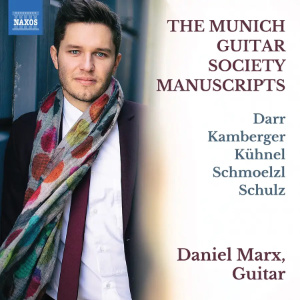
The Munich Guitar Society Manuscripts
Daniel Marx (guitar)
rec. 2024, Kreuzlingen, Switzerland
Naxos 8.551472 [61]
Given the centuries that have intervened in the evolution of Western Art Music, it is reasonable to anticipate that, among the massive repertory that accumulated, scores would be misplaced, some temporarily, others permanently lost. There are innumerable examples of scores believed lost , only to be rediscovered years, sometimes centuries, later; others permanently lost and destroyed. As recently as 2004, two library archives announced the unearthing of previously unknown music by Mozart and Chopin. Germany’s Leipzig municipal libraries uncovered a previously unknown set of serenades by Mozart. An unknown waltz in A minor by Chopin, was discovered in Manhattan’s Morgan Library and Museum, and subsequently recorded by Lang Lang.
While the classical guitar has a relatively short history, it has not been immune from repertory losses suffered by other instruments, such as the piano. After the death of Andrés Segovia, his wife, Emilia, gave access to his archives. Here were discovered unpublished and unplayed works by composers who wrote music for the guitar, and dedicated it to the Maestro. More than sixty unknown compositions from his own pen were also discovered
The review disc presents a programme based on original music for the guitar, rediscovered in 2009 from a large collection in the attic of Mrs. Gabrielle Wiedermann in Munich. This discovery represents the richness of guitar music in the early 20th century, originally belonging to the Munich Guitar Society. On this CD are the works of five different obscure composers, who lived during the period 1809 to1892. These are generally totally unknown to guitar aficionados, and very little is known about them.
Had the music on this disc been accessible to Andrés Segovia when he began his career as a concert artist, would he have embraced it in the environment of paucity to which he so often referred? Segovia was always quite vocal about the guitar repertory in that early period of his career and claimed to have had to rescue the instrument twice: from its poor repertory, and from the noisy hands of the flamenco guitarists. While he acknowledged the contributions of Sor, and gave minor concession to Carulli and Giuliani, the remainder he deemed to have contributed ‘a fervent and dedicated incompetence’ to the guitar’s repertory.
The music here is from the late Classical/early Romantic period, but in comparison to Sor, Aguado, and Giuliani, although pleasant to listen to, it offers no special virtues. Segovia had access to superior music, and elected to ignore it. This music probably won’t appear on concert programmes or on future recordings
During the period when this music was written, the eminent virtuosi of the time composed their own music for the instrument. Francisco Tarrega (1852-1909) was an exception who, although he wrote some beautiful music for the guitar, was influenced by his piano affiliation to transcribe music from that instrument for the guitar; also transcriptions from other stringed instruments. There is no record of him ever having played music for the guitar, composed by other guitarists, in his concert programmes. In a similar vein, all five composers of the music here were also guitarists. All the compositions on the review disc are substantial, ranging in timings from 8:55 to 14:19. All are single-movement pieces, the one exception being Darr’s Sonata, which has three movements.
Introduction and Variations Op, 4 by Schmoelzl is stylistically seen as the threshold between Classical and Romantic aesthetic. The introduction is borrowed from Giuliani (No1 Op 26). It is evident in Schulz’s Rondo Savoyard that the light harmonization was set to benefit the melody and phrasing. It does not utilize E major tuning found in his other works. Kühnel’s Fantasia is derived from Sigmund Thalburg’s piano music. When direct transcription was not possible, Kühnel composed his own passages which imitate the musical emotions that are trying to be conveyed.
Kamburger’s Grand Fantasy is a composition based on many opera themes, a lot of quotations stem from the opera Alessandro Stradella by Friedrich Von Flotow (1812-1888). It is considered rather unconventional for the period, especially as compared with works by Mauro Giuliani such as Rossinianas. The first movement of Darr’s Sonata quickly evidences his pursuit of the guitar’s potential. The second movement is full of rich orchestral-like texture, with up to four simultaneous voices, redolent of piano writing. The third movement is strongly influenced by Alpine folk music.
Daniel Marx commenced playing the guitar at age seven under the tutelage of Peter Hackel at the Music School of Erding. He subsequently studied under Susanne Schoeppe and Roberto Aussel at the Hochschule fur Musik, Köln where he earned his bachelor’s and master’s degree with distinction. He is the winner of multiple international competitions. His playing on this recording is generally exemplary; if he has an Achilles’ heel, it is the picado in rapid, single note passages. The tone extracted from a 1925 Herman Hauser guitar is most pleasing, and redolent of the guitars of Panormo/Lacote, rather than the later guitars of Hauser, as played by Julian Bream.
With a smaller repertory than its stringed relatives, a good deal of duplication occurs in guitar recordings, for good and for bad. This disc avoids that by presenting unknown, and unrecorded works, albeit from a period, and of a nature, that will not appeal to all. It does have important historical relevance, and is generally pleasant to listen to.
Zane Turner
Buying this recording via the link below generates revenue for MWI, which helps the site remain free
Contents
Wilhelm Schmoelzl (1809-1845)
Introduction and variations
Leonard Schulz (1813-1860)
Rondo Savoyard
Adam Darr (1811-1866)
Guitar Sonata in D major
Friedrich Kühnel (1820-1878)
Fantasie
Friedrich Carl Josef Kamberger (1824-1892)
Grand Fantasy for Guitar No 1













