
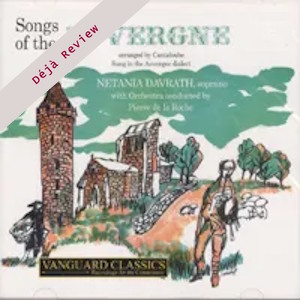
Déjà Review: this review was first published in April 2011 and the recording is still available.
Joseph Canteloube (1879-1957)
Songs of the Auvergne – series 1-5 (1923-1935)
New Songs of the Auvergne (orch. Gershon Kingsley)
Netania Davrath (soprano)
Orchestra/Pierre de la Roche (Songs); Gershon Kingsley (New Songs)
rec. 27 March 1963, 16 March 1966, Baumgarten Hall, Vienna. ADD
Vanguard Classics ATM-CD-1189 [2 CDs: 120]
These absolute gems of the vocal catalogue were first issued on LP as a gatefold double VSD713-4 and then on CD as Vanguard Classics SVC-38/39 and OVC8001/2.
Netania Davrath (1931-1987) for all her apparent obscurity has never been matched for her innocence, artlessness, vulnerability and sensitivity in these often heartbreakingly fragile blooms. While Gens, Upshaw, de Los Angeles, von Stade, Bayo, Gomez, Te Kanawa and even Madeleine Grey have their moments Davrath stands supreme in any company. Davrath, fluent in eight languages, had six months of study with a language coach to secure an authentic approach to pronunciation. The New Songs are in straightforward French. Sung texts and translations used to appear side by side in earlier versions of the Vanguard booklet; not so now. All we get here are the translations into English.
Canteloube showed a very sure hand when arranging and orchestrating these gems. His skill bears comparison with Grainger’s without being quite so oddball. The trick which both composers pull off while using classical apparatus is not to stifle the butterfly, birdsong, mist, escarpments, sun-dazzle, sheep calls and heat-haze of the originals. Canteloube works with an impressionistic palette, making the subtlest intensifying use of piano figures, flute, oboe and clarinet voicings. The lovely in-your-face balance takes the lightest tincture from Ravel, d’Indy, Roussel and Bonnal.
Davrath’s light-suffused girlish quality takes you to a land which has parallels with that of the novels of Marcel Pagnol (Manon des Sources). She is free from any stultifying operatic heaviness. Her vocal production is pure but is lit with endearment, affection, humour and sensuousness. She is elegant without gentility; folk-like, pristine and flamboyant. The tracks to sample are numerous. There is the trilling L’aïo dè rotso, Chut, Chut and the melting sweetness of Lo fiolaire. The heat haze shimmers in Obal, din lo coumbèlo, Pastorale, Baïlèro, Jou l’pount d’o Mirabel and Pastourello. There is humour too as in the cheeky wink in Hé! Beyla-z-y d’au fé! (with its donkey brays), Pastrouletta, Lou Coucut, and in Malurous qu’o uno fenno. The zip and vocal bravura of the dog-calls in Tè l’co tè are not to be missed.
The original 30ips half inch master tapes were made on an Ampex 300 series vacuum tube (valve) tape recorder. Specially designed playback heads were used and greatest attention paid to alignment, signal-to-noise ratio and frequency response. The results are there for all to revel in.
Rob Barnett
Buying this recording via the link below generates revenue for MWI, which helps the site remain free

See also Ralph Moore’s survey of the Chants d’Auvergene.













