
Gregory Fritze (b.1954)
Overtures and Symphonies
London Overture (2022)
A Day in Valencia (2022)
Waterplace Park (2012)
Sinfonia de Valencia (2023)
London Symphony Orchestra/Rafael Sanz-Espert
rec. 2024, L.S.O. St. Luke’s London
Naxos 8.559964 [75]
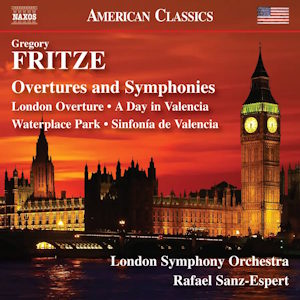
The booklet cover is emblazoned with a view of the Thames across to Big Ben and the Houses of Parliament bathed in a rather unlikely-looking red radiance, and the first work on the disc, especially composed for the London Symphony orchestra and this CD, is entitled London Overture. Like the rest of the recording, the music of this piece music was inspired by various places which the composer especially loves.
London Overture rather naively takes you on a guided tour of its sites, such as Buckingham Palace, hailed by blazing fanfares, and various older buildings, perhaps the churches, which are signalled by a somewhat short-lived fugue. The hustle and bustle of modern Oxford Street sets the overall mood with its syncopations and brash orchestration. It’s all good fun and would please any audience if used to open a concert.
Waterplace Park is another programmatic piece. It is not called an overture by the composer but would certainly work as a concert opening. It is entirely jovial and brilliantly orchestrated. This park is a meeting place, a melting pot one might say, for a plethora of different people, and the composer works this idea by designing the orchestra, which is without strings, around five contrasting instruments with their own individual material. Through these, he imagines five people, sometimes arriving together, sometimes separately walking into the park, represented by a marimba, bass clarinet, bass trombone, piccolo and timpani. The whole work is colourful and rhythmical. It was awarded a prize at the World Association of Symphonic Bands Composition Competition in 2013.
The other two works are inspired by the Spanish city of Valencia which is near to where Fritze lived at one time. I know the city well and have stayed there but not since the terrible floods. He describes both works as symphonies and each lasts almost half an hour.
The Sinfonia de Valencia forms three movements. The first is entitled ‘Los Castillos’ the Castle; there are number to choose from in that area, mostly dating back to the time of the Crusades, and Fritze lived near to one. This is a dramatic movement with often dissonant harmonies and jagged melodies. The second movement, ‘La Tomatina’, conjures up the famous tomato throwing day in Buñol, involving thousands of participants. Here, a major role is played by the percussion: tam-tams, snare drum, gong, castanets and various higher pitched drums. It’s all very brash and chaotic, reminding me at times of Ginastera and also Cuban music. The finale is a bit of a hotch-potch. In theory the marking ‘Pastorale y las Montanes’ seems to set up the beautiful atmosphere of remote mountain scenery, but it comes to a brusque ending with brazen rhythms, like the one you will recognise in Bernstein’s America. After another quiet passage, the walker reaches the top of the difficult climb, briefly represented by an excerpt from a Valencian hymn, before a powerful ending including trombone glissandi. I admire this work but find its lack of subtlety unappealing.
I decided to listen to the other programmatic symphony, A Day in Valencia, without first reading the composer’s very detailed programme. This was not a success, as the music revolves strongly around its subject. Movement 1 is ‘Sunrise over the Mediterranean’. This is nicely orchestrated and culminates in a glowing, if rather corny, G major chord. To give you some idea of the programmatic detail, let’s take the second movement, ‘Workday’. It begins with a busy 5/4 idea which returns, rondo-like. During the movement we are presented with friends meeting up for a snack in mid-morning portrayed by a group of contrasted solo instruments (including bassoon and piccolo), then with three retired gentlemen telling jokes (contrabassoon, double bass and tuba). Later, ‘Lunch with the Family’ which is – surprisingly, perhaps – quite tranquil and features woodwinds and horn. Movement three is ‘An Early Evening Walk’ which acts a tribute to the late, great tuba player Harvey Phillips and quotes a suitably solemn chorale by Bach. The finale is a wild ‘Fiesta’ which briefly, for some reason, quotes The Rite of Spring. As fun as all this sounds you might find it all a bit much and I have to say, that ultimately, despite the composer’s strong affiliation with this colourful and beautiful city, it seems to me to be a strongly American view of that culture.
It’s good to have the composer’s notes and the recording is brilliantly clear and spacious. The London Symphony Orchestra is on top form and Rafael Sanz-Espert’s clear enthusiasm for this music makes a convincing case for it.
Gary Higginson
Previous review: Rob Barnett
Buying this recording via the link below generates revenue for MWI, which helps the site remain free














