
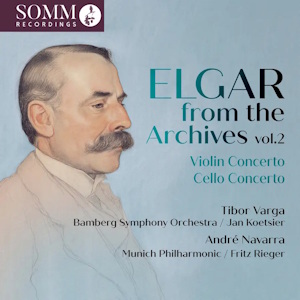
Sir Edward Elgar (1857-1934)
Elgar from the Archives Volume 2
Cello Concerto in E minor, Op.85 (1919)
Violin Concerto in B minor, Op.61 (1910)
André Navarra (cello)
Tibor Varga (violin)
Munich Philharmonic/Fritz Rieger (cello)
Bamberg Symphony Orchestra/Jan Koetsier (violin)
rec. 29 November 1956, Herkules-Saal, Residenz, Munich (cello); 19 December 1957, Kulturraum, Bamberg (violin)
SOMM Ariadne 5047 [72]
Somm’s ‘From the Archives’ series continues with an Elgarian concerto brace recorded in Germany in 1956-57. The protagonists are major soloists, one of whom, André Navarra, is well-known for his Cello Concerto recording with John Barbirolli but the other is a more shadowy figure these days, Tibor Varga, who is probably best remembered by violin aficionados.
Navarra, like most French soloists of his generation – Paul Tortelier, for instance – had studied the Elgar Cello Concerto at the Paris Conservatoire where, most unusually for an English work, it was taught. His first appearance in Britain was in 1950 where he performed the work with Barbirolli, recording it with him in 1957, the year after this Munich Philharmonic performance with conductor Fritz Rieger. The only real divergence in tempo comes in the finale where Barbirolli takes a more relaxed tempo than Rieger – 10.50 to 9.38 – though this is still far more compact a tempo than the one Barbirolli and Jacqueline du Pré took, which stretched beyond 12 minutes. Navarra evinces the best of his qualities – direct, unsentimental but duly expressive, keeping tempi on elastic but directional lines. His negotiation of tempos and moods are alike splendid. He and Tortelier shared a rather patrician view of the work, never allowing it to become mired in excess and always respecting its emotional parameters. Hysteria and melodrama were alien to Navarra’s expressive powers.
Tibor Varga broadcast the Violin Concerto in December 1957 with the Bamberg Symphony under Jan Koetsier taking an unexceptional 47-minutes. Varga has a fast vibrato which limits the ultimate in expressive breadth and his tone is inclined to be razory and resinous, being especially fluty in the higher positions. His virtuosic flair, though, is not in doubt though he ladles on the vibrato too often, most notably in the slow movement. This is something many soloists do today, such as Nicola Benedetti, for example. There are a few unconvincing tempo changes in the finale and once again Varga can’t quite vest the music with the necessary variegation of tone colours, though he essays a couple of rather slick slides in attempted compensation. The accompanied cadenza is well handled but I found the end itself somewhat underwhelming.
Both these broadcasts are heard in good mono sound, and courtesy of Lani Spahr they have scrubbed up well. The fine notes are by Andrew Neill of the Elgar Society and read attractively. This disc presents Navarra’s known strengths and adds Varga’s now largely forgotten qualities. What the disc certainly shows, though, is the quality of Germany’s regional orchestras and the able, though very differing insights, of the soloists.
Jonathan Woolf
Buying this recording via the link below generates revenue for MWI, which helps the site remain free














