
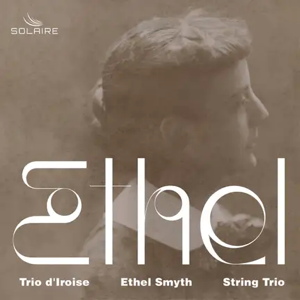
Dame Ethel Smyth (1858-1944)
Ethel • String Trio in D major, Op. 6 (1884)
Trio d’Iroise (Sophie Pantzier (violin), François Lefèvre (viola), Johann Caspar Wedell (cello))
rec. 2025, Adelbrinsaal, Kloster Drübeck, Ilsenburg, Germany
Reviewed as lossless download
Solaire Records SOLD004 [28]
This recording of Ethel Smyth’s String Trio introduces the Solaire Records ‘Mini-Album’ format, summed up as “One artist, one work, one stage. Each release is dedicated entirely to a single work – presented visually, historically and sonically in its own right, free from imposed contexts.” This title is currently an online release and reviewed here as a HiRes WAV download.
Ethel Smyth’s music was largely forgotten for many years as the result of a discriminatory attitude towards female musicians and composers, in Smyth’s case starting at an early age with her father’s opposition to her pursuing a career in music. Her String Trio was remarkably only given its premiere in 2008, but it comes from a period in which the likes of Brahms were still very much alive and active, and its high Romantic idiom is very much of its time. Brahms’ string quartets have always seemed to me to be rather over-wrought, and it is refreshing to hear how close Smyth comes to the impact of that string quartet sound with only three instruments, at the same time composing with much more transparency and lightness, even where the music reaches maximum intensity.
The four movements of the String Trio are indeed quite an intense experience, with even the Adagio (non troppo) third movement maintaining a restless momentum with only rare moments of repose. Thematic character is strong in the first Allegro and second Allegretto grazioso movements, but with swift development and constantly swirling instrumental discourse keeping the intellect on its toes in following each musical argument. The Finale has more of a folk-like feel in its dancing rhythms with perhaps hints of Dvořák, another contemporary of Smyth’s, but even where there might be influences penetrating this String Trio they remain elusive, such is theauthenticity of imagination behind this work.
What listeners of the day might have heard in this music is something most of us will miss 140 years later. The opening theme of the first movement for instance can be compared to ‘Glory, glory, Hallelujah’, which would have had its own topical significance and might have a connection to Smyth’s active role in the women’s suffrage movement. There are other symbolic references, such as a suggestion of Bach’s chorale BWV 737 ‘Vater Unser im Himmelreich’ in the Adagio, and keen earsmay pick out more of these Easter eggs throughout this fascinating work.
Talking of Bach, we have come across Trio d’Iroise before in their cross-cultural version of the Goldberg Variations with the SYRIAB Ensemble (review) and their superbly recorded performance here is assured and often highly dramatic, digging deep where the music demands, but filled with the subtle expressive touches and contrasts Smyth builds into her score.
Collectors of a certain vintage will remember classical ‘CD singles’, often with just one popular work when it came to the bigger labels, or perhaps something contemporary and obscure from specialist publishers. I don’t seem to recall these formats gaining much of a foothold on the shelves in record shops, and with so much music now available online it remains to be seen if the ‘Mini-Album’ will make an impression. Ethel Smyth’s String Trio makes as good a case as any, however, and with such a cracking performance this recording is certainly worth seeking out.
Dominy Clements
Buying this recording via the link below generates revenue for MWI, which helps the site remain free














