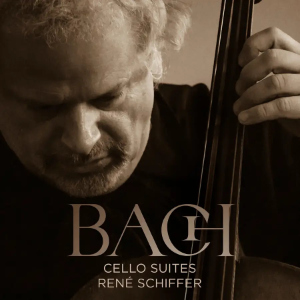
Johann Sebastian Bach (1685-1750)
Cello Suites Nos 1-6 BWV 1007-12
René Schiffer (cello)
rec. 2019-22, St. Paul’s Episcopal Church, Cleveland Heights, USA
Avie AV2704 [2 CDs: 141]
Long-standing principal cellist of Apollo’s Fire, René Schiffer, studied under celebrated Dutch master musicians Anner Bylsma and Jaap ter Linden. Their influence infuses this new complete set of Bach’s solo cello suites with a distinct blend of scholarly inquiry and theatrical flair. Recorded incrementally between November 2019 and February 2022 at St. Paul’s Episcopal Church in Cleveland Heights, Ohio, the album presents a patient, highly considered approach to these foundational works.
Schiffer’s most notable departure from performance tradition lies in his choice of instruments. For the first four suites, he plays a historical cello crafted by Benoît Fleury in 1768. For the Fifth and Sixth Suites, however, he transitions to an anonymous violoncello piccolo from a similar period to which he has added a fifth string. While employing a five-string instrument in the Sixth Suite (BWV 1012) is well established, and previous employed by several musicians, including David Watkin (review) and Anner Bylsma, Schiffer extends this practice to the C-minor Fifth Suite (BWV 1011) using his own custom arrangement. Rather than adopting Bach’s prescribed scordatura (lowering the top A string to G on a standard four-string instrument), Schiffer’s five-string arrangement allows the complex counterpoint of the fifth suite Prelude to emerge with bright, pristine clarity and easy upper-register resonance. While the extra string eases technical strain and illuminates inner lines, however, it inevitably softens the tension and gravity that scordatura should impart to the suite. It is an adventurous, intellectually defensible choice that will divide listeners, exchanging dark monumentalism for contrapuntal transparency.
Interpretatively, Schiffer balances a vocal, speech-like phrasing style with an impish, fertile willingness to embellish. His bow stroke is slightly earthier and huskier than Bylsma’s airy agility, providing a grounded, resonant warmth across the early suites. The G-major Prelude (BWV 1007) opens at a brisk, forward-moving tempo, treating the continuous arpeggiations as an active harmonic narrative rather than an expansive meditation. In the D-minor Suite (BWV 1008), the Sarabande forms a weighty centre of gravity, unfolding with introspective restraint. Across all six suites, Schiffer displays a keen sensitivity to dance character, treating rhythm as an organising rhetorical force while introducing playful, spontaneous ornamentation on repeated sections. The acoustic setting of St. Paul’s Episcopal Church provides a generous, atmospheric reverberation that complements Schiffer’s intimate, soliloquy-like performance style. However, the spatial balance occasionally permits a subtle acoustic bloom around the cello, which can slightly soften fast articulation compared to the razor-sharp clarity of modern digital sets like Jean-Guihen Queyras’s or Pieter Wispelwey’s.
Schiffer’s set is accompanied by his own engaging though highly subjective liner notes, offering insights into instrument construction, historical context, and Bach’s possible pedagogical purpose in composing these works. For listeners seeking a single, definitive period-instrument recommendation, David Watkin’s Gramophone Award-winning recording on Resonus remains the primary benchmark for its seamless blend of spontaneous pulse and structural inevitability. Among more recent releases, I find Henrik Dam Thomsen’s 2024 set on OUR Records extraordinarily compelling and deserving of far more attention than it appears to have received to date. Those desiring traditional modern-instrument polish or monumental dramatic weight will still most likely wish to turn to Antonio Meneses or Mstislav Rostropovich. Yet, Schiffer’s traversal is an absorbing, refreshing success. It offers seasoned collectors and historical-performance enthusiasts a provocative and highly rewarding alternative.
Peter Bright
Buying this recording via the link below generates revenue for MWI, which helps the site remain free