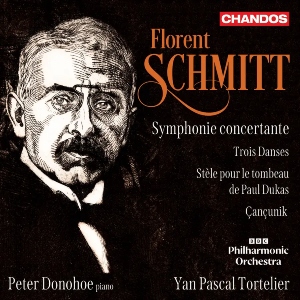
Florent Schmitt (1870-1958)
Symphonie Concertante for Orchestra and Piano, Op.82 (1928-1932)
Trois danses pour orchestra, Op.86 (1936)
Suite pour le tombeau de Paul Dukas, Op.87 No.1 (1936)
Çançunik, suite for orchestra in two parts (1927)
Peter Donohoe (piano)
BBC Philharmonic Orchestra/Yan Pascal Tortelier
rec. 2025, Salford, UK
Chandos CHAN20366 [70]
It must be forty years ago when I first came across the music of Florent Schmitt. On BBC Radio 3 Record Review, they played a section of La tragédie de Salomé. It was a lavishly orchestrated, thematically memorable late-Romantic work, and I was hooked. I now have several more recently recorded versions, but still think that Jean Martinon’s 1973 EMI recording with L’Orchestre national de l’O.R.T.F. (review) encapsulates the most gripping performance that I have heard on CD. (I have no recordings of the works played on this disc.)
Mainly because of its unusual title, I played the last work first. (Çançunik is an exotic phonetic spelling of “sens unique”, French for “one-way”.) Schmitt composed it as an entry for a Paris-Radio competition. It was supposed to be ‘music for the masses’ which would not suffer by transmission over the airwaves. Given the whistling atmospherics that were all too common during medium wave transmissions back then, I doubt very much whether any of the entries succeeded in that respect. Schmitt won the first prize.
The piece is quite inoffensive in comparison with the Symphonie Concertante, the first work here. It is in two short movements. Lied-Nocturne, at nearly nine minutes, is slow and impressionistic, rising to two climaxes. In the seven-minute Scherzo Tarantelle, lighter dance music precedes a slow, brooding central section and a reprise of the opening fast music. It is enjoyable music, but does not have the melodic catchiness to have become popular.
The Suite pour le tombeau de Paul Dukas began life as one of those ill-fated multiple-composer efforts, created with the best of intentions, but falling by the wayside after early performances. Here the motive for the composition of a piano work was as a memorial following the death in 1935 of the overly self-critical Paul Dukas. Schmitt took his contribution and re-fashioned it into the first part of his piano suite Chaine brisée, and later orchestrated it. As befits its subject, this sombre affair rises to an impressive drum-dominated climax. I found it to be an arresting piece, and have enjoyed playing it several times.
The Trois danses pour orchestre were a piano suite that Schmitt later orchestrated. The two outer movements are lively dances, somewhat neoclassical in style and orchestration. In the third dance, Schmitt portrays the circus music with a strong degree of strident dissonance. The middle movement is the most interesting: Schmitt reinvents a solemn dance created by the Dancing Master to Anne of Austria. Details of the dance no longer exist, a fact which gives Schmitt great freedom, so he creates a nocturnal, highly impressionistic piece. Strings and harp form a sort of musical halo around the horns, trumpets and clarinets, which carry the melody. It is very effective, and I find it to be the most immediately enjoyable piece in the entire programme.
The major item here is the Symphonie Concertante. Notably, Schmitt describes it as pour orchestre et piano,making it clear that this is not a traditional piano concerto where the soloist dominates the proceedings – quite the reverse, in fact. As the first movement begins, you will hear a loud, violent and extremely discordant blast from the orchestra. Peter Donohoe, virtuoso pianist that he is, battles through the cacophony, trading cascades of notes under his fingers with the would-be-dominant brass. It is not all volcanic effusion, though: lyrical episodes alternate. After the violence of the first movement, the slow movement is an oasis of dream-like calm in which the celeste plays an important role. About a third of the way through, the strings play a sweeping melody which rises in a series of waves, reaching impressive climaxes. As this movement reaches its hushed close, the last movement proceeds in a series of rugged swirls that can leave the listener gasping.
Koussevitzky, chief conductor of the Boston Symphony, commissioned the piece. The first performances in the USA met with critical hostility. The work’s sheer complexity must have been very difficult for a critic to take in after just one hearing, although audience applause greeted the slow movement.
All performances here are top-notch – the orchestra and the soloist. This is as would be expected from Peter Donohoe, the BBC Philharmonic and Yan Pascal Tortelier, whose recordings with Chandos over the years have included much French music. The recording is magnificent in every respect, well up to the highest standard the Chandos have achieved over many years. The booklet notes are detailed and very readable.
Those interested in Schmitt’s life will struggle to find a biography published in English. The most recent one in French that I can find, by Catherine Lorent, appeared in 2012. If your command of French does not reach the standard required to read a musical biography, there is a good alternative at the Florent Schmitt website. It contains a multitude of sources relating to the composer, not least of which is a short biography in English. Another very fine resource, if you are on Facebook, is the space devoted to Schmitt.
Jim Westhead
Buying this recording via the link below generates revenue for MWI, which helps the site remain free