
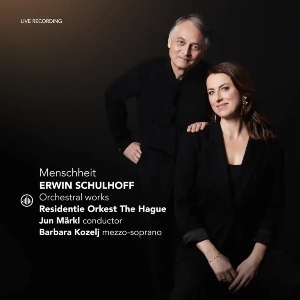
Erwin Schulhoff (1894-1942)
Menschheit
Landchaften, Symphony for mezzo-soprano and orchestra, Op.26, WV 44 (1918-19)
Menschheit, Symphony for alto and orchestra, Op.28, WW 48 (1919)
Suite for chamber orchestra, Op.37, WW 58 (1921)
Ludwig van Beethoven (1770-1827)
Rondo a Capriccio in G major, Op.129 ‘Rage over a Lost Penny’ (arr. Erwin Schulhoff, 1940)
Barbara Kozelj (mezzo-soprano)
Residentie Orkest The Hague/Jun Märkl
rec. live, 2025/26, Amare, The Hague, Netherlands
German texts included – no translations
Challenge CC720061 [75]
Both these song cycles, or Symphonies for voice and orchestra, were long believed to have been lost but reappeared decades after Schulhoff’s death – in the case of Landchaften, its premiere came in 1999. Both works are the product of immediate post-War experience, as Schulhoff had been injured during the First War and suffered a form of shell-shock. Yet he soon managed to compose both works in rapid succession between 1918 and 1919.
Landchaften or ‘Landscapes’ sets five poems by the little-known Johannes Theodor Kuhlemann to which Schulhoff responds in a variety of ways, from Straussian richness to Mahlerian depth but also impressionistic harmonic colour. Far from being indigestible, the result is evocative despite, to me, the rather ‘samey’ tempos of two of the central movements – a function of the composer’s setting, I should add, not a quirk of the conductor, Jun Märkl. The disc was recorded live but you’d not believe it, so utterly quiet is the audience and so detailed the orchestral sound. Every glistening harp run is caught with brilliant clarity. Each bass pizzicato rings out richly and the balancing is excellent – the lower brass in particular, all of which suite Schulhoff’s rich, almost indulgent orchestrational powers. If passages come close to the ethos of Das Lied von der Erde or even Kindertotenlieder, Schulhoff retains his independence of imagination. Mezzo-soprano Barbara Kozelj proves a powerful, resilient soloist, her rather pressing vibrato adding to the intensity of the performance.
The companion cycle, Menschheit (‘Humanity’), is lengthier and its orchestration has a richer palette. The rustic winds in the opening panel certainly put me in mind of Mahler’s Fourth Symphony though the chugging rhythms and bagpipe imitations sound authentically Czech (Schulhoff had been born in Prague and as a boy studied, with the encouragement of Dvořák, at the city’s conservatory). Good though Landchaften is, the companion work offers much more variety of texture and mood, more tempo freedom and flexibility, and much more sharply-drawn orchestral characterisation. The evocative if lonesome wind calls of the second song – the texts are by Theodor Däubler – and the associated deftness of orchestral space, shows a real advance in technique. The recurring thematic nature of the work also offers a sense of bigness and completion, still couched maybe in a broadly Strauss-Mahler-influenced language but one that supports the soaring lines of the soloist with remarkable agility.
After the hothouse of these two works comes the more familiar Schulhoff, the composer who dabbled in Euro-Jazz, in the form of his Suite for chamber orchestra, Op.37, WW 58, composed in 1921. It’s couched in the light post-War dance rhythms of the time, the Valse Boston, Shimmy, Step, though it opens with a Ragtime movement and ends with Jazz. The Boston sounds decidedly more expressive and romantic than is usually the case and Step is reserved for percussion. The disc ends with Schulhoff’s droll, exciting 1940 arrangement for orchestra of Beethoven’s Rondo a Capriccio.
The performances are uniformly excellent and the hall acoustic, Amare, in The Hague, Netherlands, has a vivid presence that enhances the performances. The balancing and recording engineers have done an outstanding job. The only obvious demerit in the production is the lack of song translations. Otherwise, this disc, strongly recommendable to Schulhoff adherents, outclasses previous recordings of the two song cycles, on Orfeo and Simax.
Jonathan Woolf
Buying this recording via the link below generates revenue for MWI, which helps the site remain free













