
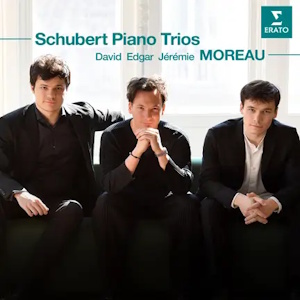
Franz Schubert (1797-1828)
Piano Trio No.1 in B flat
Piano Trio No.2 in E fat
Der Hirt auf dem Felsen (arr. Moreau)
Auf dem Wasser zu singen (arr. Soudoplatoff)
Du bist die Ruh (arr. Moreau)
Ständchen (arr. Soudoplatoff)
David Moreau (violin), Edgar Moreau (cello) Jérémie Moreau (piano)
rec. January 2025, RIFFX Studio 1, La Seine Musicale, Boulogne-Billancourt, France
Erato 5021732940261 [2 CDs: 113]
Three brothers who play piano, cello and violin to the highest level: what are the chances of a piano trio that meets around the Christmas dinner table?!
The Moreau Trio are an admirable group of musicians, and their two-disc set of Schubert’s piano trios enters a fearfully competitive market. However, it has a certain something to recommend it, and it is one of those tricky circumstances where it is hard to know whether your ears are telling the truth. Would I have picked up a greater sense of communication, sensitivity, listening out for one another if I had not known that they were brothers?
In a sense, that does not matter, because this is undoubtedly a good listening experience. The B flat Trio begins in a marvellously upbeat manner, balancing the music’s forward thrust with a lovely sense of dignity. From the off, you get a strong sense of the brothers (and instruments) working in lockstep, and the recording balance helps by picking them out but giving them equal prominence. The cello then brings seamless liquid beauty to the second subject, and takes the right level of lead in the mysterious passage that brings the exposition to an end. There is a lovely sense of purposeful busyness to the central development and, hearteningly, there never appear to be any diva-ish behaviour of one instrument pushing itself to the front. There is a pleasingly tentative feel to the coda, as though nobody is entirely sure where the music is about to go, before an affirmative full stop in the final chords.
Jérémie Moreau’s piano sets up a mood of beautiful stillness to the slow movement, over which the cello and violin sing gently; the music seems to pause to enjoy the view without ever losing coherence. The Scherzo has the genteel manner of a Menuet in its outer sections, with singerly legato in the central Trio, and the string melodies of the finale have a very appealing butter-wouldn’t-melt sophistication, punctuated by regular bursts of assertiveness.
You get similar qualities in the E flat trio, and not just in its persuasive walking-pace slow movement, tempered here by touchingly beautiful legato playing for the melodies. Alongside this, you get pleasing assertiveness to the opening of the first movement and genteel playfulness to the Menuetto. Overall, the finale keeps its textures playful but with an undercurrent of deep seriousness: the balance of the two works excellently, and the integration of the second movement’s slow march theme brings air of marvellous inevitability to the ending.
So the Trios are great. How much of this mutual understanding and mutual listening is down to the fact that the players are brothers, and how much to the fact that they are jolly good musicians? Who knows and, really, who cares? The key thing is that the playing and the musical understanding are lovely, and that comes out in the listening. Of course, nobody is going to put away their sets by, say, the Beaux Arts Trio or Trio Wanderer when they acquire this one, but this is a beautiful release, well worth your time and investment.
The real USP comes in the fillers, arrangements of Schubert’s songs for piano trio. And jolly successful they are, too. It takes a while to tune into the cello as a substitute for the clarinet in The Shepherd on the Rock, but the effect is really magical when the violin comes in for the voice’s part. I found myself thoroughly convinced. There is a persuasive suavity to Auf dem Wasser zu singen. If Du bist die Ruh is a bit less engaging, that is because it is a less interesting song. The trio’s own arrangement of Liszt’s arrangement (!) of Ständchen, however, is a winner, with a persuasive lilt from the piano and gorgeous interplay of strings.
Recorded sound is excellent, but the booklet essay is rather slight.
Simon Thompson
Buying this recording via the link below generates revenue for MWI, which helps the site remain free













