
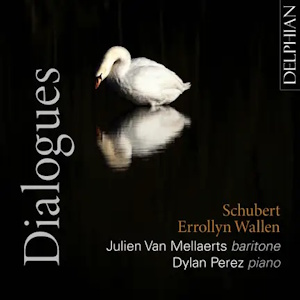
Dialogues
Franz Schubert (1797-1828)
Schwanengesang, D957
Errollyn Wallen (b. 1958)
The Lake (2022)
Julian Van Mellaerts (baritone); Dylan Perez (piano)
rec. April 2025, St. Cuthbert’s Parish Church, Edinburgh
Sung texts and English translation provided
Delphian DCD 34369 [73]
At first sight this appears to be a simple coupling of two song-cycles, one by Schubert and one by the Master of the King’s Music, Errollyn Wallen. The reality is quite complex, however. Schubert’s Schwanengesang (Swansong) is a set of 14 songs to poems by Schubert’s contemporaries: Ludwig Rellstab (1799-1860), 7 poems; Heinrich Heine (1797-1856) 6 poems; and a single setting, “Die Taubenpost”, to a poem by Johann Gabriel Seidl (1804-1875). All 14 were composed in the final months of the composer’s life when he was at the height of his powers. Evidence as to what he had in mind for the publication of these songs is both slim and conflicting, but there is no suggestion that they were conceived as or intended to be a cycle. Schubert’s publisher collected them together after the composer’s death and published them under the ‘Swansong’ title.
The Lake is a real cycle of five songs to Errollyn Wallen’s own words. It was composed to a request from these performers who wanted a work that could be programmed alongside Schwanengesang. That was not all. “We said, here are the fourteen songs of Schwanengesang; we want you to create a reflection, to find inspiration in these songs.” We read in the booklet that Wallen was “delighted with the commission.”
What happened next was a decision to rearrange the order of Schubert’s songs and insert those by Wallen, also reordered, amongst them. What Julian Van Mellaerts writes in the booklet is worth quoting in full: “We managed to create a story. It’s a loose story – but the whole idea was to reinvent something that we’ve heard a hundred times, and to change the idea of what a Schubert song recital could be.” This is how the repertoire is presented on this disc, but other ideas were incorporated into subsequent performances. These included “harmonising some of The Lake as duets” and “presenting Schubert numbers as dialogues”, presumably between the two singers.
Now that I have explained the premise of this disc, it is time to for a confession. I decided to begin my listening with The Lake, which, by judicious twiddling, I was able to hear in the composer’s original order. We read that Wallen was asked “to take the texts of Schwanengesang as her starting point.” Though there are lighter moments, those 14 texts are consistently melancholy, filled with images of longing, often for distant or departed lovers. There are many references to the natural world, and notions of place and of home are also present. Wallen’s opening song has the poet, a lake, and, probably, a lover. It is tranquil and all is well. “All my life” seems to feature the same protagonists, but now in London, where “winds of doubt” are blowing. The lake features in “Timeless”, but now it is “where the souls of those who love do wait”. I am at a loss to understand the place of “Ready” in the overall scheme, but in the final song, to words that Tippett might have written, the speaker has, first, no sense of home, yet, in the final lines, takes courage and new possibilities emerge. Wallen’s music is by moments tough and uncompromising, yet will suddenly turn and resolve onto a melting major chord. The vocal line is impressively wrought – even if few listeners will find themselves whistling the tunes – and the superbly conceived piano part carries much of the musical weight. “Ready” is accompanied by a slowly turning series of individual notes, and in the final song the rapturous piano part does much to communicate the notion of optimism and renewal. The Lake seems to ask many questions and answers only a few; but make no mistake, this is a fine work indeed.
Throughout this recital, Dylan Perez plays with great authority, conviction and sensitivity. He and Julian Van Mellaerts are an inseparable duo, at one both in Schubert and in Wallen. The particular way in which this programme is presented means that it cannot be a first choice for someone wanting simply a recording of Schwanengesang. Comparisons are therefore rather pointless. Van Mellaerts has the full measure of these songs, with complete identification with the texts and great skill at demonstrating the difference between dark and less dark. My only wish is that a less leisurely tempo for “Ständchen” had been chosen. He is just as persuasive in The Lake. Paul Baxter’s recording, with an outstandingly natural balance between the two performers, merits a special word of praise.
The question is waiting, and now must be asked: the reorganisation of Schubert’s songs and the interpolation of others in a completely different idiom, does it work? If we reduce it to wondering if one’s perception “of what a Schubert song recital could be” is changed, the answer from this listener is no. And yet, the sequence has been skilfully devised, and the presence of Errollyn Wallen’s superb songs within a sublime Schubert series does not jar at all. I have now listened to this recital from beginning to end three times, and it has totally held my attention each time. At the end Wallen’s “Courage” is followed without a break by Schubert’s horrifying “Der Doppelgänger”. The cumulative effect has already been deeply affecting up to that point, but crowning it with these two astonishing songs leaves this listener wanting to sit on in silence.
William Hedley
Buying this recording via the link below generates revenue for MWI, which helps the site remain free
Order of the songs
1. The Lake (Wallen, song 1)
2. Liebesbotschaft
3. Das Fischermädchen
4. Frühlingssehnsucht
5. Kriegers Ahnung
6. Ready (Wallen, song 4)
7. Ständchen
8. Timeless (Wallen, song 3)
9. Am Meer
10. Der Atlas
11. Abschied
12. Die Taubenpost
13. Aufenthalt
14. Ihr Bild
15. All My Life (Wallen, song 2)
16. Die Stadt
17. In der Ferne
18. Courage (Wallen, song 5)
19. Der Doppelgänger













