
Elena Ruehr (b. 1963)
Winter Night
Boston Trio
Marcus Thompson (viola)
rec. 2025, Fraser Performance Studio, Brighton, USA
Reviewed as a digital download
Avie Records AV2876 [58]
I first encountered the music of Elena Ruehr through the 2025 recording of her ninth, tenth, and eleventh string quartet on the Avie album The Northern Quartets. I remember being quite impressed by her gift for varied, lyrical writing. Everything is likeable and engaging, but that never means bland or trite. She takes the listener on a comprehensive and satisfying journey through her impressions of locations in Michigan, Massachusetts, and Iceland. I’d still recommend that disc for anyone wanting to get acquainted with Ruehr’s compositional voice.
Ruehr, a former faculty member at MIT, is a prolific writer. I count five operas, nine concertos, twelve quartets, and quite a number of other works. Her orchestral works, including the O’Keeffe Pictures, were reviewed back in 2015 (review). Brian Wilson described them as sui generis, with an ‘appealing beauty’. I also enjoyed her Carnival disc this April, featuring quirky, lively works for chamber orchestra and woodwind quintet.
Here, we have her third, fourth, and fifth piano trio performed by Trio Boston, an ensemble formed in 1997. I’m not familiar with them, but they seem to have an album called Elegy and Blues on Centaur. They are joined by violist and professor Marcus Thompson in her second piano quartet.
The very first thing you hear on the album Winter Night is a movement titled ‘Ski’, which, I’ll confess, is a first for me, in terms of movement designations. Her fourth piano trio, composed in 2021, is subtitled “Ski, Kayak, Bike”, and each of the three movements depicts one of these activities. The piece is dedicated to her father, with whom she would – well, ski, kayak, and bike. I think that’s a charming idea for structuring a piece. First, the dedication adds a little bit of human depth. In other words, that first movement is not just ‘about skiing’ in the abstract, but specifically her memories of going skiing with her father. Second, I think that these activities being movement-based inspires Ruehr to write with great energy, dynamism, and flow.
In ‘Ski’, the strings play a very long melody over a regular piano pulse which I think is meant to convey that fluent downhill rush. Certainly, the decrescendos create the effect of something speeding away. Some of the piano figures towards the middle remind me of snow flurries. ‘Kayak’ seems to be set in a placid lake. It is quiet and dreamy, with lots of piano ripples. ‘Bike’ uses pizzicato and a jerky start-stop feel to suggest an amateur bike ride, rather than, say, the Tour de France. When the strings really get going, the excitement is infectious. Ski, Kayak, Bike runs about fifteen minutes. It is an exciting, fresh work that I would gladly hear at any chamber music recital. There is something of Ravel in her writing here, primarily in the way she handles the piano. I do find that the two strings often work together as a unit, which means it can start to sound like you’re hearing a duet. I do appreciate having the cello’s extra bass there, but I think it’s worth pointing out.
Two years later, Ruehr was back with a fifth piano trio, this one titled Troubled Times. I have not been able to ascertain which specific troubles (if any) the title indicates, but, then again, it’s not as though we’re short of options. This one was commissioned by the Boston Trio, so it’s nice to hear them record it. It was clever programming to open with the fun but relatively uncomplicated Ski, Kayak, Bike before getting into a piece which, while hardly challenging in the grand scheme of art music, is markedly more serious. Once again, the movement titles are illuminating. ‘Gutty and Laborious’ opens things with what you could describe as a sort of slow agitato. There’s definitely a slight Russian accent here – the Rachmaninoff Trio élégaique might be a good point of comparison among better-known repertory. For me, this was one of the album’s highlights. I think Ruehr is able to do something interesting by balancing anxiety and hope. The brief middle movement is marked ‘Spooky then Aggressive’. I suppose these might depict the troubled times themselves as opposed to our reactions to them? It begins with quite a lot of gusto, softens towards the middle, and then builds to a climax at the end, essentially functioning as a scherzo. The third movement, ‘Playful but Anxious’ lives up to its title. Ruehr knows how to inject just a little more playfulness here, then just a little more anxiety there, and thus keep the movement poised – really, torn might be more apt – between two moods. The main theme in this movement has a slightly Beethovenian flair, but her development is much more contemporary. I liked this trio a lot, but it should really be stressed for the listener that this is not a narrative, but rather, three distinct vignettes, three moods. It runs for about sixteen minutes.
At this point, we bring in a viola for her second piano quartet, subtitled Maple. The listener will probably detect that Ruehr is drawing on older influences – there is a distinctly baroque set of trills and a lack of vibrato. This is done quite tastefully and subtly, I hasten to add; there is no pastiche here. It turns out that Ruehr had in mind those maple trees of the 17th and 18th centuries which, having withstood especially cold winters, were highly valued by luthiers for creating exquisite instruments. It must be a little bit intimidating for a string player to know they’re facing a work which is written to evoke the trees from which Stradivarius violins are made. The first movement, ‘Sapling’, reminds me of the slow movements of those baroque trio sonatas; Corelli, say. Maybe Bach’s Air from Orchestral Suite 3 is also intended. It’s very lovely, and I appreciate the fact that Ruehr coaxes that early 18th century aesthetic out of the music while allowing for more modern chord progressions. The title of the middle movement is ‘Prelude, Fughetta, Chorale’ which, I think, over-promises a little bit. The prelude section is by far the longest, and we get the brief suggestion of a fugue in the strings, while the piano plays arpeggios. The chorale certainly sounds like it could be a hymn tune to me – it may be one; I’d need to consult someone better versed in that field. It ends on a slightly funereal note, before a cheeky baroque embellishment takes us into ‘The Luthier’, our third movement. This one is structured something like a Rondo, with a sort of ambiguous connecting theme around snippets that sound like they were lifted from Vivaldi wholesale. It’s a lot of fun, and, once again, I commend Ruehr for executing such interesting ideas so well.
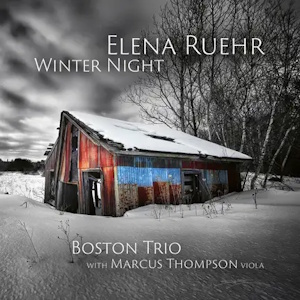
Given that Ruehr’s third piano trio, Winter Night, was selected as the title of the album, I went into it wondering if it might be the highlight. I think it probably is. The album cover might mislead you into expecting a chilly, snowy winter’s night, but the music depicts something rather more domestic and frequently brighter – right up until the end. The first movement, marked ‘Lyrical’ has its slightly stormier outbursts, but, true to form, much of it is song-like and pretty. This leads into the second movement, ‘Grazioso’, which is really a sentimental dance. Ruehr ensures that the rhythm is alive and constantly varying, which helps keep things interesting. The third movement is labelled ‘Aria’. It has a gorgeous, soaring theme played by the violin in a duet with the cello – still, this is an introspective, contemplative aria, not a showboat. According to Ruehr, the fourth movement, ‘Finale’, brings aspects from the previous three movements together. It is, surprisingly, the darkest movement in the whole trio, especially leading up to the climax. After that, it features a long, stomping coda which ends with dissonance. I found this work fascinating, and knowing where it goes in the finale allows for more depths to be discovered on repeated listening. I think it is also the work here that sounds most distinctive. Something about the combination of soundworlds is entirely Ruehr’s, although, it’s also possible that the rest of the album sets that up by showing off successive sides of her music.
The Boston Trio are ideal advocates for Ruehr’s music. They dialogue with each other exactly the way you’d like a chamber music ensemble to do, and they have an affinity for the contours of Ruehr’s writing. My impression after listening to this disc is that the Boston Trio are under-recorded.
The sound quality was quite clear and well-balanced. I enjoyed reading that Elena Ruehr was the recording producer on the album – I wonder how many composers have learnt the art of production, and I wonder, theoretically, how it might influence one’s writing. There is a nice little booklet with programme notes in English, German, and French.
Ruehr has said about her music that “the surface [should] be simple, the structure complex.” I think she achieves that in all four works on this album, and I suspect there are many more would-be Ruehr fans out there who will enjoy hearing this disc.
Aidan Gray
Buying this recording via the link below generates revenue for MWI, which helps the site remain free
Contents
Elena Ruehr (b. 1963)
Piano Trio No. 4 “Ski, Kayak, Bike” (2021)
Piano Trio No. 5 “Troubled Times” (2023)
Piano Quartet No. 2 “Maple” (2024)
Piano Trio No. 3 “Winter Night” (2020)













